SEO Meta Description: Principal vs. principle explained with clear US English rules, examples, common mistakes, memory tricks, and real-world usage.
Principal and principle are both correct English words, but they have different meanings and grammatical functions. Principal can refer to a person in charge, the main or most important thing, or the original amount of money in a loan or investment. Principle means a fundamental rule, belief, standard, or guiding idea.
Principal vs. Principle: The Quick Answer
Use principal when you mean a person in charge, something most important, or an original sum of money:
The school principal spoke to the students.
The principal reason for the change was safety.
She paid down the loan principal.
Use principle when you mean a rule, belief, or basic idea that guides behavior or thinking:
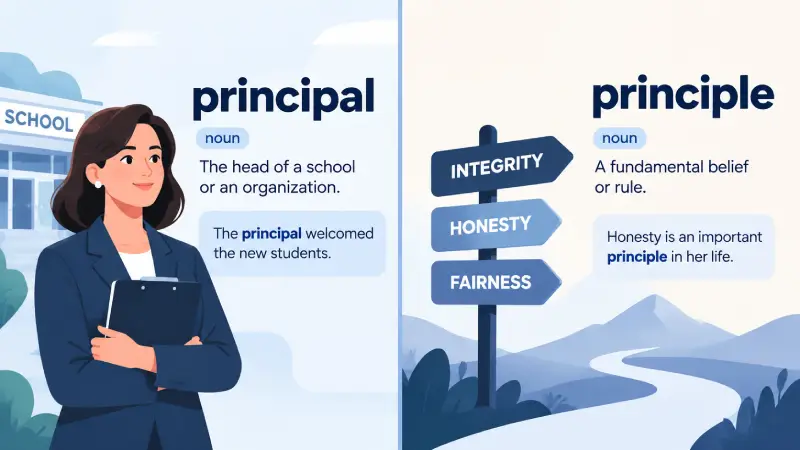
Honesty is an important principle.
The decision goes against my principles.
A quick memory trick is:
Principal = person, primary, or money
Principle = rule or belief
What Does Principal Mean?
Principal has several meanings, but they share an important idea: the person or thing that is primary, leading, or original.
Principal as a person in charge
In American English, a principal is the person who leads a school.
The principal welcomed the new students.
I spoke with the school principal about the issue.
The principal announced the changes during the assembly.
The students waited for the principal to address the situation.
This use is particularly common in US education.
The word can also refer to a person who holds a leading position in certain organizations or professional settings.
For example:
She became a principal at the consulting firm.
Here, principal functions as a noun referring to a person with a senior role.
Principal as “main” or “most important”
Principal can also function as an adjective meaning main, chief, or most important.
Examples:
Safety was the principal concern.
The principal reason for the delay was bad weather.
Our principal goal is to improve customer service.
The building’s principal entrance faces the street.
In these sentences, you could often substitute main:
Safety was the main concern.
The main reason for the delay was bad weather.
That substitution provides a useful way to recognize this meaning.
Principal in finance
In financial contexts, principal refers to the original amount of money borrowed or invested, excluding interest.
- For a loan:
I made a payment toward the loan principal.
- For an investment:
The investor received the principal plus the agreed return.
- For example, if someone borrows $10,000, the original $10,000 is the principal. Interest is an additional amount charged for borrowing the money.
As the loan is repaid, payments may cover both interest and principal.
What Does Principle Mean?
Principle is a noun meaning a fundamental rule, belief, standard, or guiding idea.
Examples:
Honesty is one of her core principles.
The company operates according to several important principles.
He refused to compromise his principles.
The principle behind the design is simple.
The word can refer to personal values, ethical standards, scientific foundations, or general rules.
Unlike principal, principle does not normally refer to a school leader or the main amount of a loan.
Principle as a Personal Belief
A principle can be a belief that guides someone’s behavior.
For example:
She believes that treating people fairly is an important principle.
He refused the offer on principle.
The expression on principle means that someone acts according to a belief or standard rather than simply for practical convenience.
Example:
I won’t support the proposal because it violates my principles.
Here, principles means the values that guide the speaker’s decisions.
Principle as a Basic Rule or Idea
The word can also describe a fundamental idea behind a system.
Examples:
The machine operates on a simple scientific principle.
The principle of supply and demand helps explain price changes.
The teacher explained the basic principles of physics.
The design follows the principle that simplicity improves usability.
In these cases, principle means a foundational rule or concept.
Principal vs. Principle: Side-by-Side Comparison
| Feature | Principal | Principle |
|---|---|---|
| Part of speech | Noun and adjective | Noun |
| Main meanings | School leader, main/most important, original money | Rule, belief, standard, guiding idea |
| Person? | Yes | No |
| School leader? | Yes | No |
| Means “main”? | Yes | No |
| Financial meaning? | Yes | No |
| Means “belief/rule”? | No | Yes |
| Example | The principal called a meeting. | Honesty is a principle. |
| Memory clue | Principal = primary | Principle = rule |
The two words are pronounced similarly, which makes them easy to confuse when you hear them in conversation.
When to Use Principal
1. For a school leader
Use principal for the person who leads a school.
The principal met with the parents.
Our principal announced the new schedule.
The principal asked everyone to remain calm.
She has worked as a school principal for several years.
This is one of the most common uses in American English.
2. For something most important
Use principal as an adjective when something is the main or most important part.
The principal objective is to reduce costs.
The principal cause of the problem was a software error.
The principal challenge is finding enough staff.
The principal entrance is on the east side of the building.
A useful substitution test is main.
If main fits naturally, principal may be the intended word.
3. For borrowed or invested money
Use principal when discussing the original amount of a loan or investment.
She made an extra payment toward the loan principal.
The interest is calculated based on the outstanding principal.
He invested $5,000 and later withdrew the principal.
Paying down the principal can reduce the amount of interest charged over time.
The exact financial details can depend on the loan or investment agreement, but the word itself refers to the original or outstanding amount rather than the interest.
When to Use Principle
1. For a moral belief
Honesty is a basic principle of good leadership.
She refused to lie because it went against her principles.
Fairness is one of his strongest principles.
2. For a rule or standard
The organization follows several environmental principles.
The agreement is based on the principle of equal treatment.
The policy reflects a basic principle of accountability.
3. For a scientific or technical idea
The device works according to the same principle as a basic lever.
Students learned the fundamental principles of chemistry.
The engineer explained the principle behind the system.
Here, principle means a foundational idea or rule.
Common Principal vs. Principle Mistakes
Mistake 1: Calling a School Leader a Principle
Wrong:
The school principle called a meeting.
Right:
The school principal called a meeting.
A school leader is a principal.
Mistake 2: Using Principal for a Moral Rule
Wrong:
Honesty is an important principal.
Right:
Honesty is an important principle.
A moral belief or guiding rule is a principle.
Mistake 3: Using Principle for Loan Money
Wrong:
I made a payment toward the loan principle.
Right:
I made a payment toward the loan principal.
The original amount borrowed is the principal.
Mistake 4: Using Principle for “Main”
Wrong:
The principle reason for the delay was bad weather.
Right:
The principal reason for the delay was bad weather.
Here, principal means main.
Mistake 5: Using Principal for a Guiding Rule
Wrong:
The company operates according to several ethical principals.
Right:
The company operates according to several ethical principles.
A guiding rule or belief is a principle.
How to Remember Principal vs. Principle
Principal = Primary
The easiest memory trick is:
Principal → primary
Both begin with pri and relate to something important or first in rank.
A school principal is the primary leader of a school.
A principal amount is the original amount of money.
The principal reason is the main reason.
Principle = Rule
Think:
Principle = a rule or belief
If you are talking about honesty, fairness, ethics, science, or a fundamental rule, principle is usually the word you need.
Honesty is a principle.
The system follows a basic principle.
The “Main” Test
When deciding between principal and principle, try replacing the word with main.
The principal reason was cost.
→ The main reason was cost.
That works, so principal is correct.
But:
Honesty is an important principle.
→ Honesty is an important main.
That does not work, so principle is correct.
This test works particularly well when principal is being used as an adjective.
The “Rule or Belief” Test
Ask whether the word refers to a rule, value, belief, or fundamental idea.
If yes, use principle.
Respect is a core principle.
The principle of equal treatment matters here.
We studied the principles of economics.
If the answer is no, check whether you mean a school leader, a main feature, or money. Those uses require principal.
Principal vs. Principle in Real-World Contexts
In a text message
Liam: Why are you meeting with the principal?
Chris: There was a problem at school, and the principal wants to discuss it with my parents.
Here, principal means the school leader.
In a professional email
Our principal objective is to reduce unnecessary costs while maintaining service quality. The plan follows the principle that essential customer support should remain available at all times.
Both words are correct, but they perform different jobs. Principal means “main,” while principle means a guiding rule.
In a financial article
Making additional payments toward the loan principal can reduce the amount of money you owe. Your exact savings will depend on the loan terms, interest rate, and payment schedule.
Here, principal refers to the amount borrowed rather than the interest.
Principal vs. Principle in School Writing
This pair frequently causes mistakes in student writing because principal and principle sound alike.
Consider:
The principal announced the new school policy.
The word refers to a person.
Now:
The policy is based on the principle of equal treatment.
The word refers to an idea or standard.
A single paragraph can legitimately contain both:
The principal explained that the school follows the principle of treating every student fairly.
The principal is the person. The principle is the rule or belief.
Principal vs. Principle in Business Writing
Business documents often use both words in different contexts.
Principal can mean the main or most important:
Our principal objective is customer satisfaction.
It can also refer to money:
The company repaid part of the loan principal.
Principle can describe a business value:
Transparency is one of the company’s core principles.
These distinctions remain important in formal writing because substituting one word for the other can change the meaning.
A Note About “Principal” and “Principle” Plurals
The plural forms are also different.
Principal → principals
The district held a meeting for all school principals.
Principle → principles
The organization follows several ethical principles.
If you are writing about multiple school leaders, use principals. If you are writing about multiple rules or beliefs, use principles.
Related Confusions
Principle vs. principal cause
When you mean main cause, use principal:
The principal cause of the failure was overheating.
Do not use principle simply because the two words sound similar.
Principal vs. principle of a system
When referring to a foundational rule or idea, use principle:
The machine operates according to a basic principle of physics.
When referring to the main component or most important factor, use principal:
The principal component of the system requires regular maintenance.
Principal vs. principle in “on principle”
The established expression is on principle:
She refused the offer on principle.
It means she refused because the action conflicted with her beliefs or standards.
Do not write on principal in this meaning.
FAQs
Use principal.
The school principal addressed the students.
A principle is a rule, belief, or guiding idea.
Use principle.
Honesty is an important principle.
Use principal when you mean the original or outstanding amount borrowed.
I made an extra payment toward the loan principal.
use principal.
The principal reason for the decision was safety.
Here, principal means “main” or “most important.”
Think principal = primary and principle = rule. The first helps you remember the school leader, main thing, and financial amount; the second points to a belief or guiding rule.
Conclusion
Principal vs. principle is a common word-choice confusion because the two words sound alike but have different meanings.
- Principal can mean a school leader.
- Principal can mean main or most important.
- Principal can mean the original or outstanding amount of money in a loan or investment.
- Principle means a rule, belief, value, standard, or fundamental idea.
- Principal = primary is a useful memory aid.
- Principle = rule is another quick way to remember the difference.
Quick rule: If you mean person, primary, or money, choose principal. If you mean rule, belief, or guiding idea, choose principle.

Olivia Smith is a US English writer and language enthusiast who specializes in spelling, word choice, and commonly confused words. She creates clear, practical guides that help readers understand the correct spelling, meaning, and usage of English words.
At GrammarPool.com, Olivia focuses on spelling-choice topics, common spelling mistakes, and easy-to-understand explanations for everyday English users. Her writing is designed to make confusing word choices simple, accurate, and easy to remember.
Expertise: US English, spelling, word choice, commonly confused words, grammar, and language usage.