
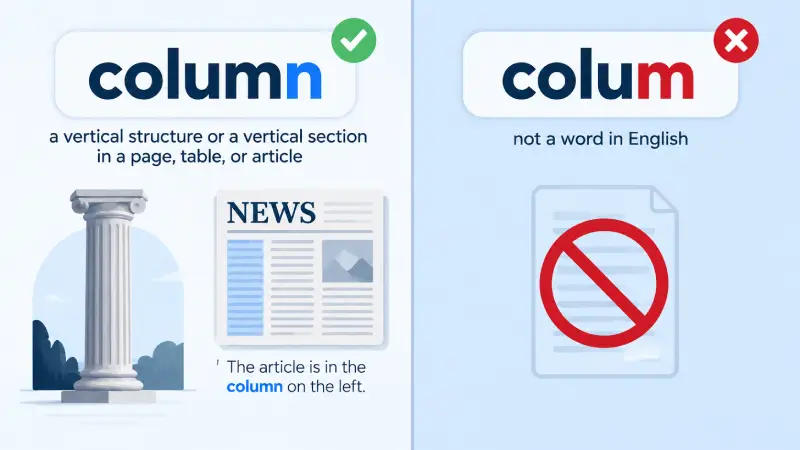
Column is the correct spelling when you mean a vertical section of text or numbers, a supporting pillar, a newspaper feature, or something arranged vertically. Colum is not the standard spelling of this English word and is usually a misspelling of column.
For example:
- Correct: Please enter the figures in the second column.
- Incorrect: Please enter the figures in the second colum.
The tricky part is that column does not sound exactly the way it looks. The final n is pronounced in ordinary American English, but the middle of the word is easy to overlook when typing or spelling it from memory. That makes column vs. colum a common spelling question.
What Is the Correct Spelling: Column or Colum?
The correct English spelling is column.
Column is a noun with several related meanings. It can refer to a vertical arrangement of information, a vertical section of a page, an architectural support, a regular newspaper or magazine feature, or a vertical structure in various technical contexts.
Colum, when used as an attempt to spell this common English noun, is incorrect.
| Spelling | Correct English word? | Main use |
|---|---|---|
| column | Yes | Vertical section, numbers, pillar, article, or similar structure |
| colum | No, when intended to mean “column” | Usually a spelling mistake |
There is one important qualification: Colum can appear as a proper name, particularly as a personal name. That does not make colum an alternative spelling of the common noun column.
Why Is “Column” the Correct Spelling?
The spelling column comes through Middle English and Anglo-French from Latin columna. The modern English spelling retained the n found in the historical form.
That history matters mainly because it explains why the spelling cannot be safely reconstructed from pronunciation alone. English has many words whose spelling preserves letters that are not strongly represented in everyday speech.
In column, the final n is part of the standard spelling:
c-o-l-u-m-n
A useful way to see the word is to divide its letters rather than relying only on how it sounds:
COL + UMN
The ending is -umn, not simply -um.
This same spelling pattern appears in related words such as:
- columnist
- columnar
- columned
For example:
She writes a weekly column for the local newspaper.
The person who writes such a feature is a columnist, not a “columist.” Recognizing the related form can help reinforce the spelling of the base word.
What Does “Column” Mean?
Column is a noun, and its meaning depends on context.
1. A vertical section of a page
In documents, newspapers, magazines, and websites, a column is a vertical section of text.
The article appears in the left column of the page.
A page can have two, three, or more columns. Designers often use columns to make large amounts of text easier to read.
For example:
The newspaper printed the story across two columns.
In this sense, column contrasts naturally with row, which generally refers to a horizontal arrangement.
2. A vertical arrangement of numbers or information
A column can also be a vertical line of information in a table, spreadsheet, or chart.
Add the numbers in the third column.
In a spreadsheet, for example, names might appear in one column, dates in another, and prices in a third.
The price column contains the updated amounts.
This meaning is especially common in office work, accounting, data analysis, and school assignments.
3. An architectural pillar
A column can also mean a vertical supporting structure in a building.
The entrance is supported by four stone columns.
Architectural columns can be made from stone, concrete, steel, wood, or other materials. In this sense, column is closely related to words such as pillar and post, although those words are not always interchangeable in technical contexts.
4. A regular newspaper or magazine feature
A writer may have a recurring column in a newspaper, magazine, or online publication.
She writes a weekly opinion column.
A columnist is a person who writes such a regular feature.
This meaning is common in journalism:
The sports column discusses the team’s chances this season.
5. A vertical structure in science or technical writing
The word also appears in specialized fields.
For example, scientists may refer to a column of water, while chemistry uses the term column for equipment involved in chromatographic separation.
In mathematics, a column can describe a vertical set of elements in a matrix.
So the word is much broader than its everyday spreadsheet meaning.
Column: Examples in Everyday American English
Here are natural examples showing how column works in different situations.
Everyday conversation
Which column should I put this number in?
The name is listed in the last column.
There is a tall stone column outside the building.
I accidentally deleted the wrong column from the spreadsheet.
The table has five columns and twelve rows.
School and academic writing
Write your answers in the right-hand column.
The teacher asked us to compare the information in each column.
The chart places the dates in the first column.
The results are summarized in the final column of the table.
Professional writing
Please review the third column before submitting the report.
The sales figures in the final column need to be updated.
We added a new column for customer feedback.
The report contains four columns of financial data.
Journalism and publishing
Her newspaper column focuses on local politics.
I read his column every Sunday.
The magazine introduced a new travel column this month.
The editor asked the writer to shorten the column by 200 words.
Why Do People Write “Colum”?
The mistake usually happens because column is not spelled exactly as a person might expect from its pronunciation.
When someone says column quickly, the word can be perceived as a short sequence of sounds. A writer who is spelling it from memory may leave out the n and produce colum.
There are several common reasons for the error.
1. Spelling from pronunciation
Some people remember the sound of a word more strongly than its written form.
That can produce:
colum ❌ → column ✅
The solution is to remember that the written word ends in -umn, not -um.
2. Dropping the final “n”
The final n is easy to forget because the word’s pronunciation does not make every letter visually obvious.
A writer may type:
Add another colum to the table. ❌
The standard spelling is:
Add another column to the table. ✅
3. Fast typing
On a phone or keyboard, people sometimes omit a letter without noticing.
This is especially likely when typing quickly:
Please check the second colum.
The missing n may survive a quick reread because the word still looks familiar.
4. Visual familiarity
Colum looks enough like column that the mistake can escape notice.
Compare:
- colum
- column
Only one letter separates them, making proofreading particularly important.
5. Autocorrect or spell-check assumptions
Spell-checking software can catch many spelling errors, but users should not rely on it as their only proofreading method. A misspelling may sometimes remain unnoticed depending on the application, dictionary, or surrounding text.
When accuracy matters, visually check the spelling yourself.
Column vs. Colum: Side-by-Side Comparison
| Feature | Column | Colum |
|---|---|---|
| Standard spelling for the common noun | Yes | No |
| Part of speech | Noun | Not the standard noun spelling |
| Refers to a vertical section | Yes | No |
| Refers to a pillar | Yes | No |
| Refers to a newspaper feature | Yes | No |
| Used in spreadsheets | Yes | No |
| Used in mathematics/data | Yes | No |
| Common spelling mistake | No | Yes |
| Can appear as a proper name | — | Yes, in some contexts |
The key distinction is simple: column is the word you want for the ordinary English meanings discussed above.
Common Mistakes: Wrong → Right
Mistake 1: Spreadsheet
Wrong:
Add the information to the fourth colum.
Right:
Add the information to the fourth column.
Mistake 2: Newspaper article
Wrong:
I read her colum every week.
Right:
I read her column every week.
Mistake 3: Architecture
Wrong:
The building has six marble colums.
Right:
The building has six marble columns.
Notice that the plural is formed from column:
column → columns
You do not remove the n before adding -s.
Mistake 4: Data table
Wrong:
The final colum shows the total.
Right:
The final column shows the total.
Mistake 5: Academic writing
Wrong:
Compare the values in each colum.
Right:
Compare the values in each column.
How to Remember the Spelling of Column
A simple memory trick is:
COLUMN ends with N.
Think:
A columN is a vertical liNe of information.
The connection between N and line can remind you not to drop the final n.
Another useful technique is to remember a related word:
column → columnist
If you can remember columnist, you can work backward to column.
You can also memorize the visual pattern:
COL-UM-N
When you type the word, make sure the final N is there.
A quick substitution test
If you are unsure whether you need column, ask yourself:
Am I talking about a vertical section, a vertical list of information, a pillar, or a recurring article?
If the answer is yes, column is almost certainly the spelling you need.
For example:
Put the date in the second ___.
The correct answer is:
Put the date in the second column.
Column vs. Row
One related confusion is column vs. row.
A column normally runs vertically, while a row normally runs horizontally.
For example:
| Name | Age | City |
|---|---|---|
| Alex | 24 | Chicago |
| Maya | 31 | Seattle |
In this table:
- Name, Age, and City are columns.
- Alex, 24, Chicago form one row.
- Maya, 31, Seattle form another row.
A useful memory aid is:
Columns go up and down; rows go across.
Column vs. Pillar
These words can overlap when discussing architecture, but they are not always interchangeable.
A column is a vertical architectural structure, often designed as part of a particular structural or decorative system.
A pillar is a broader everyday term for a vertical support.
For example:
The entrance is lined with marble columns.
The word column is particularly natural when discussing formal architectural features.
Column vs. Line
In tables and data, column and line can describe different arrangements.
A column normally moves vertically:
Look at the numbers in the second column.
A line usually moves horizontally or refers to a sequence:
Write your answer on the next line.
This distinction becomes especially important in spreadsheets, forms, and data tables.
Column vs. Columnist
Another related spelling question involves columnist.
A columnist is a person who writes a column, especially for a newspaper, magazine, or other publication.
The spelling follows the base word:
column + -ist = columnist
Examples:
The columnist published a new opinion piece.
She became a newspaper columnist after several years as a reporter.
If you accidentally spell the base word colum, you may also be tempted to write columist. The correct form is columnist.
Column vs. Columnar
Columnar is an adjective meaning related to, resembling, or characterized by columns.
For example:
The building has a columnar design.
The tree has a tall, columnar shape.
The word begins with the same spelling:
columnar
That makes it another useful reminder that the n belongs to the word family.
In Context: Real-World Examples
Text message
A: Did you finish the spreadsheet?
B: Almost. I added a new column for the order numbers.
A: Great. Make sure the dates stay in the first column.
The word column refers to a vertical category of information in the spreadsheet.
Professional email
I updated the report and added a column for the revised estimates. I also moved the totals to the final column so they are easier to review.
Here, column describes structured financial information.
Article-style context
The museum’s entrance is framed by two massive stone columns. Inside, visitors can read a short history of the building in a display column beside the main staircase.
The first use refers to architectural supports. The second refers to a vertical arrangement or structure. The meaning changes according to context, but the spelling remains column.
Is “Colum” Ever Correct?
Yes, but not as the ordinary spelling of the English noun column.
Colum can occur as a proper name. For example, Colum is used as a personal name and appears in the names of real people.
That is different from writing colum in a sentence such as:
Put the value in the third colum.
In that sentence, the intended word is clearly column, so colum is a spelling error.
This distinction matters because it would be inaccurate to claim that the sequence of letters colum can never appear in English writing. The issue is whether it is being used as the standard noun meaning a vertical section, pillar, or regular publication feature.
Frequently Asked Questions
No. When you mean the common English noun for a vertical section, pillar, or recurring article, the correct spelling is column.
The spelling comes through historical forms related to Latin columna. Modern English retains the n, even though the spelling may not feel obvious from pronunciation.
Yes. Column is primarily a noun. It can refer to a vertical section of information, an architectural support, a newspaper feature, or other column-like structures.
The plural is columns.
The spreadsheet contains eight columns.
The n remains in the plural.
Colum can be used as a proper name, but it is not the standard spelling of the common English noun column. If you mean a vertical section of a table or page, use column.
Conclusion
The correct spelling is column, not colum, when you mean a vertical section of information, a spreadsheet category, an architectural pillar, a newspaper feature, or a similar structure.
Remember the final n:
Column ✅
Colum ❌
The easiest memory aid is to connect column with columnist and remember that the word ends in -n. If you are talking about a vertical part of a table, page, spreadsheet, chart, or building, column is the standard spelling.

Olivia Smith is a US English writer and language enthusiast who specializes in spelling, word choice, and commonly confused words. She creates clear, practical guides that help readers understand the correct spelling, meaning, and usage of English words.
At GrammarPool.com, Olivia focuses on spelling-choice topics, common spelling mistakes, and easy-to-understand explanations for everyday English users. Her writing is designed to make confusing word choices simple, accurate, and easy to remember.
Expertise: US English, spelling, word choice, commonly confused words, grammar, and language usage.