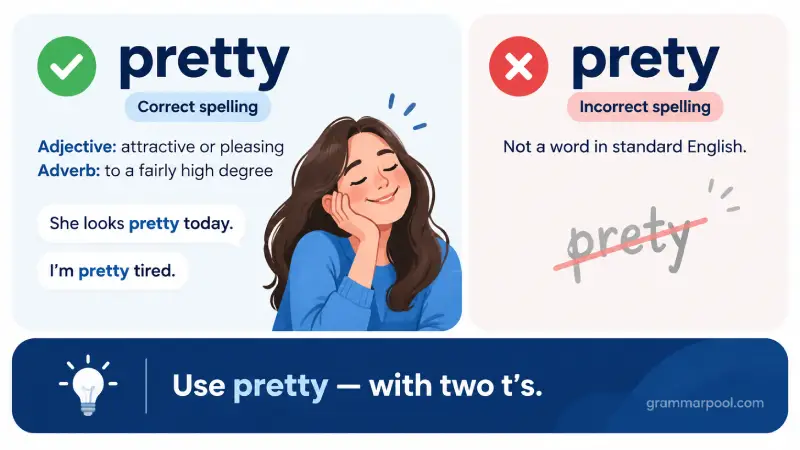
Is it pretty or prety? The correct spelling is pretty. Prety is a common misspelling. The word pretty can describe something attractive, pleasant, or appealing. It can also function as an adverb meaning “fairly,” “quite,” or “to a considerable degree.”
The main spelling challenge is the double “t” in the middle. The correct form is:
pretty
not:
prety
Once you remember the double t, this spelling becomes much easier to recognize and use correctly.
Is It Pretty or Prety?
Pretty is the correct spelling in standard English.
Prety is an incorrect spelling when you intend to use the English word pretty.
| Spelling | Correct? | Meaning |
|---|---|---|
| Pretty | ✅ Yes | Attractive, pleasing, fairly, or quite |
| Prety | ❌ No | Common misspelling of “pretty” |
For example:
- She has a pretty dress.
- The garden looks pretty in spring.
- That was a pretty difficult question.
- The movie was pretty good.
In each example, the correct spelling is pretty.
What Does Pretty Mean?
Pretty has several common meanings in English. Its meaning depends on how it functions in a sentence.
As an adjective, pretty can mean attractive, pleasing, or beautiful, especially in a delicate or pleasant way.
For example:
She wore a pretty dress.
Here, pretty describes the dress as attractive.
However, pretty can also describe things that are visually pleasant without necessarily meaning beautiful.
We stayed in a pretty little town.
The word can also function as an adverb.
The test was pretty difficult.
In this sentence, pretty means quite or fairly.
Therefore, context determines the exact meaning.
How Do You Spell Pretty?
The correct spelling is:
P-R-E-T-T-Y
The word contains two t’s:
pre + tty = pretty
A common mistake is to remove one of those letters and write:
❌ prety
Instead, remember:
✅ pretty
The double t is an important part of the standard spelling.
Why Do People Spell Pretty as Prety?
The misspelling prety is easy to make because people sometimes leave out one of the repeated letters when writing quickly.
Pronunciation can also contribute to the mistake. When people say pretty, the two t’s are not always strongly noticeable as separate letters.
As a result, someone who knows the word from speech may write prety.
However, the standard written form is always pretty.
Another reason is that English contains many words with double consonants, and remembering when to repeat a letter can be difficult.
For this word, the safest approach is simple:
Remember the two T’s in pretty.
Pretty as an Adjective
The most familiar use of pretty is as an adjective.
As an adjective, pretty can describe someone or something that is attractive or pleasing to look at.
Examples include:
- She bought a pretty necklace.The necklace is attractive.
- The flowers are pretty.The flowers look pleasant or beautiful.
- They live in a pretty neighborhood.The neighborhood is visually pleasant.
- He gave her a pretty card.The card has an attractive appearance.
- That is a pretty picture.The picture is pleasing to look at.
In these examples, pretty describes a noun.
Pretty as an Adverb
Pretty can also work as an adverb. In this use, it usually means fairly, quite, or to a considerable degree.
For example:
The weather is pretty cold today.
Here, pretty does not mean attractive. Instead, it means quite cold or fairly cold.
Consider these examples:
- The movie was pretty good.
- She is pretty tired.
- The test was pretty difficult.
- We arrived pretty late.
- The restaurant was pretty expensive.
- He runs pretty fast.
This use is extremely common in conversational American English.
Pretty vs. Beautiful
Pretty and beautiful can both describe something attractive, but they are not always identical.
Beautiful often expresses a stronger or more intense sense of attractiveness.
Pretty can sound lighter, softer, or more delicate.
Compare:
She has a pretty smile.
She has a beautiful smile.
Both are compliments. However, beautiful can suggest a stronger level of admiration.
The distinction depends on context, speaker, and personal preference. Therefore, the two words can overlap considerably.
Pretty vs. Cute
Pretty and cute also overlap, especially when describing people, animals, clothing, or objects.
Cute often suggests charm, smallness, playfulness, or endearing qualities.
Pretty usually focuses more directly on attractive appearance.
For example:
That’s a pretty dress.
This focuses on the dress’s attractive appearance.
That’s a cute dress.
This may suggest that the dress is charming, playful, or appealing.
Neither word is automatically stronger. The appropriate choice depends on the meaning you want to express.
Pretty in Everyday American English
The adverbial use of pretty is especially common in everyday American English.
For example:
I’m pretty tired.
This means:
I’m quite tired.
Similarly:
That’s pretty expensive.
This means the speaker considers the price fairly or quite high.
Other common examples include:
- I’m pretty sure.
- It’s pretty cold outside.
- She works pretty hard.
- The restaurant is pretty busy.
- We are pretty close to the station.
- He is pretty good at basketball.
This use is natural in conversation and informal writing.
Is Pretty Formal or Informal?
The answer depends on how you use it.
As an adjective meaning attractive, pretty is completely standard and can appear in both everyday and formal writing.
For example:
The village has a pretty landscape.
As an adverb meaning “fairly” or “quite,” pretty is more conversational.
For formal academic writing, alternatives such as fairly, relatively, or quite may sometimes sound more appropriate.
Compare:
The results were pretty significant.
with:
The results were relatively significant.
The best choice depends on the intended tone and meaning.
Common Phrases With Pretty
Learning common expressions can help you understand how pretty works.
Some common phrases include:
- pretty good
- pretty bad
- pretty easy
- pretty difficult
- pretty sure
- pretty important
- pretty expensive
- pretty cheap
- pretty close
- pretty far
- pretty much
- pretty soon
- pretty well
Examples:
I’m pretty sure she’s coming.
We finished the project pretty quickly.
That’s pretty much what I expected.
These expressions are common in natural English.
Pretty Much: What Does It Mean?
Pretty much is a common expression in English.
It generally means almost, nearly, essentially, or more or less, depending on context.
For example:
That’s pretty much everything we need.
This means that the list is essentially complete.
Another example:
I pretty much agree with you.
This means the speaker agrees to a large extent.
The phrase is especially common in informal American English.
Pretty vs. Prety in Sentences
The easiest way to identify the spelling is to compare the two forms.
❌ She bought a prety dress.
✅ She bought a pretty dress.
❌ The garden looks prety today.
✅ The garden looks pretty today.
❌ The test was prety difficult.
✅ The test was pretty difficult.
❌ I’m prety sure about the answer.
✅ I’m pretty sure about the answer.
The correct form always contains the double t.
Common Mistakes With Pretty
The biggest spelling mistake is dropping one t.
❌ prety
✅ pretty
Here are more examples:
❌ She looks very prety today.
✅ She looks very pretty today.
❌ That is a prety good idea.
✅ That is a pretty good idea.
❌ We stayed in a prety village.
✅ We stayed in a pretty village.
❌ I’m prety sure that’s correct.
✅ I’m pretty sure that’s correct.
The spelling does not change based on whether pretty functions as an adjective or an adverb.
How to Remember the Spelling of Pretty
A simple memory trick is:
Pretty has two T’s.
Think of the word as:
PRE + TT + Y
That gives:
PRETTY
Another useful trick is to associate the double t with the word’s pronunciation and visual shape:
pretty = P-R-E-T-T-Y
Whenever you are tempted to write prety, pause and ask:
“Did I include both T’s?”
If not, add the second t.
Is Prety Ever Correct?
In standard English, prety is not the correct spelling of pretty.
If you are writing an essay, email, article, report, social media post, or school assignment, use pretty.
The spelling prety may appear online because of typing mistakes or informal errors. However, it is not the standard English spelling.
Therefore:
pretty = correct
prety = incorrect
Pretty vs. Prety: Quick Comparison
| Feature | Pretty | Prety |
|---|---|---|
| Standard English spelling | ✅ Yes | ❌ No |
| Part of speech | Adjective and adverb | Misspelling |
| Meaning | Attractive, pleasing, fairly, or quite | No standard meaning |
| Common in everyday English | Yes | No |
| Example | She looks pretty. | She looks prety. ❌ |
The most important point is that pretty always contains two t’s.
FAQs
Is pretty the correct spelling?
Yes. Pretty is the correct spelling. Prety is a common misspelling.
Is prety a word?
No. Prety is not the standard spelling of the English word pretty.
How do you spell pretty?
The correct spelling is:
P-R-E-T-T-Y
Remember the two t’s in the middle.
What does pretty mean?
As an adjective, pretty can mean attractive or pleasing. As an adverb, it can mean fairly, quite, or to a considerable degree.
Is pretty an adjective or an adverb?
Pretty can be both an adjective and an adverb.
As an adjective:
She has a pretty dress.
As an adverb:
The dress is pretty expensive.
What is the difference between pretty and beautiful?
Both words can describe something attractive. Beautiful often expresses a stronger degree of admiration, while pretty can suggest a lighter or more delicate kind of attractiveness.
What is the difference between pretty and cute?
Pretty usually focuses on attractiveness, while cute often suggests charm, playfulness, or an endearing quality.
Is pretty informal?
Not always. Pretty is a standard English word. However, its use as an adverb meaning “fairly” or “quite” is especially common in conversational English.
How can I remember the spelling of pretty?
Remember:
PRE + TT + Y = PRETTY
The key is the double T.
Quick-Reference Takeaway
- ✅ Pretty = correct spelling
- ❌ Prety = incorrect spelling
- Pretty contains two t’s.
- As an adjective, pretty can mean attractive or pleasing.
- As an adverb, pretty can mean fairly or quite.
- Pretty much is a common English expression.
- Remember: PRE + TT + Y = PRETTY.
Conclusion
The correct spelling is pretty, not prety. The word can describe something attractive or pleasing, and it can also function as an adverb meaning fairly, quite, or to a considerable degree.
The easiest way to remember the spelling is to focus on the two t’s:
PRE + TT + Y = PRETTY
Although prety is a common spelling mistake, it is not the standard English form. Therefore, whenever you write this word, remember to keep both t’s in pretty.

Olivia Smith is a US English writer and language enthusiast who specializes in spelling, word choice, and commonly confused words. She creates clear, practical guides that help readers understand the correct spelling, meaning, and usage of English words.
At GrammarPool.com, Olivia focuses on spelling-choice topics, common spelling mistakes, and easy-to-understand explanations for everyday English users. Her writing is designed to make confusing word choices simple, accurate, and easy to remember.
Expertise: US English, spelling, word choice, commonly confused words, grammar, and language usage.