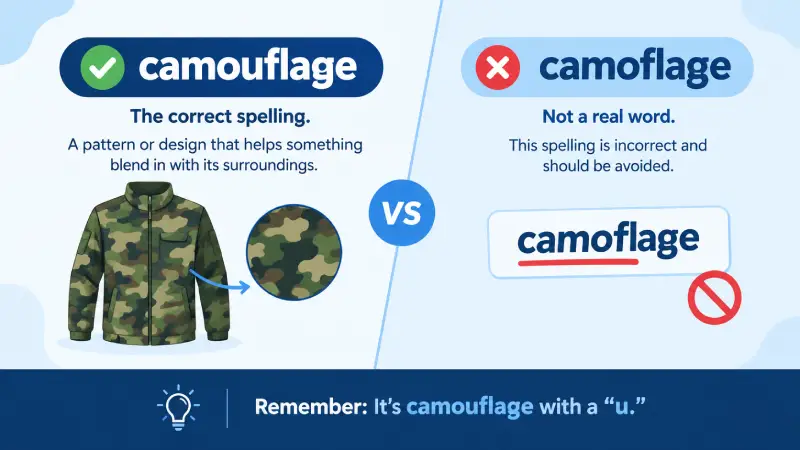
Camouflage is the correct spelling. Camoflage is a misspelling. Use camouflage when referring to a pattern, color, material, or method that helps a person, animal, or object blend into its surroundings or remain difficult to notice.
The correct spelling is:
Camouflage ✅
The incorrect spelling is:
Camoflage ❌
If you are wondering whether it is camouflage or camoflage, choose camouflage every time in standard American English.
What Is the Difference Between Camouflage and Camoflage?
This is a spelling issue, not a difference between two valid English words.
Camouflage is a standard English word. Camoflage is simply a misspelling created by leaving out the u after the o.
The correct spelling is:
C-A-M-O-U-F-L-A-G-E
A common incorrect version is:
C-A-M-O-F-L-A-G-E
The key spelling pattern is -ouflage.
So remember:
camouflage ✅
camoflage ❌
The unusual spelling can be difficult because the word contains several letters that are not pronounced as clearly as they appear in writing. The word is commonly pronounced approximately KAM-uh-flahzh in American English, so pronunciation alone does not make the spelling obvious.
What Does Camouflage Mean?
Camouflage can function as both a noun and a verb.
Camouflage as a Noun
As a noun, camouflage means something that helps conceal a person, animal, vehicle, object, or position by making it blend with the surrounding environment.
For example:
The soldiers wore camouflage in the forest.
Here, camouflage refers to clothing designed to make the soldiers harder to see.
Camouflage can involve colors, patterns, shapes, materials, or other visual techniques.
Examples:
- The leopard’s spots provide natural camouflage.
- The vehicle was covered with camouflage before testing began.
- The photographer used camouflage to hide the equipment.
- The tent’s camouflage helped it blend into the landscape.
- The insect’s natural camouflage made it difficult to spot.
Camouflage as a Verb
Camouflage can also function as a verb meaning to hide or disguise something so that it becomes harder to recognize or detect.
Examples:
- The designers camouflaged the equipment with a matching pattern.
- The animal camouflages itself among the leaves.
- Workers camouflaged the structure so it would blend into the surroundings.
- The photographer tried to camouflage the camera against the wall.
- The company used the design to camouflage the machinery.
The verb can take several forms:
camouflage
camouflages
camouflaged
camouflaging
The spelling retains the u throughout these forms.
Why Is Camouflage Spelled With a U?
The spelling camouflage comes from French camouflage, and English retained the French-based spelling. Merriam-Webster traces the English noun to French camouflage and lists its first known use in the early 20th century.
This French spelling helps explain why camouflage does not look as straightforward as some English words.
For modern English learners, the most useful thing to remember is the sequence:
CAMOUFLAGE
Pay special attention to:
CAM + OU + FLAGE
The incorrect form camoflage removes the u from the middle.
This is similar to other English words whose spelling reflects their historical development rather than a simple letter-for-sound pattern. You should therefore memorize camouflage as a complete spelling rather than trying to spell it purely from pronunciation.
Camouflage vs. Camoflage: Side-by-Side Comparison
| Feature | Camouflage | Camoflage |
|---|---|---|
| Correct spelling | Yes | No |
| Standard English word | Yes | No |
| Part of speech | Noun and verb | Not a standard word |
| Meaning | Concealment, disguise, or the act of concealing | No standard meaning |
| Correct middle | -ouflage- | -oflage- |
| American English | Correct | Incorrect |
| Formal writing | Correct | Incorrect |
| Related adjective | Camouflaged | Not standard |
| Related verb | Camouflage | Not standard |
There is no difference in meaning between the two forms because camoflage is not a standard alternative spelling.
Examples of Camouflage in Everyday English
The word appears in many different contexts, not just military situations.
Clothing and Fashion
He wore a camouflage jacket during the hiking trip.
Camouflage pants have become a familiar casual fashion choice.
She bought a camouflage backpack for the outdoor trip.
The store displayed several camouflage-patterned shirts.
In these examples, camouflage describes a visual pattern or style.
Nature and Animals
Camouflage plays an important role in the natural world.
The frog’s green skin provides camouflage among the leaves.
The owl’s feathers give it excellent camouflage against the tree bark.
The insect’s camouflage made it almost impossible to see.
Some animals use camouflage to avoid predators.
A snowshoe hare’s seasonal coloring can provide camouflage in snowy conditions.
Here, camouflage describes a natural feature that helps an animal remain less noticeable.
Military and Outdoor Contexts
The soldiers wore camouflage uniforms during the training exercise.
The vehicle was painted in a camouflage pattern.
The equipment was covered with camouflage netting.
The shelter’s camouflage helped it blend into the surrounding vegetation.
This is one of the most familiar uses of the word.
Figurative Use
Camouflage does not always involve physical appearance.
The word can also describe something used to hide a problem, intention, or fact.
His confident attitude was camouflage for his nervousness.
The complicated explanation served as camouflage for the company’s mistake.
Humor can sometimes act as camouflage for embarrassment.
Here, camouflage means something that conceals a less obvious reality.
Camouflage as a Verb: More Examples
Because camouflage works as both a noun and a verb, learners sometimes focus only on its clothing-related meaning.
As a verb, it means to conceal or disguise.
The artist camouflaged the electrical equipment inside the display.
The animal camouflaged itself against the rocks.
They used artificial leaves to camouflage the camera.
The designers camouflaged the building during the renovation.
The dark paint helped camouflage the scratches.
The company tried to camouflage the warning signs with decorative graphics.
These sentences demonstrate that camouflage can describe physical concealment as well as figurative concealment.
Common Mistakes With Camouflage
1. Dropping the U
This is the main spelling mistake.
Wrong:
The soldiers wore camoflage uniforms.
Right:
The soldiers wore camouflage uniforms.
Remember the middle sequence:
OU
not simply:
O
2. Writing Camoflage Because It Sounds Shorter
The pronunciation does not clearly reveal the u, which can lead writers to leave it out.
Wrong:
The animal’s camoflage made it difficult to find.
Right:
The animal’s camouflage made it difficult to find.
When you are unsure, rely on the visual spelling camouflage rather than pronunciation.
3. Misspelling Camouflaged
The same problem can appear when the word becomes an adjective or past-tense verb.
Wrong:
The vehicle was camoflaged near the trees.
Right:
The vehicle was camouflaged near the trees.
The correct base spelling remains camouflage.
4. Misspelling Camouflaging
The present participle can also cause trouble.
Wrong:
The workers were camoflaging the equipment.
Right:
The workers were camouflaging the equipment.
The u remains part of the word.
5. Misspelling the Word in Professional or Academic Writing
A spelling mistake can be particularly noticeable in research, journalism, military writing, wildlife articles, and educational material.
Wrong:
The researchers studied the animal’s natural camoflage.
Right:
The researchers studied the animal’s natural camouflage.
How to Remember Camouflage Fast
The easiest trick is to remember the unusual middle:
CAMOUFLAGE
Think:
CAM + OU + FLAGE
The important part is OU.
A simple memory sentence is:
“Camouflage uses OU to hide.”
You can also connect the word with its related forms:
- camouflage
- camouflaged
- camouflages
- camouflaging
All of them retain the OU sequence.
If you remember camouflage, the other forms become easier to spell.
Camouflage vs. Camouflaged
These two forms are related but have different grammatical functions.
Camouflage can be a noun:
The camouflage was effective.
It can also be a verb:
They camouflage the equipment.
Camouflaged can function as a past-tense verb or adjective:
The soldiers camouflaged the vehicle.
The camouflaged vehicle was difficult to see.
Notice that camouflaged keeps the spelling camouflage before adding -d.
Camouflage vs. Concealment
Camouflage and concealment have related meanings, but they are not always interchangeable.
Concealment is the broader idea of hiding something from view or preventing it from being discovered.
Camouflage specifically involves disguising or blending something with its surroundings so that it becomes less noticeable.
For example:
The box was hidden behind the wall.
This is concealment.
The box was painted to match the wall.
This is camouflage.
Camouflage can therefore be one method of concealment, but not every form of concealment is camouflage.
Camouflage vs. Disguise
Disguise and camouflage also overlap.
A disguise usually changes or conceals the identity or appearance of a person or thing.
He wore a disguise to avoid being recognized.
Camouflage more often makes something blend into its surroundings or become difficult to detect.
The tent used camouflage to blend into the forest.
In figurative writing, however, the two ideas can overlap.
Camouflage in Real-World Context
Text Message
Ryan: Why are you wearing that camouflage jacket?
Jake: We’re going hiking tomorrow. I thought it would be useful outdoors.
Ryan: Fair enough. Just don’t disappear into the trees!
Here, camouflage refers to a clothing pattern.
Professional Context
The engineering team covered the prototype with a temporary camouflage material during outdoor testing. The material helped conceal the equipment from public view while the team evaluated its performance.
Here, camouflage functions as a noun describing a concealment method.
Article-Style Context
Many animals rely on natural camouflage to avoid predators or approach prey. Some species blend with leaves, bark, rocks, or snow, while others use patterns that break up the outline of their bodies.
This use shows that camouflage is a broader natural adaptation, not simply a military clothing pattern.
Is Camoflage Ever Correct?
In standard English, camoflage is not an accepted alternative spelling of camouflage.
You may occasionally see the misspelling online, in informal posts, or in user-generated content. Its appearance does not make it a standard spelling.
For school assignments, professional writing, websites, articles, reports, and other edited content, use:
camouflage
not:
camoflage
Frequently Asked Questions
Camouflage is correct. Camoflage is a misspelling.
The English word comes from French camouflage, and English retained that spelling. For practical purposes, remember the middle sequence OU.
The correct spelling is C-A-M-O-U-F-L-A-G-E. Remember CAM + OU + FLAGE.
Camouflage means a method or pattern used to make someone or something harder to see or recognize by blending it with the surroundings. It can also be a verb meaning to conceal or disguise something.
No. Camouflage also describes natural concealment in animals, outdoor equipment, vehicles, objects, and figurative forms of concealment.
Conclusion
Camouflage is the correct spelling, while camoflage is a misspelling. Camouflage can be a noun referring to a method, pattern, or material used for concealment, and it can also be a verb meaning to conceal or disguise something. The easiest way to remember the spelling is to focus on the unusual middle: CAMOUFLAGE, with OU before FLAGE. When writing in standard American English, always choose camouflage.

Olivia Smith is a US English writer and language enthusiast who specializes in spelling, word choice, and commonly confused words. She creates clear, practical guides that help readers understand the correct spelling, meaning, and usage of English words.
At GrammarPool.com, Olivia focuses on spelling-choice topics, common spelling mistakes, and easy-to-understand explanations for everyday English users. Her writing is designed to make confusing word choices simple, accurate, and easy to remember.
Expertise: US English, spelling, word choice, commonly confused words, grammar, and language usage.