
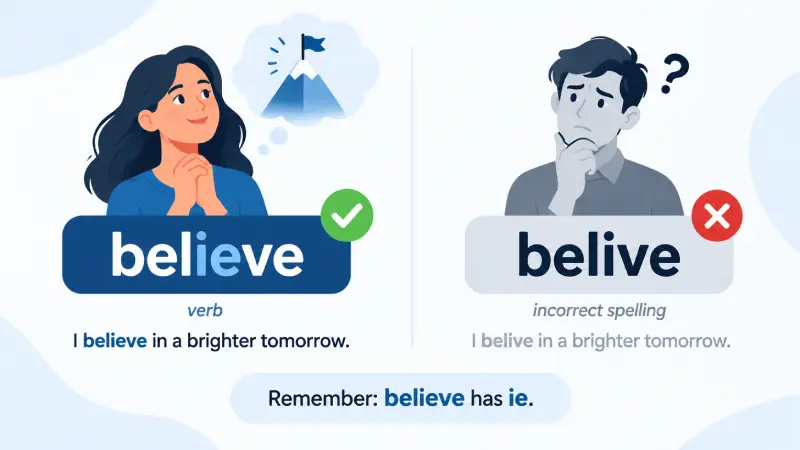
Believe is the correct spelling. Belive is a common misspelling and is not the standard English form. Use believe as a verb when you mean to accept something as true, trust someone or something, or hold an opinion or conviction.
What Does Believe Mean?
Believe is a verb. It has several related uses in English, depending on the context.
The most common meaning is to accept something as true or real.
I believe your story.
It can also mean to have confidence or trust in someone or something.
We believe in our team.
Another use is to express an opinion or judgment.
I believe this is the best option.
Believe can also describe a person’s conviction about a religious, philosophical, or personal matter.
She believes in God.
He believes that everyone deserves a second chance.
The important spelling point is that believe contains “ie” after the l:
believe
not:
belive
Believe vs. Belive: The Basic Difference
| Word | Correct? | Part of Speech | Meaning |
|---|---|---|---|
| believe | Yes | Verb | To accept as true, trust, or hold an opinion |
| belive | No | Not standard English | Misspelling of believe |
There is no standard English context in which belive is an alternative spelling of believe.
If your sentence needs the verb meaning “accept as true,” “trust,” or “think something is true,” use believe.
Why Is Believe Spelled With “ie”?
The spelling of believe is one of the common places where English learners remember the phrase “i before e” but still hesitate.
The correct spelling is:
B-E-L-I-E-V-E
The important middle sequence is:
IE
So:
believe
not:
belive
The easiest way to remember the word is to notice that it contains lie:
be + lie + ve → believe
This is only a memory aid, not a rule for how the word was historically formed. The spelling itself must simply be learned as believe.
When Is Believe Correct?
1. When you accept something as true
Use believe when you accept a statement, explanation, or claim as true.
I believe what you told me.
Do you believe his explanation?
She believed the story at first.
They believe the report is accurate.
I don’t believe everything I read online.
Here, believe expresses acceptance of something as true.
2. When you trust someone
Believe can express confidence in another person.
I believe you.
Her parents always believed in her.
We believe in your ability to succeed.
The coach believes in his players.
The structures believe someone and believe in someone can have slightly different meanings.
I believe you.
This usually means I accept what you are saying as true.
I believe in you.
This usually means I have confidence in your abilities or potential.
3. When expressing an opinion
Believe can introduce a personal opinion or judgment.
I believe this decision is reasonable.
We believe the project will succeed.
She believes the company needs a new strategy.
I believe there is a better solution.
In formal writing, believe can sometimes sound more measured than simply saying know, because believe does not necessarily claim absolute certainty.
Compare:
Use up and down arrow keys to resize the meta box pane.
Move upMove downShow or hide panel
Analysis resultsLearn more about the readability analysis(Opens in a new browser tab)
Problems (1)
- Word complexity: Is your vocabulary suited for a larger audience? Yoast SEO Premium will tell you!
Improvements (1)
- Transition words: Only 25% of the sentences contain transition words, which is not enough. Use more of them.
Good results (5)
- Passive voice: You are not using too much passive voice. That’s great!
- Consecutive sentences: There are no repetitive sentence beginnings. That’s great!
- Subheading distribution: Great job!
- Paragraph length: There are no paragraphs that are too long. Great job!
- Sentence length: Great!
PostBlock
Believe vs. Belive: Which Spelling Is Correct?
Set featured image
Generate with Elementor AIShow featured image in the posts lists only, but hide it in the single post view.Add an excerpt…
1,772 words, 9 minutes read time.
Last edited 2 hours ago.
StatusDraft
PublishImmediately
Slugbelieve vs belive
TemplateDefault template
DiscussionOpen
Revisions
FormatStandard

Go from blank page to live website faster – get 300+ templates and powerful design tools.Upgrade NowMove to trash
Yoast SEO
SEO analysis: OK
Readability analysis: Good
Inclusive language: GoodImprove your post with Yoast SEO
Categories
UncategorizedAngel Numbers MeaningsSlangs MeaningSpelling ComparisonsSymbol MeaningsWord Meanings
Tags
Move upMove downShow or hide panelDisable CacheDisable Image LazyloadDisable VPIViewport ImagesViewport Images – Mobile
Learn MoreOpen publish panel
- Post
- Heading 2
I know the answer.
I believe the answer is correct.
The second sentence communicates a belief rather than definite knowledge.
4. When discussing faith or convictions
Believe is commonly used when discussing religious or philosophical beliefs.
They believe in God.
She believes in the power of forgiveness.
He believes that people can change.
The word itself does not specify what a person believes. The rest of the sentence provides that information.
Natural Example Sentences With Believe
Everyday English
I believe you, so don’t worry about explaining it again.
She couldn’t believe how quickly the day had passed.
Work and business
We believe the new policy will improve communication.
The manager believes in giving employees more responsibility.
School and academic writing
The researchers believe the results require further investigation.
Many historians believe that the settlement developed gradually.
Formal writing
We believe the evidence supports this conclusion.
The organization believes that greater transparency would improve public confidence.
Casual conversation
I can’t believe you remembered my birthday!
Do you really believe that?
These examples show that believe is common in virtually every type of modern English writing and speech.
When Is Belive Correct?
In standard English, belive is not the correct spelling of the verb believe.
For example:
Wrong:
I belive you.
Right:
I believe you.
Another example:
Wrong:
She belives everything he says.
Right:
She believes everything he says.
The same spelling issue carries over to other forms of the verb.
Common Mistakes With Believe
Mistake 1: Writing “belive”
This is the most common error.
Wrong:
I belive that you’re right.
Right:
I believe that you’re right.
The missing e changes the spelling from believe to the incorrect belive.
Mistake 2: Writing “beleive”
Another common mistake reverses the i and e.
Wrong:
I beleive you.
Right:
I believe you.
The correct sequence is:
bel + ie + ve
not:
bel + ei + ve
Mistake 3: Writing “believes” incorrectly
When believe changes to the third-person singular form, the ending becomes -s, but the spelling of the root remains recognizable.
Correct:
She believes me.
Incorrect:
She belives me.
The correct spelling is:
B-E-L-I-E-V-E-S
Mistake 4: Confusing believe with belief
Believe is a verb.
I believe him.
Belief is a noun.
Her belief was strong.
This is an important difference because adding or removing the final letters changes the part of speech.
Compare:
I believe that the plan will work.
My belief in the plan remains strong.
Mistake 5: Confusing believe with belief in expressions
The expression believe in uses the verb believe.
I believe in you.
The noun form uses belief in.
Her belief in herself helped her succeed.
Do not write belive simply because the word is followed by in. The correct verb remains believe.
Believe vs. Belief
These words are closely related but perform different grammatical jobs.
Believe is a verb:
I believe you.
Belief is a noun:
I respect your belief.
The easiest test is to ask whether the word describes an action or state of thinking or names the idea or conviction itself.
They believe the story.
Their belief is sincere.
The spelling also changes:
believe → belief
Notice that believe ends in -eve, while belief ends in -ief.
Believe vs. Trust
- Believe and trust overlap, but they are not always interchangeable.
- Believe often means accepting something as true.
I believe what she said.
Trust often focuses on confidence in a person’s honesty, reliability, or judgment.
I trust her to handle the situation.
You can believe a statement without necessarily trusting the person who made it.
For example:
I believe his explanation, but I don’t completely trust him.
This distinction is useful in everyday communication.
Believe vs. Know
Believe and know also express different levels of certainty.
Know generally presents something as established or certain from the speaker’s perspective.
I know where he lives.
Believe expresses a conviction or judgment without necessarily claiming absolute certainty.
I believe he lives nearby.
This difference is particularly useful in professional and academic writing, where careful wording matters.
Believe in vs. Believe Someone
The preposition in can change the meaning.
Believe someone
I believe you.
This means I accept what you are saying as true.
Believe in someone
I believe in you.
This usually means I have confidence in you, your abilities, or your potential.
The distinction becomes especially clear in conversation:
“Do you believe me?”
means:
“Do you think what I’m saying is true?”
But:
“Do you believe in me?”
usually means:
“Do you have confidence in me?”
How to Remember Believe vs. Belive
The easiest memory trick is:
Remember “LIE”
The word believe contains lie:
BE + LIE + VE
So visualize:
BE-LIE-VE
That can help you remember the i-e sequence.
Another simple method is to memorize the middle:
bel + ie + ve
Whenever you see belive, check whether the second e is missing.
Correct:
BELIEVE
Incorrect:
BELIVE
Believe in Real-World Context
Scenario 1: Text conversation
Jake: Do you think Emma will finish the project today?
Nina: I believe she will. She was almost done when I left.
Here, believe introduces an opinion about what is likely to happen.
Scenario 2: Workplace email
We believe the updated process will reduce delays and make the approval system easier for everyone to use.
The verb works naturally in professional writing.
Scenario 3: Personal conversation
“I don’t know if I can do this.”
“I believe in you. You’ve handled more difficult challenges before.”
Here, believe in means having confidence in someone’s ability.
Related Spelling Confusions
Believe vs. Belief
- Believe is a verb, while belief is a noun.
I believe the claim.
I have no belief in the claim.
Believe vs. Believes
- Believe is used with subjects such as I, you, we, and they in the present tense.
They believe the story.
With he, she, or it, use believes.
She believes the story.
Believed vs. Believe
Believed is the past tense and past participle of believe.
I believe you now.
I believed you yesterday.
The spelling changes to believed, but the original believ- spelling remains visible.
Believing vs. Believe
Believing is the -ing form.
She is believing the story.
However, this form is less common than constructions such as She believes the story or She is beginning to believe the story. The exact choice depends on the sentence and intended meaning.
Is “Belive” a Word?
In standard modern English, belive is not an accepted alternative spelling of believe. If you are writing an English sentence and mean “accept as true,” “trust,” or “hold an opinion,” use believe.
A spell checker may flag belive, but relying on autocorrect alone is not ideal. Remembering the spelling helps you catch the error even when automatic correction is unavailable.
FAQs
The correct spelling is believe. Belive is a misspelling.
Spell it B-E-L-I-E-V-E. A useful memory trick is to notice the lie inside believe.
Believe is a verb meaning to accept something as true, trust someone or something, or hold an opinion or conviction.
Yes. Believe is a verb. For example: “I believe you.”
Believe is a verb, while belief is a noun. For example, “I believe her” and “I respect her belief.”
Conclusion
Believe is the correct spelling, while belive is incorrect in standard English.
Remember the spelling:
B-E-L-I-E-V-E
The easiest memory aid is BE-LIE-VE, which helps you remember the ie sequence.
Use believe when you mean to accept something as true, trust someone, express an opinion, or hold a conviction:
I believe you.
We believe in you.
She believes the information is accurate.
Never use belive when writing standard American English.

Olivia Smith is a US English writer and language enthusiast who specializes in spelling, word choice, and commonly confused words. She creates clear, practical guides that help readers understand the correct spelling, meaning, and usage of English words.
At GrammarPool.com, Olivia focuses on spelling-choice topics, common spelling mistakes, and easy-to-understand explanations for everyday English users. Her writing is designed to make confusing word choices simple, accurate, and easy to remember.
Expertise: US English, spelling, word choice, commonly confused words, grammar, and language usage.

Pingback: Camouflage vs. Camoflage: Which Spelling Is Correct?
Pingback: Caribbean vs. Carribean: Which Spelling Is Correct?