
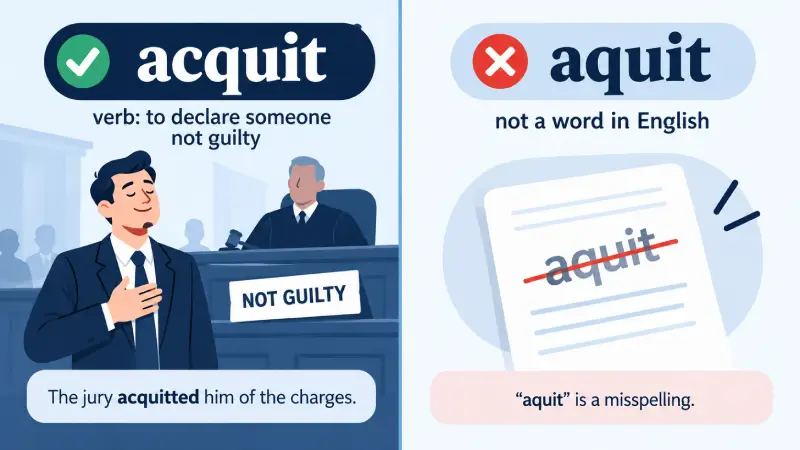
Acquit vs aquit: Which spelling is correct? Acquit is the correct spelling in American English, while aquit is a misspelling. The verb acquit means to officially declare someone not guilty of a crime or charge, as in “The jury decided to acquit the defendant.” The key difference is simple: acquit contains a c, and leaving it out creates a spelling error.
Knowing the difference between acquit and aquit can help you avoid mistakes in school assignments, professional documents, and everyday writing. Although the two forms look nearly identical, only one is standard English. This guide explains the correct spelling, the meaning of acquit, and clear example sentences so you can use the word accurately and confidently.pping the c produces a misspelling.
SEO Meta Description: Acquit vs. aquit explained: learn the correct spelling, meaning, pronunciation, verb forms, examples, and common mistakes in US English.
Acquit vs aquit: Learn the correct spelling, understand what acquit means, and explore clear examples and practical usage tips for everyday English.
Quick Answer: Acquit or Aquit?
Acquit is correct. Aquit is incorrect in standard English.
Use acquit when you mean to officially find someone not guilty of a crime or charge.
The jury decided to acquit the defendant.
You can also use acquit yourself to describe how someone performs or behaves.
She acquitted herself well during the interview.
Remember the spelling:
AC + QUIT = ACQUIT
The c is essential.\
Acquit vs. Aquit: Which Spelling Is Correct?
Acquit is the correct English spelling. Aquit is a misspelling and should not be used in standard American English.
How do you spell “acquit” in English?
The correct spelling is acquit: A-C-Q-U-I-T. The spelling aquit is incorrect.
How do you pronounce “acquit” in English?
Acquit is pronounced uh-KWIT, with the stress on the second syllable.
What does the word “acquit” mean?
Acquit means to officially decide that someone is not guilty of a crime or charge.
The jury decided to acquit the defendant.
What does it mean to acquit someone?
To acquit someone means to officially declare that the person is not guilty of the crime they were accused of committing.
The court acquitted him of all charges.
Is “acquit” the correct word to use?
Yes. Acquit is the correct word when you mean to find someone not guilty or to release someone from a particular obligation or responsibility.
Is “aquit” a correct spelling?
No. Aquit is an incorrect spelling of acquit. If you mean to declare someone not guilty, use acquit.
Is this correct use of “acquit”?
Yes, if the sentence uses acquit to describe declaring someone not guilty or releasing someone from an obligation.
The jury voted to acquit the defendant.
Acquit in Everyday English
Can you use “acquit” in a sentence?
Yes. Acquit is commonly used in legal contexts.
The jury chose to acquit the accused after reviewing the evidence.
What is the past tense of “acquit”?
The past tense is acquitted.
The defendant was acquitted of the charges.
The spelling changes from acquit to acquitted by doubling the final t before adding -ed.
What Does Acquit Mean?
Acquit is a verb with two main modern uses.
The most common use is legal. To acquit someone means to officially find that person not guilty of a particular criminal charge.
The jury voted to acquit the defendant.
Here, acquit means that the jury decided the defendant was not guilty of the charge.
The second use appears mainly in formal writing. Acquit yourself means to perform, behave, or conduct yourself in a particular way.
She acquitted herself well during the interview.
In this sentence, the word has nothing to do with a courtroom. It means that she handled the interview successfully or appropriately.
Is Acquit a Verb or a Noun?
Acquit is a verb.
It describes an action, such as finding someone not guilty or conducting oneself in a particular way.
The jury will acquit the defendant.
She acquitted herself well under pressure.
The related noun is acquittal.
The defendant’s acquittal came after a lengthy trial.
So the basic distinction is:
- acquit = verb
- acquittal = noun
How Do You Pronounce Acquit?
Acquit is pronounced approximately uh-KWIT.
The pronunciation can make the spelling confusing because the c is not pronounced as a separate sound.
That is one reason some writers accidentally spell the word aquit.
A useful way to remember it is to separate the spelling:
ac-quit
The first part contains ac, followed by quit.
acquit = correct
aquit = incorrect
Why Is Acquit Spelled With a C?
The spelling can look unusual because the c is not strongly noticeable when the word is pronounced.
Acquit developed historically through Middle English and Anglo-French forms associated with the idea of releasing or discharging someone.
However, you do not need to memorize its history to spell it correctly.
For everyday writing, the easiest rule is:
Remember the C: AC + QUIT = ACQUIT.
This also helps when forming related words such as acquitted and acquitting.
When Is Acquit Correct?
1. When a court finds someone not guilty
This is the most common modern meaning.
The jury chose to acquit the defendant.
The defendant was acquitted after the trial.
The court acquitted her of the charges.
The jury voted to acquit him.
In legal contexts, acquit describes a formal decision concerning a particular charge.
2. With “of” to identify a charge
A common grammatical structure is:
acquit + someone + of + charge
Examples:
The jury acquitted the man of murder.
She was acquitted of all charges.
The court acquitted him of fraud.
The defendant was acquitted of the robbery charge.
The preposition of is important in this structure.
3. In the phrase “acquit yourself”
Acquit yourself has a different meaning from the legal use.
It means to perform or behave in a particular way.
The phrase is usually followed by an adverb such as well, poorly, admirably, capably, brilliantly, or professionally.
She acquitted herself well during the presentation.
The new employee acquitted himself admirably under pressure.
The team acquitted itself well against a stronger opponent.
He acquitted himself poorly during the interview.
This use is formal and is less common in casual conversation.
When Is Aquit Correct?
For standard English, aquit is not the correct spelling of the verb you are looking for.
If you want to say that a court found someone not guilty, write:
The jury decided to acquit him.
Not:
The jury decided to aquit him.
Likewise, if you want to describe someone’s performance, write:
She acquitted herself well.
Not:
She aquitted herself well.
In standard American English, acquit is the form to use.
Acquit, Acquits, Acquitted, and Acquitting: Correct Forms
The spelling of acquit changes when different verb endings are added.
| Verb form | Correct spelling | Example |
|---|---|---|
| Base form | acquit | The jury may acquit him. |
| Third-person singular | acquits | The court acquits the defendant. |
| Past tense | acquitted | The jury acquitted her. |
| Past participle | acquitted | She was acquitted. |
| -ing form | acquitting | The court is acquitting the defendant. |
Notice that the c remains throughout these forms.
The past tense and past participle are especially important because acquit becomes acquitted, with a doubled t.
The correct spelling is:
a-c-q-u-i-t-t-e-d
Not:
a-q-u-i-t-t-e-d
What Is the Past Tense of Acquit?
The past tense of acquit is acquitted.
The jury acquitted the defendant.
She was acquitted of the charges.
A common spelling mistake is aquitted, which removes the c.
Correct:
He was acquitted of the charges.
Incorrect:
He was aquitted of the charges.
The same rule applies to the -ing form:
acquit → acquitting
Not:
aquit → aquitting
Acquit vs. Aquit: Side-by-Side Comparison
| Feature | Acquit | Aquit |
|---|---|---|
| Standard English spelling | Yes | No |
| Part of speech | Verb | Not the standard English verb |
| Legal meaning | To find someone not guilty | None in standard English |
| Performance meaning | To conduct or perform oneself | None in standard English |
| Example | The jury acquitted him. | Incorrect |
| Contains “c” | Yes | No |
| US English | Standard | Misspelling |
| Past tense | acquitted | Incorrect form |
| -ing form | acquitting | Incorrect form |
The difference is therefore not one of meaning. There are not two standard English words, “acquit” and “aquit,” that you choose according to context.
For standard English, use acquit.
Common Mistakes With Acquit
Mistake 1: Dropping the C
Because the word sounds similar to “uh-quit,” writers may spell it aquit.
Wrong:
The jury voted to aquit the defendant.
Right:
The jury voted to acquit the defendant.
The pronunciation can make the c easy to overlook. When spelling the word, consciously remember ac-quit.
Mistake 2: Writing “aquitted”
Some writers remember the double t in the past tense but accidentally leave out the c.
Wrong:
He was aquitted of the charges.
Right:
He was acquitted of the charges.
Mistake 3: Writing “aquitting”
The same problem occurs with the present participle.
Wrong:
The court is aquitting the defendant.
Right:
The court is acquitting the defendant.
Mistake 4: Confusing Acquit With Quit
The words acquit and quit look and sound somewhat similar, but they have different meanings.
Quit means to stop doing something, leave, or give up.
She decided to quit her job.
Acquit can mean to find someone not guilty.
The jury decided to acquit her.
The ac- in acquit is part of the word. It cannot be removed.
Mistake 5: Treating Acquitted as a General Synonym for Innocent
In legal writing, acquitted refers to the outcome of a particular charge or proceeding.
The jury acquitted the defendant of the charge.
This describes the legal result. It does not automatically make a broader claim about every fact or allegation surrounding the person.
Acquit vs. Quit
Although acquit contains the sequence quit, it is not simply another form of quit.
| Word | Meaning | Example |
|---|---|---|
| acquit | Find someone not guilty; perform or conduct oneself | The jury acquitted him. |
| quit | Stop, leave, or give up | She quit her job. |
Compare:
The jury decided to acquit the defendant.
The defendant decided to quit the organization.
The two words have different meanings and should not be substituted for each other.
Acquit vs. Acquittal
Acquit is a verb, while acquittal is a noun.
The jury decided to acquit the defendant.
The defendant’s acquittal came after a lengthy trial.
An acquittal is the legal judgment or outcome in which a defendant is found not guilty.
A quick way to remember the difference:
- acquit = verb
- acquittal = noun
Acquit vs. Convict
Acquit and convict describe different legal outcomes.
To acquit someone is to find that person not guilty of a particular charge.
To convict someone is to find that person guilty of a crime.
The jury acquitted the defendant on one charge but convicted him on another.
This contrast can make the meaning of acquit easier to remember.
Acquit vs. Exonerate
- Acquit and exonerate can be related in meaning, but they are not always interchangeable.
- Acquit generally refers to a formal decision concerning a particular charge, especially in a legal proceeding.
- The jury acquitted the defendant.
- Exonerate can mean to clear someone from blame, responsibility, accusation, or suspicion more broadly.
New evidence exonerated the defendant.
The first sentence focuses on the legal decision. The second focuses on evidence clearing someone from blame or suspicion.
Can You Say “Acquit Someone of a Crime”?
Yes. Acquit someone of a crime or charge is a standard grammatical construction.
The usual pattern is:
acquit + person + of + crime/charge
Examples:
The jury acquitted him of murder.
The court acquitted her of fraud.
The defendant was acquitted of all charges.
The jury acquitted the man of the robbery charge.
The construction acquit someone of something is therefore useful to remember when writing about legal proceedings.
Acquit in a Sentence
Here are examples showing the word in different contexts.
Legal examples
The jury decided to acquit the defendant.
The court acquitted her of the charges.
The defendant was acquitted after the trial.
The jury could not reach a unanimous decision to acquit him.
Formal performance examples
She acquitted herself well during the interview.
He acquitted himself admirably during the competition.
The young speaker acquitted herself professionally in front of the audience.
Despite the pressure, the team acquitted itself well.
These examples show why context matters when interpreting acquit. The legal sense refers to a finding of not guilty, while acquit yourself describes performance or conduct.
Acquit in Real-World Context
In a text exchange
Jordan: Did the jury reach a decision?
Maya: Yes. They decided to acquit him because the evidence was insufficient.
Here, acquit has its standard legal meaning.
In a professional email
The court acquitted the employee of the charges brought against him. Please update the case file to reflect the final decision.
This is appropriate formal usage because the word describes a legal outcome.
In an article
Although the rookie had little experience at the professional level, she acquitted herself well in her first major competition. She remained composed under pressure and finished among the top competitors.
Here, acquit herself well describes performance rather than a legal decision.
Acquit Synonyms
Depending on the context, several words may be related to acquit, but they do not always mean exactly the same thing.
In legal contexts
Possible related terms include:
- clear
- exonerate
- absolve
- discharge
However, the exact meaning depends on the legal context. Acquit specifically refers to a formal decision concerning a charge.
In performance contexts
For acquit yourself well, related expressions may include:
- perform well
- conduct yourself well
- handle yourself well
- behave appropriately
- distinguish yourself
These alternatives can sound more natural in everyday American English.
Why Do People Spell Acquit as Aquit?
The most likely reason is pronunciation.
When people hear acquit, the c does not stand out as a separate sound. The word sounds approximately like uh-KWIT, so it can be tempting to write aquit.
The spelling becomes easier to remember when you break it into:
AC + QUIT
The same pattern helps with related forms:
acquit → acquitted → acquitting
Whenever you hear the word, remember that the written form contains c.
Is Acquit Common in American English?
Acquit is an established word in American English, particularly in legal contexts.
The legal meaning is common in news reports, court coverage, legal documents, and discussions of criminal cases.
The expression acquit yourself well is also standard English, but it has a more formal tone and appears less often in casual conversation.
For everyday writing, use acquit when discussing a legal finding and use acquit yourself when the formal performance-related meaning is intended.
Acquit vs. Aquit in American English
For US English readers, the choice is straightforward:
Acquit = correct
Aquit = misspelling
There is no standard American English spelling rule that allows you to remove the c from acquit.
For example:
The jury decided to acquit the defendant.
Correct.
The jury decided to aquit the defendant.
Incorrect.
Likewise:
She acquitted herself well.
Correct.
She aquitted herself well.
Incorrect.
A Simple Trick to Remember Acquit
Use this memory trick:
ACquit has a C.
Or remember:
AC + QUIT = ACQUIT
You can also connect the word to acquitted:
acquit → acquitted
If you remember the c in acquitted, you are less likely to remove it from acquit.
The important spelling pattern is:
A-C-Q-U-I-T
Not:
A-Q-U-I-T
FAQs
Is “aquit” a correct spelling?
No. Aquit is not the standard spelling of the English verb. The correct spelling is acquit.
Is it acquit or aquit?
It is acquit. The spelling includes a c.
The jury decided to acquit the defendant.
What does acquit mean?
Acquit most commonly means to officially find someone not guilty of a crime or charge. It can also mean to perform or behave in a particular way, especially in the phrase acquit yourself well.
What is the past tense of acquit?
The past tense of acquit is acquitted.
The jury acquitted the defendant.
Remember that acquitted contains the c and has two t’s.
How do you spell acquitted?
The correct spelling is:
A-C-Q-U-I-T-T-E-D
So:
acquit → acquitted
Not:
aquit → aquitted
What is the difference between acquit and acquittal?
Acquit is a verb, while acquittal is a noun.
The jury decided to acquit him.
His acquittal came after the trial.
What does “acquit yourself well” mean?
Acquit yourself well means to perform, behave, or conduct yourself successfully or appropriately.
She acquitted herself well during the presentation.
The phrase is more formal than many everyday alternatives.
What preposition is used after acquit?
The common legal construction is acquit someone of something.
The jury acquitted him of fraud.
She was acquitted of all charges.
Is acquit the opposite of convict?
In a legal context, acquit and convict describe different outcomes. To acquit someone means to find that person not guilty of a particular charge, while to convict means to find someone guilty.
Is acquit the same as exonerate?
Not always. Acquit generally refers to a formal decision concerning a particular legal charge. Exonerate can refer more broadly to clearing someone from blame, responsibility, accusation, or suspicion.
Why is acquit spelled with a C?
The c is part of the standard spelling of the word. Because the pronunciation does not make the letter especially noticeable, some writers mistakenly spell it aquit. Remembering AC + QUIT helps prevent the mistake.
Conclusion
Acquit is the correct spelling in standard American English. Aquit is a misspelling when you mean the English verb acquit.
Use acquit when someone is formally found not guilty:
The jury decided to acquit the defendant.
Use acquit yourself when describing someone’s performance or conduct:
She acquitted herself well under pressure.
The related forms are:
- acquit
- acquits
- acquitted
- acquitting
- acquittal
The easiest spelling rule is:
AC + QUIT = ACQUIT
If you remember the C, you will avoid the most common spelling mistake.

Olivia Smith is a US English writer and language enthusiast who specializes in spelling, word choice, and commonly confused words. She creates clear, practical guides that help readers understand the correct spelling, meaning, and usage of English words.
At GrammarPool.com, Olivia focuses on spelling-choice topics, common spelling mistakes, and easy-to-understand explanations for everyday English users. Her writing is designed to make confusing word choices simple, accurate, and easy to remember.
Expertise: US English, spelling, word choice, commonly confused words, grammar, and language usage.


Pingback: Controversy vs. Contraversy: Which Spelling Is Correct?
Pingback: Consensus vs. Concensus: Which Spelling Is Correct?