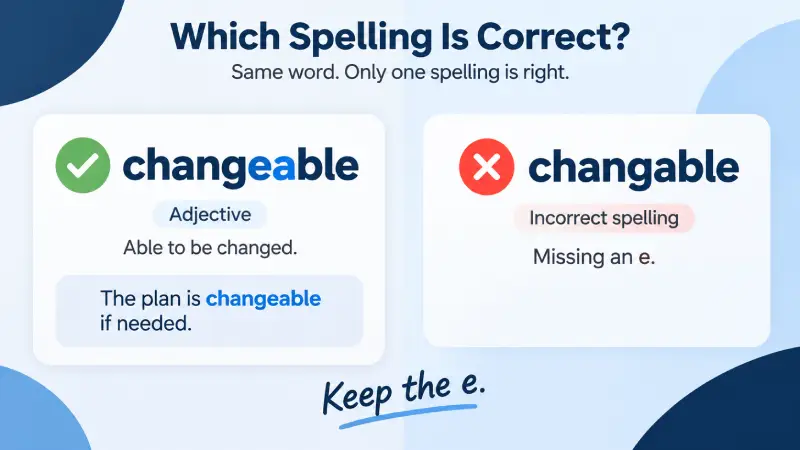
Changeable is the correct spelling. Changable is a common misspelling and is not the standard spelling in American English or British English.
The correct form is:
C-H-A-N-G-E-A-B-L-E → changeable
Not:
C-H-A-N-G-A-B-L-E → changable
If you are writing an essay, article, email, report, website content, or professional document, use changeable.
What Does “Changeable” Mean?
Changeable is an adjective that describes something that can change, is likely to change, or does not remain the same.
For example:
- The weather is very changeable this time of year.
- Her plans are changeable because her schedule is unpredictable.
- The company has a changeable pricing structure.
- His mood can be quite changeable.
- The situation remains changeable as negotiations continue.
The word comes from change + able.
The important spelling point is that the e in change remains when -able is added:
change + able = changeable
That is why changable is incorrect.
Why Is “Changable” Incorrect?
The mistake happens because writers may assume that the final e in change should disappear before adding -able.
That would give:
chang + able = changable
However, standard English spells the word:
change + able = changeable
The e remains.
Compare:
change → changeable
not:
change → changable
This is a spelling issue, not a difference in meaning or grammar. Changeable and changable do not represent two different forms that can be selected depending on context.
Changeable vs. Changable at a Glance
| Feature | Changeable | Changable |
|---|---|---|
| Standard spelling | Correct | Incorrect |
| Part of speech | Adjective | Misspelling |
| Meaning | Able or likely to change | No separate standard meaning |
| US English | Correct | Incorrect |
| UK English | Correct | Incorrect |
| Root word | Change | Incorrectly formed |
| Professional writing | Use it | Avoid it |
The key difference is the e before -able.
When Is “Changeable” Correct?
Use changeable when you want to describe something that can change or tends to change.
1. Changeable Weather
This is one of the most common uses of the word.
- The weather has been changeable all week.
- Pack a jacket because the mountain weather is changeable.
- Spring weather can be especially changeable.
- The forecast warns of changeable conditions throughout the afternoon.
- Coastal weather is often changeable.
Here, changeable means that weather conditions can shift from one state to another.
2. Changeable Plans
The word can describe plans that may be altered.
- Our travel plans are still changeable.
- The meeting time is changeable if everyone agrees.
- Because of the storm, tomorrow’s schedule is changeable.
- Her plans remain changeable until she confirms the reservation.
In these examples, the plans are not necessarily changing at that exact moment. They are simply open to change.
3. Changeable Moods
Changeable can describe a person’s emotions or mood when they shift frequently.
- The child has a changeable mood.
- His attitude toward the project has been changeable.
- Her changeable mood made the conversation difficult to predict.
- The character has a particularly changeable personality.
4. Changeable Conditions
The word frequently appears in professional, technical, and descriptive writing.
- The team had to work under changeable conditions.
- Changeable market conditions made long-term planning difficult.
- The region experiences changeable environmental conditions.
- Investors are watching the changeable economic situation closely.
Changeable Is an Adjective
Changeable is an adjective. It describes a noun.
For example:
changeable weather
- Here, changeable describes weather.
changeable plans
- Here, changeable describes plans.
changeable conditions
- Here, changeable describes conditions.
You can also use it after linking verbs:
The weather is changeable.
The situation remains changeable.
This makes changeable different from change, which can function as a verb or noun.
Change as a Verb
The weather may change tomorrow.
Change as a Noun
The company announced a change in its schedule.
Changeable as an Adjective
The weather is changeable.
These words belong to the same word family, but they perform different grammatical jobs.
Why Does the “E” Stay in Changeable?
The spelling becomes easier to understand when you look at the base word.
The base word is:
change
The suffix is:
-able
Together:
change + able = changeable
The important point is that the spelling of the base word is retained in changeable.
This gives you:
change
changeable
changeability
The spelling may look unusual because many English words lose a final e when a suffix is added. However, English spelling does not apply one simple rule to every suffix and every word. The established spelling of this word is changeable.
So it is better to remember the standard form rather than assume that the final e must disappear.
Common Mistakes With Changeable
Mistake 1: Dropping the E
The most common error is removing the e from change.
Wrong: The weather is very changable.
Right: The weather is very changeable.
Remember that the word contains change at its beginning.
Mistake 2: Writing “Changable” Because It Sounds Shorter
When spoken naturally, the middle of changeable may not make every letter obvious.
That can lead writers to hear something closer to:
changable
However, spelling should not be based entirely on pronunciation.
Wrong: The schedule is changable.
Right: The schedule is changeable.
Mistake 3: Removing the E Automatically
Writers who know that some English words drop a final e before a suffix may apply that pattern too broadly.
For example, they may think:
change + able → changable
But the standard spelling is:
change + able → changeable
When you are unsure, check whether the word still visibly contains change.
Mistake 4: Using the Misspelling in Professional Content
Wrong: Our prices are changable depending on demand.
Right: Our prices are changeable depending on demand.
The second version is the standard spelling and is appropriate for business writing.
How to Remember Changeable
The easiest memory trick is:
Keep CHANGE, then add ABLE.
Think:
CHANGE + ABLE
→ CHANGEABLE
Do not remove the e.
The “CHANGE” Test
Look at the beginning of the word:
CHANGEable
If you can see the complete word CHANGE inside changeable, the spelling is correct.
This gives you a simple visual check:
CHANGE + ABLE = CHANGEABLE
Not:
CHANG + ABLE = CHANGABLE
Changeable vs. Flexible
These words can sometimes appear in similar contexts, but they do not always mean exactly the same thing.
Changeable emphasizes that something can change or tends to change.
The weather is changeable.
Flexible often emphasizes the ability to adapt or adjust.
The schedule is flexible.
A schedule can be both changeable and flexible, but the words emphasize slightly different ideas.
Changeable focuses on change itself.
Flexible focuses on the ability to adjust.
Changeable vs. Variable
Variable is another related word.
The results are variable.
This means the results can differ or vary.
The weather is changeable.
This emphasizes that weather conditions can change.
In some contexts, the words overlap, but they should not automatically be treated as exact synonyms.
Changeable vs. Changing
These forms are also different.
Changeable
Means capable of changing or likely to change.
The schedule is changeable.
The schedule may be changed.
Changing
Means currently undergoing change or becoming different.
The schedule is changing.
The schedule is actually being modified.
Compare:
The weather is changeable.
This describes weather that can shift.
The weather is changing.
This tells us that a change is happening now.
Changeable vs. Changed
These forms have different meanings as well.
The policy is changeable.
The policy can still be changed.
The policy has changed.
The policy has already been modified.
This distinction is useful because adding -able creates an adjective describing possibility or capability, while changed describes a completed change.
Changeable in Real-World Context
Text Message
Alex: Are we still meeting at 6?
Sam: Maybe. The time is changeable because of the weather.
Here, changeable means the meeting time may be altered.
Professional Email
The delivery date is currently changeable because the supplier has not confirmed the shipment.
The adjective describes a date that may still change.
Article-Style Context
Spring weather can be highly changeable. A sunny morning may give way to clouds, rain, or cooler temperatures later in the day.
Here, changeable describes weather that can shift noticeably.
Changeable in Different Types of Writing
Everyday English
My plans are changeable this weekend.
School Writing
The region has a changeable climate.
Business Writing
Pricing may be changeable depending on market conditions.
Technical Writing
The system operates under changeable environmental conditions.
Travel Writing
Visitors should prepare for changeable weather during the spring months.
The spelling remains the same in every context.
Related Spelling Confusions
Changeable vs. Changable
This is the main spelling issue.
Changeable is correct because the standard word retains the e from change.
Changable is a misspelling.
Manageable vs. Manageble
This is a useful comparison because it shows that English suffix spelling cannot always be predicted simply by deleting or keeping letters.
The correct spelling is manageable, not manageble.
The workload is manageable.
Just as changeable retains the spelling needed to form the standard word, other -able words have established spellings that must be learned individually.
Noticeable vs. Noticeble
The correct form is noticeable.
There was a noticeable improvement.
The spelling keeps the e from notice before -able.
This provides another useful comparison with changeable.
Believable vs. Beliveable
The correct spelling is believable, not beliveable.
The base word is believe, and the standard derivative is believable.
This illustrates why checking the established spelling of a word family is more reliable than applying one automatic spelling rule to every word.
Is “Changable” Ever Correct?
No. Changable is not a standard alternative spelling of changeable.
You may encounter it in online searches, comments, informal writing, or user-generated content, but it remains a misspelling.
For edited American English, use changeable.
FAQs
Is it changeable or Changeable is correct. Changable is a misspelling.Why does changeable have an E??
The standard spelling retains the e from the base word change before -able. The result is changeable, not changable.
Spell it C-H-A-N-G-E-A-B-L-E.
A useful breakdown is:
CHANGE + ABLE = CHANGEABLE
Changeable means capable of changing, likely to change, or not fixed. For example, The weather is changeable means the weather can shift from one condition to another.
Yes. Changeable is an adjective that describes something capable of or likely to change.
Conclusion
The correct spelling is changeable, not changable.
The easiest way to remember it is to keep the complete base word change before adding -able:
CHANGE + ABLE = CHANGEABLE
The word means capable of changing, likely to change, or subject to change. It can describe weather, plans, schedules, moods, conditions, prices, policies, and many other things.
If you see changable, check the middle of the word. The e belongs there:
changeable ✅
changable ❌

Olivia Smith is a US English writer and language enthusiast who specializes in spelling, word choice, and commonly confused words. She creates clear, practical guides that help readers understand the correct spelling, meaning, and usage of English words.
At GrammarPool.com, Olivia focuses on spelling-choice topics, common spelling mistakes, and easy-to-understand explanations for everyday English users. Her writing is designed to make confusing word choices simple, accurate, and easy to remember.
Expertise: US English, spelling, word choice, commonly confused words, grammar, and language usage.