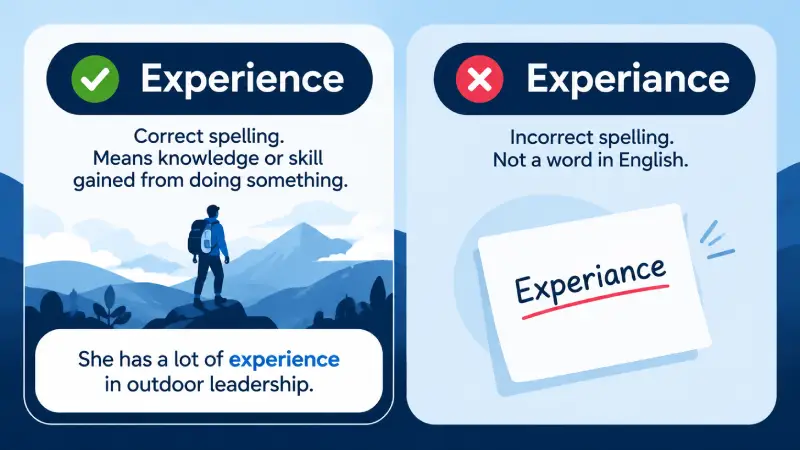
Experience is the correct spelling. Experiance is a common misspelling and is not the standard spelling in American English.
Quick answer:
✅ experience
❌ experiance
What Is the Correct Spelling: Experience or Experiance?
The standard spelling is experience:
e-x-p-e-r-i-e-n-c-e
The incorrect form experiance changes the e in the middle to a:
e-x-p-e-r-i-a-n-c-e
If you mean knowledge or skill gained through doing something, an event or situation that someone has lived through, or the act of encountering something, the correct word is experience.
❌ She has five years of experiance in marketing.
✅ She has five years of experience in marketing.
The same spelling applies whether experience is used as a noun or a verb.
She has valuable experience.
She experienced a difficult situation.
What Does Experience Mean?
Experience has several closely related meanings, which is why it is one of the most useful words in English.
As a noun, it can refer to:
- Knowledge or skill gained through practical involvement.
- Something that happens to or is lived through by someone.
- The overall knowledge gained from a series of events or activities.
As a verb, experience means to encounter, undergo, or live through something.
Experience as Knowledge or Skill
This is one of the most common uses, especially in employment and professional contexts.
She has extensive experience in web development.
He gained valuable experience while working at the company.
The position requires three years of experience.
Her previous experience helped her solve the problem quickly.
Here, experience refers to knowledge or ability developed through practical activity.
Experience as Something You Live Through
Experience can also mean an event or situation that someone encounters.
Traveling alone was a memorable experience.
The interview was a stressful experience.
Moving to a new city was an exciting experience.
That was one of the strangest experiences of my life.
In these examples, the word refers to something a person actually went through.
Experience as a Verb
As a verb, experience means to encounter or undergo something.
We experienced heavy traffic on the way home.
She experienced several problems with the software.
The region experienced unusually cold weather.
He experienced a major change in his career.
The spelling remains experience in the base form.
Why Is Experience Spelled With E?
The spelling experience can be difficult because the pronunciation does not make every vowel obvious.
The standard spelling is:
E-X-P-E-R-I-E-N-C-E
The middle sequence is:
-perience-
not:
-periance-
This is the key distinction between experience and the misspelling experiance.
A useful way to divide the word visually is:
EX + PERI + ENCE
The spelling contains -ience- toward the end:
experience
not:
experiance
The e after i is part of the standard spelling.
Experience vs. Experiance: Side-by-Side Comparison
| Feature | Experience | Experiance |
|---|---|---|
| Standard spelling | ✅ Yes | ❌ No |
| Part of speech | Noun and verb | Not a standard word |
| Meaning | Knowledge gained, an event lived through, or to undergo something | Intended as a misspelling of experience |
| Correct middle | -ience- | -iance- |
| Professional use | Very common | Incorrect |
| Example | She has work experience. | ❌ She has work experiance. |
The practical rule is simple:
experience = correct
experiance = misspelling
When Should You Use Experience?
Use experience when the context involves knowledge gained through practice, an event someone lived through, or something someone undergoes.
In Everyday Conversation
That was an amazing experience.
I have some experience with computers.
She had a strange experience at the airport.
You need more experience before doing that alone.
These uses are natural in ordinary American English.
In Professional Writing
Experience is particularly common in résumés, job applications, business documents, and workplace communication.
The candidate has five years of experience in customer service.
Previous management experience is preferred.
She brings extensive experience in digital marketing.
My professional experience includes project management and content development.
One important grammar point is that experience is generally uncountable when it means accumulated knowledge or skill.
For example:
She has ten years of experience.
rather than:
❌ She has ten years of experiences.
However, when referring to separate events, experiences can be correct:
Her travels gave her many unforgettable experiences.
Experience in School Writing
Students commonly use experience when describing education, activities, personal growth, or events.
My first day at college was an unforgettable experience.
Volunteering gave me valuable experience.
The project was a useful learning experience.
Students gain practical experience through internships.
The spelling does not change in formal school writing.
Experience in Text Messages
Informal communication still uses the same standard spelling.
That was such a weird experience 😂
Do you have any experience with this app?
I had a terrible experience at the restaurant.
This has been a great experience so far.
Even when punctuation and capitalization are relaxed, experience remains the correct spelling.
Common Mistakes With Experience
Mistake 1: Writing Experiance
This is the main spelling error.
❌ He has years of experiance.
✅ He has years of experience.
The important part to remember is:
experi-ence
not:
experi-ance
Mistake 2: Confusing Experience With Experiance Because of Pronunciation
The final part of experience may sound closer to “ens” than the spelling suggests, especially in natural speech.
Because English pronunciation does not always reveal every written vowel, writers may choose a instead of e in the middle.
However, pronunciation is not a reliable way to reconstruct this spelling.
When in doubt, remember:
experience = -ience
Mistake 3: Writing Experiences When You Mean Experience
This is a grammar issue rather than a spelling issue.
When experience means accumulated knowledge or skill, it is normally uncountable.
❌ She has many experiences in accounting.
✅ She has a lot of experience in accounting.
But when you mean separate events, the plural is correct:
Her travels gave her many memorable experiences.
The meaning determines whether the singular or plural form works.
Mistake 4: Confusing Experience With Expertise
These words are related but not identical.
Experience refers to knowledge or skill gained through practical involvement.
Expertise refers to specialized knowledge or skill.
She has ten years of experience in graphic design.
She has considerable expertise in user-interface design.
Someone can have substantial experience without necessarily being described as an expert.
How to Remember the Spelling of Experience
The easiest memory trick is to remember the ending:
Experience = IENCE
Focus on the last part:
exper-IENCE
The common misspelling changes this to:
exper-IANCE
So remember:
Experience has E before N.
Another useful connection is the related word:
experienced
an experienced teacher
The spelling family helps reinforce the correct form:
- experience
- experiences
- experienced
- experiencing
The root experienc- remains recognizable throughout these forms.
Experience vs. Experienced
These forms have different grammatical functions.
Experience can be a noun or verb:
She has valuable experience.
She will experience several changes.
Experienced is an adjective or a past-tense/past-participle form of the verb.
She is an experienced designer.
He experienced a major setback.
Notice that experienced is spelled with the same experienc- sequence.
Experience vs. Experiment
These words look somewhat similar but have different meanings.
Experience refers to something encountered, lived through, or knowledge gained through practice.
She has teaching experience.
An experiment is a controlled test conducted to investigate something.
The students conducted an experiment in the laboratory.
The words may both appear in academic writing, but they are not interchangeable.
Experience vs. Expertise
Experience is usually connected with practical involvement over time.
Expertise emphasizes a high level of specialized knowledge or skill.
His work experience helped him understand the industry.
His technical expertise made him valuable to the team.
The two can naturally appear together:
She has years of experience and considerable expertise in the field.
Experience vs. Exposure
Exposure can mean having contact with or an opportunity to encounter something.
Experience generally suggests actual involvement or knowledge gained through doing or encountering something.
The internship gave her exposure to professional marketing.
The internship gave her practical experience in marketing.
Exposure may be relatively limited, while experience often implies more direct participation.
Experience in Real-World Contexts
In a Job Application
I have more than five years of experience working with customers, managing projects, and creating digital content.
Here, experience means accumulated professional knowledge and skill.
In a Text Exchange
Mia: Have you ever worked with WordPress?
Leo: Yes, I have some experience with it.
Mia: Great. We need someone to update the site.
The phrase experience with is natural when describing familiarity gained through practical use.
In an Article
For many travelers, visiting a new country is more than a vacation. It can be an educational experience that introduces them to unfamiliar traditions, foods, and ways of life.
Here, experience means an event or period that someone lives through.
Useful Grammar Patterns With Experience
Several common structures are worth remembering.
Experience + With
Use experience with when referring to a tool, activity, system, or area.
She has experience with WordPress.
He has experience with customer-service software.
Experience + In
Use experience in when referring to a field, profession, or area of work.
She has experience in marketing.
He has extensive experience in construction.
Experience + As
Use experience as when identifying a role or position.
She has five years of experience as a teacher.
He has experience as a project manager.
Experience + Doing Something
You can also use experience + -ing to describe a particular activity.
She has experience working with children.
He has experience managing large teams.
These patterns are especially useful in professional writing.
Is Experiance Ever Correct?
For standard modern American English, experiance is not an accepted alternative spelling of experience.
If you mean knowledge gained through practice, an event someone lived through, or the act of encountering something, use:
experience
not:
experiance
The latter is simply a spelling error.
FAQ
Is experience or experiance correct?
Experience is correct. Experiance is a misspelling.
Why is experience spelled with an E instead of an A?
The standard spelling contains -ience-, giving experience. The pronunciation can make the vowel difficult to identify, which contributes to the common spelling error.
Is experience countable or uncountable?
It depends on the meaning. Experience is usually uncountable when referring to knowledge or skill, but experiences is countable when referring to separate events or things someone lived through.
What is the plural of experience?
The plural is experiences when you mean multiple individual events or situations.
She had several interesting experiences while traveling.
When referring to accumulated skill, use the uncountable form:
She has years of experience.
What is the correct spelling: experienced or experanced?
The correct form is experienced. It comes from experience and keeps the experienc- spelling.
Quick-Reference Takeaway
| Word | Status | Meaning |
|---|---|---|
| experience | ✅ Correct | Knowledge gained, an event lived through, or to undergo something |
| experiences | ✅ Correct | Plural for separate events or situations |
| experienced | ✅ Correct | Having practical knowledge or having undergone something |
| experiance | ❌ Incorrect | Common misspelling of experience |
Remember This
EXPERIENCE = EXPERI + ENCE
The correct spelling is:
E-X-P-E-R-I-E-N-C-E
Not:
E-X-P-E-R-I-A-N-C-E
If you mean knowledge gained through practice, an event you lived through, or something you undergo, the correct word is always experience in standard American English.

Olivia Smith is a US English writer and language enthusiast who specializes in spelling, word choice, and commonly confused words. She creates clear, practical guides that help readers understand the correct spelling, meaning, and usage of English words.
At GrammarPool.com, Olivia focuses on spelling-choice topics, common spelling mistakes, and easy-to-understand explanations for everyday English users. Her writing is designed to make confusing word choices simple, accurate, and easy to remember.
Expertise: US English, spelling, word choice, commonly confused words, grammar, and language usage.