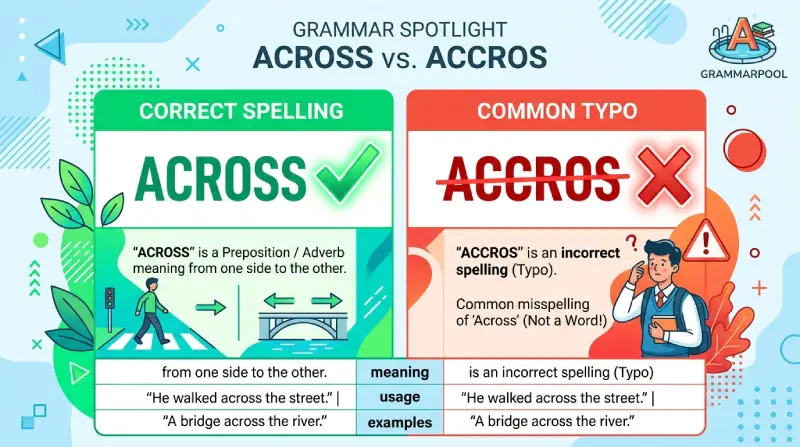
Across is the correct spelling. Accros is a common misspelling and is not a standard English word.
If you are wondering whether to write across or accros, always choose across. It is a common English word used to describe movement from one side to another, a position on the opposite side, or something extending from one side to another.
Quick Answer: Across or Accros?
The correct spelling is across.
- Across ✅ Correct
- Accros ❌ Incorrect
The main difference is the final s. Across is spelled:
A-C-R-O-S-S
The incorrect form accros has the letters in the wrong pattern and is missing the second s.
Correct: We walked across the street.
Incorrect: We walked accros the street.
What Does Across Mean?
Across is commonly used as a preposition or adverb. It can describe movement from one side of something to another, a location on the opposite side, or something extending from one side to another.
For example:
She walked across the bridge.
There is a store across the street.
The road runs across the valley.
The meaning depends on the sentence, but the central idea often involves two sides or a movement between them.
Why Is Accros Incorrect?
Accros is incorrect because it does not follow the standard spelling of across.
The correct word ends with -ross:
ac + ross = across
A common mistake is to leave out the second s, producing accros. However, standard English requires two s’s at the end.
Remember:
Across ends with SS.
How Do You Spell Across?
The correct spelling is:
A-C-R-O-S-S
That gives you:
across
A simple spelling trick is to remember the ending:
-ross
So:
ac + ross = across
The word has two s’s at the end.
Across ✅
Accros ❌
Across as a Preposition
As a preposition, across often describes movement or position in relation to something.
For example:
We walked across the road.
He ran across the field.
A bridge stretches across the river.
She looked across the room.
In these sentences, across connects an action or position with an area, object, or distance.
Across as an Adverb
Across can also function as an adverb.
For example:
The children ran across.
She moved across quickly.
The message came across clearly.
In these cases, across does not directly introduce a noun after it.
The word can also appear in common expressions such as:
Come across.
Get across.
Come across as friendly.
The exact meaning changes according to the phrase.
Across in Everyday English
Across is extremely common in everyday English.
You may use it when talking about places, movement, communication, distance, or comparison.
For example:
My office is across the street.
We drove across the country.
She walked across the room.
I came across an interesting article.
The news spread across the city.
Because across appears so frequently, learning its correct spelling is especially useful.
Common Phrases With Across
Across the street
This means on the opposite side of a street.
The pharmacy is across the street.
Across the country
This means throughout or from one side of a country to another.
The company has offices across the country.
Across the world
This means throughout the world.
People across the world use smartphones.
Across the room
This refers to the opposite side or movement through a room.
He saw his friend across the room.
Come across
Come across can mean to find something by chance or to give a particular impression.
I came across an old photograph.
She comes across as confident.
Across vs. Through
- Across and through can both describe movement, but they emphasize different ideas.
- Across usually describes movement from one side to another.
We walked across the field.
Through usually describes movement from one part of an enclosed or surrounding space to another.
We walked through the forest.
The distinction depends on the physical or figurative situation.
Across vs. Over
Across and over can sometimes describe similar movement, but they are not always interchangeable.
Use across when the focus is on moving from one side to another:
She walked across the bridge.
Use over when the focus is on crossing above something:
The plane flew over the city.
Choosing the right word depends on what the sentence emphasizes.
Across vs. Accros Examples
The following examples show the correct spelling in context.
Correct
We walked across the street.
The bridge extends across the river.
She ran across the field.
I found the information across several websites.
His voice carried across the room.
Incorrect
We walked accros the street.
The bridge extends accros the river.
She ran accros the field.
I found the information accros several websites.
His voice carried accros the room.
In every incorrect example, accros should be replaced with across.
Is Across a Correct Word?
Yes. Across is a standard English word and is used very frequently.
It can function as both a preposition and an adverb.
For example:
The restaurant is across the road.
She walked across.
By contrast, accros is not a standard English spelling.
How Do You Pronounce Across?
In American English, across is commonly pronounced:
uh-KROSS
The pronunciation contains an s sound at the end, but pronunciation alone may not make it obvious that the word is spelled with ss.
Remember the written form:
A-C-R-O-S-S
How to Remember the Spelling Across
A simple trick is to remember:
Across has two S’s at the end.
You can break the word into:
AC + ROSS = ACROSS
The ending -ross makes the spelling easier to remember.
Think:
Across = AC + ROSS
Not:
Accros
This small spelling pattern can help prevent the common mistake.
Across or Accros in American English
For standard American English, use across.
Accros is not an alternative American spelling. It is simply a misspelling.
Whether you are writing an email, school assignment, article, report, social media post, or professional document, the correct form is across.
The standard spelling is also used in other major varieties of English.
Why Do People Spell Across as Accros?
The error usually occurs because the letters r, o, and s appear together in the middle and end of the word.
Some writers accidentally rearrange the final letters and produce accros instead of across. Others may forget the second s.
The correct pattern is:
A-C-R-O-S-S
A useful way to remember it is to focus on CROSS:
A + CROSS = ACROSS
This is an especially effective memory trick because across can be visually remembered as A + CROSS.
Across vs. Accros: Quick Comparison
| Word | Correct? | Meaning |
|---|---|---|
| Across | ✅ Yes | From one side to another, on the opposite side, or extending from side to side |
| Accros | ❌ No | Common misspelling of across |
The key spelling reminder is simple:
Across = A + CROSS
FAQs
Is across or accros correct?
Across is correct. Accros is a misspelling and should not be used in standard English.
How do you spell across correctly?
The correct spelling is A-C-R-O-S-S: across. You can remember it as A + CROSS.
What does across mean?
Across can mean from one side to another, on the opposite side, or extending from one side to another.
Is accros a word?
No. Accros is not the standard spelling of the English word across.
Is across a preposition or an adverb?
Across can function as both a preposition and an adverb, depending on how it is used in a sentence.
What is an easy way to remember across?
Think of across as A + CROSS. The word contains cross, which helps you remember the correct order of the letters.
Conclusion
Across is the correct spelling, while accros is incorrect. Across is a common English word that can describe movement from one side to another, a position on the opposite side, or something extending from side to side.
The easiest spelling trick is:
A + CROSS = ACROSS
Whenever you are unsure whether to write across or accros, choose across.

Olivia Smith is a US English writer and language enthusiast who specializes in spelling, word choice, and commonly confused words. She creates clear, practical guides that help readers understand the correct spelling, meaning, and usage of English words.
At GrammarPool.com, Olivia focuses on spelling-choice topics, common spelling mistakes, and easy-to-understand explanations for everyday English users. Her writing is designed to make confusing word choices simple, accurate, and easy to remember.
Expertise: US English, spelling, word choice, commonly confused words, grammar, and language usage.