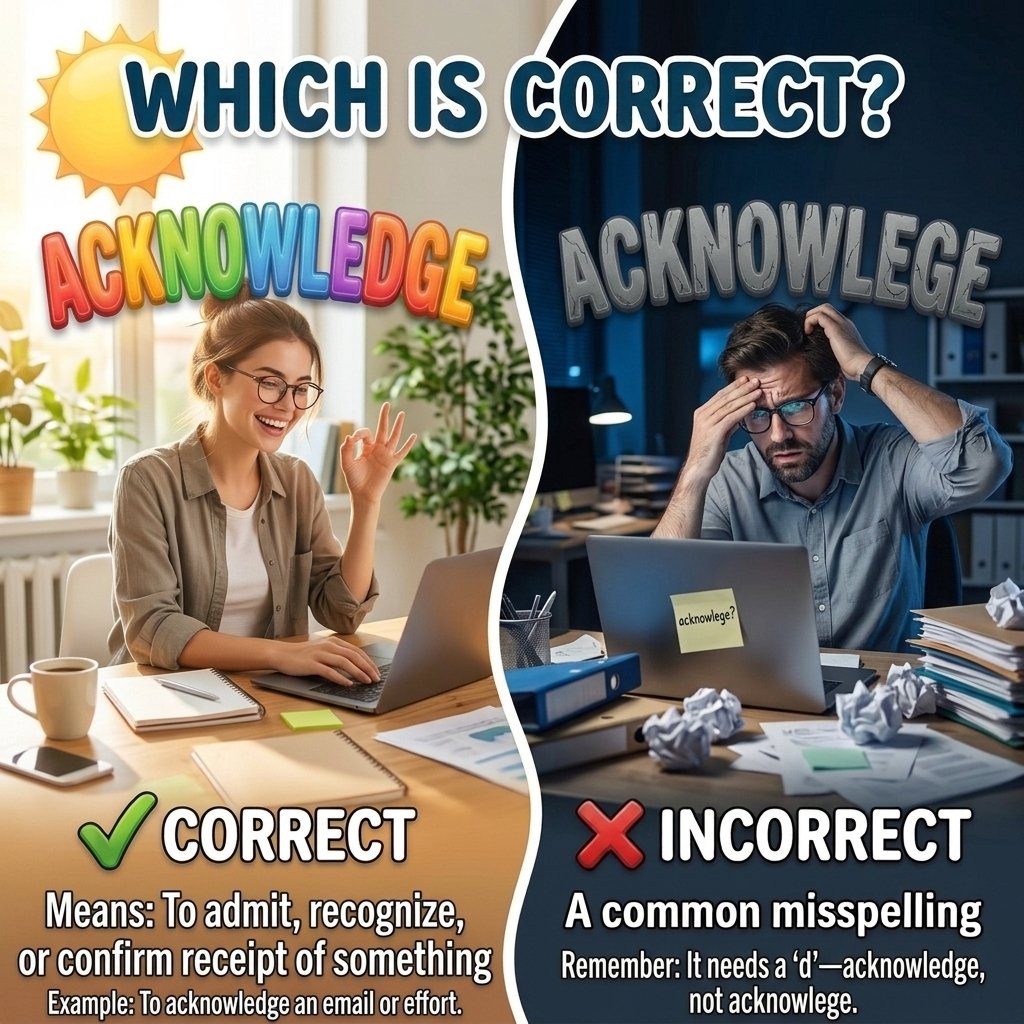
Acknowledge is the correct spelling in American English. Acknowlege is incorrect because it leaves out the letter d.
The word acknowledge is used when recognizing a fact, admitting a mistake, confirming receipt of a message, or giving credit to someone. Whether you are writing a business email, a school assignment, or a personal message, use acknowledge.
Quick Answer: Acknowledge or Acknowlege?
The correct spelling is acknowledge, not acknowlege.
- Correct: Please acknowledge receipt of the email.
- Incorrect: Please acknowlege receipt of the email.
The correct spelling contains ten letters: a-c-k-n-o-w-l-e-d-g-e. The incorrect version omits the d before the final g-e.
Both American and British English use acknowledge. There is no regional spelling difference between these two forms.
What Does Acknowledge Mean?
Acknowledge is a verb with several related uses:
- Recognize a fact: She acknowledged that the deadline had passed.
- Admit something: He acknowledged his mistake.
- Confirm receipt: Please acknowledge receipt of the document.
- Give credit: The manager acknowledged the team’s hard work.
The exact meaning depends on the context, but each use involves recognizing, admitting, or confirming something.
Why Do People Confuse Acknowledge and Acknowlege?
The two spellings look almost identical. When typing quickly, writers may accidentally omit the d from the ending -dge.
Pronunciation can also make the spelling less obvious. In American English, acknowledge is pronounced approximately “ak-NOL-ij.” The d is not strongly heard as a separate sound, but it remains necessary in the written word.
A helpful memory tip is to remember the ending -ledge, as in knowledge. Always check that acknowledge contains the d before the g.
Acknowledge vs. Acknowlege At A Glance
| Feature | Acknowledge | Acknowlege |
|---|---|---|
| Correct spelling | Yes | No |
| Standard English word | Yes | No |
| Part of speech | Verb | No standard grammatical role |
| Meaning | Recognize, admit, or confirm | No established standard meaning |
| American English | Correct | Incorrect |
| British English | Correct | Incorrect |
The difference is spelling accuracy, not meaning, formality, or regional preference.
Correct Forms of Acknowledge
The verb changes form depending on how it appears in a sentence.
| Word Form | Example |
|---|---|
| Acknowledge | Please acknowledge the request. |
| Acknowledges | She acknowledges the team’s effort. |
| Acknowledged | He acknowledged his mistake. |
| Acknowledging | We are acknowledging every submission. |
| Acknowledgment | She sent an acknowledgment of receipt. |
Acknowledgment is generally preferred in American English. Acknowledgement is also accepted and is common in British English. This variation applies to the noun, not to the misspelling acknowlege.
Common Spelling Mistakes and Quick Fixes
1. Leaving Out the D
Incorrect: I acknowlege your support.
Correct: I acknowledge your support.
Quick fix: Check that the word contains the complete ending -dge.
2. Misspelling the Past Tense
Incorrect: She acknowleged the problem.
Correct: She acknowledged the problem.
Quick fix: Keep the complete spelling when adding -ed: acknowledge becomes acknowledged.
3. Misspelling the -Ing Form
Incorrect: He is acknowleging the contribution.
Correct: He is acknowledging the contribution.
Quick fix: Remove the final e before adding -ing, but retain the d. The correct form is acknowledging.
4. Confusing the Verb With the Noun
Incorrect: Thank you for your acknowlegement.
Correct: Thank you for your acknowledgment.
Quick fix: Learn the forms separately. Use acknowledge as the verb and generally prefer acknowledgment as the noun in American English.
Examples of Acknowledge in Everyday American English
- Work: Please acknowledge receipt of the updated report.
- School: The teacher acknowledged the student’s improvement.
- Personal responsibility: I acknowledge that I made a mistake.
- Customer service: We will acknowledge your complaint within one business day.
- Teamwork: The supervisor acknowledged everyone’s contribution.
- Communication: She acknowledged my message but replied later.
- Professional writing: The author acknowledged the researchers who contributed to the study.
- Everyday conversation: He finally acknowledged that his friend was right.
Every example uses the correct spelling. Replacing acknowledge with acknowlege would introduce an error.
Synonyms for Acknowledge
The best synonym depends on what you want to express.
- Recognize: To identify or give credit to someone or something.
- Admit: To accept or confess that something is true.
- Confirm: To establish that information or receipt is correct.
- Accept: To recognize something as valid or true.
- Appreciate: To recognize the value or contribution of someone or something.
These words have related meanings, but they are not interchangeable in every sentence. Acknowlege is not a standard synonym because it is a misspelling.
FAQs
Is It Acknowledge or Acknowlege?
Acknowledge is correct. Acknowlege is incorrect because it omits the d before g. Use acknowledge in standard American and British English.
What Does Acknowledge Mean?
Acknowledge means to recognize, admit, or confirm something. For example, acknowledging an email can mean confirming that you received it.
How Do You Spell Acknowledge Correctly?
Spell it a-c-k-n-o-w-l-e-d-g-e. The word contains ten letters, including the d in the ending -dge.
Is Acknowlege Ever Correct in English?
No. Acknowlege is not an accepted standard spelling. Correct it to acknowledge in formal and informal writing.
What Is the Past Tense of Acknowledge?
The past tense is acknowledged. For example: “The manager acknowledged the team’s efforts.”
Is It Acknowledgment or Acknowledgement?
Both spellings are accepted. Acknowledgment is generally preferred in American English, while acknowledgement is common in British English. The verb remains acknowledge in both varieties.
Conclusion
When comparing acknowledge vs. acknowlege, always choose acknowledge. The incorrect form omits the d from the standard spelling.
Remember the ending -ledge to help spell the word correctly in emails, reports, assignments, and everyday communication.