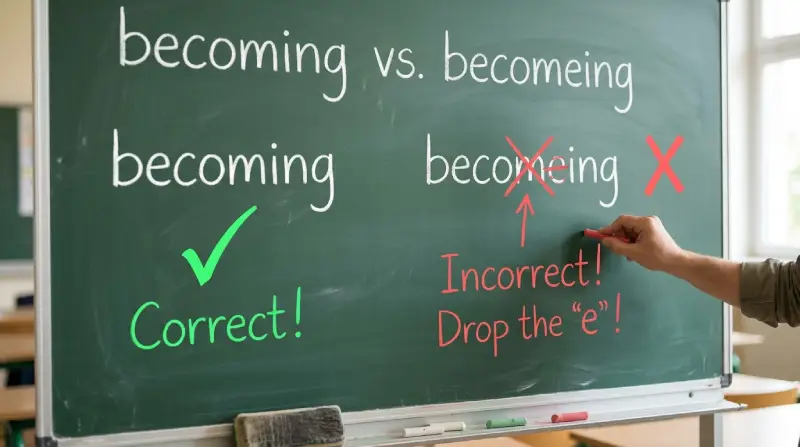
Becoming vs. becomeing is a common English spelling confusion. Both forms look similar, but only one is correct in standard English. The confusion often happens when writers add -ing to the verb become without applying the correct spelling rule.
The correct spelling is becoming. The spelling becomeing is incorrect because the final silent e in become must be dropped before adding -ing.
This guide explains the difference between becoming and becomeing, shows how the spelling rule works, and provides useful examples to help you use the word correctly.
Quick Answer
Becoming is the correct spelling. Becomeing is a misspelling and should not be used in standard English writing.
- Correct: She is becoming more confident.
- Incorrect: She is becomeing more confident.
Remember this rule: When a verb ends in a silent e, usually drop that e before adding -ing.
Become + ing = becoming
What Does Becoming Mean?
Becoming is the -ing form of the verb become. It can describe a change in progress, a developing situation, or something that is starting to be true.
It can also function as an adjective meaning attractive, suitable, or flattering, although this use is less common in everyday American English.
Becoming as an Action in Progress
When used in a continuous verb tense, becoming describes a change that is happening over time.
Examples:
- She is becoming a skilled writer.
- The weather is becoming colder.
- He is becoming more confident at work.
- The city is becoming increasingly popular with tourists.
- They are becoming close friends.
In each sentence, becoming describes a gradual or developing change.
Becoming to Describe a Developing Situation
The word can also describe a trend or a change in circumstances.
Examples:
- Online learning is becoming more common.
- The road is becoming difficult to travel on.
- The project is becoming more complicated.
- Healthy eating is becoming a priority for many families.
These sentences show how becoming connects a current situation with a developing condition.
Becoming as an Adjective
In a more formal or traditional use, becoming means attractive, appropriate, or flattering.
Examples:
- She wore a becoming blue dress.
- The jacket was a becoming choice for the occasion.
- His calm manner was becoming of a responsible leader.
In modern American English, words such as flattering, suitable, and appropriate are often more natural alternatives, depending on the context.
Why Do People Confuse Becoming and Becomeing?
People confuse these spellings because they may assume that adding -ing simply means attaching the suffix to the entire base word.
However, English spelling follows a common rule for verbs that end in a silent e. In most cases, the final e disappears before -ing is added.
The verb become follows this pattern:
- Base verb: become
- Remove the final e: becom
- Add -ing: becoming
The result is becoming, not becomeing.
The Letter That Makes the Difference
| Spelling | Status | Explanation |
|---|---|---|
| Becoming | Correct | Drops the final e before adding -ing |
| Becomeing | Incorrect | Keeps the final e unnecessarily |
Spelling rule: For verbs such as make, write, and come, the final silent e is generally dropped before adding -ing.
Examples include:
- Make → making
- Write → writing
- Come → coming
- Become → becoming
Becoming vs. Becomeing: Key Differences
| Feature | Becoming | Becomeing |
|---|---|---|
| Correct spelling | Yes | No |
| Base verb | Become | Intended to be become |
| Grammar | Standard -ing form | Incorrect spelling |
| Meaning | Changing into or developing into something | No standard meaning |
| Example | He is becoming more patient. | He is becomeing more patient. |
The difference is spelling, not meaning. Becoming is the standard form used in modern English.
How to Use Becoming in a Sentence
Use becoming when describing a change in progress or, less commonly, when describing something flattering or appropriate.
Examples About Personal Growth
She is becoming more independent.
He is becoming a better public speaker.
I am becoming more comfortable with English grammar.
They are becoming more responsible.
The young athlete is becoming a strong competitor.
Examples About Changes and Trends
Technology is becoming more advanced every year.
The neighborhood is becoming more crowded.
The task is becoming easier with practice.
Online shopping is becoming increasingly popular.
The situation is becoming more serious.
Examples Using Becoming as an Adjective
The dress was becoming on her.
She chose a becoming color for the event.
The outfit was both simple and becoming.
These examples demonstrate the different ways the correct word can appear in sentences.
What Is the Difference Between Become and Becoming?
Become is the base form of the verb, while becoming is its -ing form. The correct choice depends on the sentence structure.
| Word | Use | Example |
|---|---|---|
| Become | Base verb, often used after to, will, or modal verbs | I want to become a teacher. |
| Becomes | Present tense with he, she, or it | She becomes nervous before exams. |
| Became | Simple past tense | He became a manager last year. |
| Becoming | -ing form | She is becoming more confident. |
| Become | Past participle | They have become good friends. |
Notice that become has the same spelling as its past participle. For example, “They have become good friends” is correct.
How to Add -Ing to Verbs Ending in E
The word becoming illustrates a common spelling rule, but it helps to understand how the rule applies to other verbs.
Drop the Final E Before Adding -Ing
Most verbs ending in a silent e drop that letter before adding -ing.
Examples:
- Take → taking
- Give → giving
- Dance → dancing
- Hope → hoping
- Become → becoming
This rule prevents an unnecessary e from appearing in the middle of the resulting word.
Remember That English Has Exceptions
Not every verb ending in e follows the same pattern. For example, see becomes seeing, and agree becomes agreeing. These words keep both vowels because removing the final e would change the established spelling pattern.
Therefore, learn common forms as well as the general rule. For become, the standard form is always becoming.
Common Spelling Mistakes to Avoid
Even familiar verbs can be misspelled when a suffix changes their form. Use these tips to remember becoming.
1. Do Not Keep the Final E
The incorrect form becomeing keeps a letter that should be removed.
- Correct: becoming
- Incorrect: becomeing
2. Learn the Base Verb and Its Forms
Practice these related forms together:
- Become
- Becomes
- Became
- Becoming
This helps you recognize which form belongs in each sentence.
3. Practice With Complete Sentences
Writing the word in context reinforces the correct spelling.
- She is becoming more confident.
- He wants to become a doctor.
- The weather is becoming warmer.
4. Proofread Before Publishing
A spellchecker can often identify becomeing, but always review your writing. Correct spelling is important in essays, emails, professional documents, and website content.
FAQs
Is Becoming or Becomeing Correct?
Becoming is correct. Becomeing is a misspelling because the final e in become is dropped before adding -ing.
How Do You Spell Becoming Correctly?
The correct spelling is b-e-c-o-m-i-n-g. Start with become, remove the final e, and add -ing.
Why Is the E Dropped in Becoming?
The final e is dropped because English generally removes a silent e before adding -ing to verbs such as make, write, and become.
What Does Becoming Mean?
Becoming can mean changing into something or gradually developing a particular quality. For example, “She is becoming more confident.”
What Is the Difference Between Become and Becoming?
Become is the base verb, while becoming is its -ing form. For example, “I want to become a teacher” and “I am becoming a better writer.”
Is Becomeing Ever Correct?
No. Becomeing is not the standard spelling of the -ing form of become. Use becoming instead.
Conclusion
The correct spelling is becoming, while becomeing is incorrect. When you add -ing to become, drop the final silent e first.
Remember the simple pattern become → becoming. Applying this rule will help you avoid the same spelling mistake with many other English verbs.