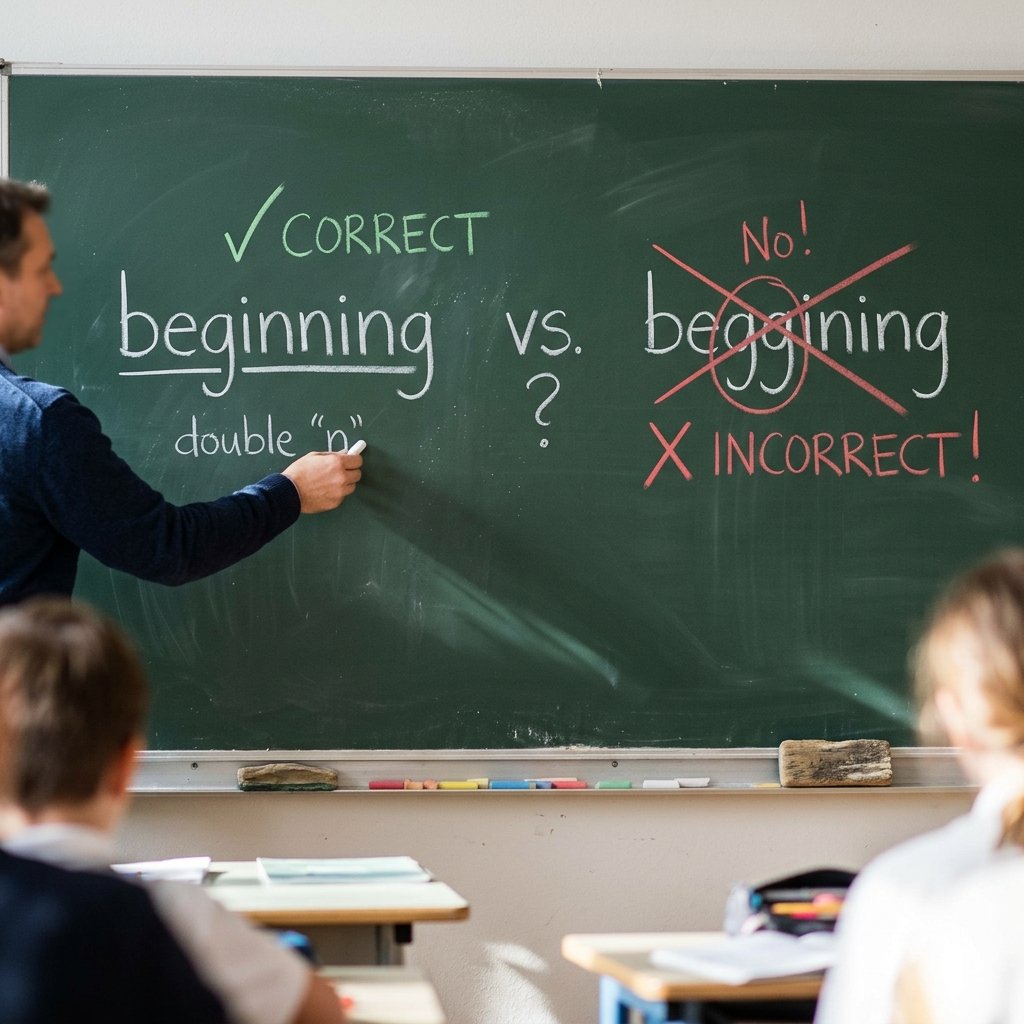
The difference between beginning vs. beggining is simple: beginning is the correct spelling, while beggining is a common misspelling. If you are writing an essay, an email, a school assignment, or a professional document, always use beginning.
The confusion occurs because the word beginning contains a double n, which can make some writers think it needs a double g as well. However, English spelling rules do not support that change. Once you understand how the word is formed, remembering the correct spelling becomes much easier.
In this guide, you will learn why beginning is correct, how to use it in sentences, which spelling mistakes to avoid, and how to remember the word.
Quick Answer:
Beginning is the correct spelling in American English and British English. Beggining is incorrect and should not be used in standard writing.
- Correct: The beginning of the movie was exciting.
- Incorrect: The beggining of the movie was exciting.
Use beginning when referring to the start of something, such as a story, journey, lesson, project, or period.
What Does Beginning Mean?
The word beginning is a noun or a verb form that refers to starting something or the point at which something starts. It comes from the verb begin.
As a noun, beginning identifies the starting point of an event, activity, process, or period. As a verb form, it appears in progressive constructions with a form of the verb be.
For example:
- The beginning of the book introduces the main character.
- We are beginning our English lesson now.
- Every new beginning offers an opportunity to learn.
- She was beginning to understand the instructions.
In each example, beginning is spelled with one g followed by a double n.
What Does Beggining Mean?
Beggining is a misspelling of beginning. It is not an accepted standard spelling in American or British English.
Writers often make this mistake because they remember that some English words double their final consonant when adding a suffix. However, the spelling of beginning follows a specific pattern: the verb begin becomes beginning by doubling the final n, not the letter g.
Examples of incorrect usage include:
- Incorrect: The beggining of the school year is approaching.
- Incorrect: We are beggining a new project.
- Incorrect: This is the beggining of a great adventure.
Correct these sentences by replacing beggining with beginning.
Why Is Beginning the Correct Spelling?
The correct spelling comes from the base verb begin. When you add the suffix -ing, you double the final consonant because begin has a short vowel sound in its final stressed syllable.
The spelling changes as follows:
Begin + ing = Beginning
Notice what happens:
- The original word is begin.
- The suffix -ing is added.
- The final consonant, n, is doubled.
- The result is beginning.
The letter g is not doubled. Therefore, beggining is incorrect.
This pattern also appears in other English words, including running, swimming, and planning. In these examples, the final consonant is doubled when the suffix -ing is added.
Beginning vs. Beggining: Key Differences
| Feature | Beginning | Beggining |
|---|---|---|
| Spelling status | Correct | Incorrect |
| Standard English usage | Accepted | Not accepted |
| Number of g’s | One | Two |
| Number of n’s | Two | Two |
| Meaning | The start of something | No standard meaning |
| Suitable for formal writing | Yes | No |
The key difference is the letter g. Remember to write one g and two n’s in beginning.
Examples of Beginning in Sentences
Reading examples can help you recognize the correct spelling and understand how to use the word naturally.
- The beginning of the story immediately captured my attention.
- We are beginning our training session at nine o’clock.
- At the beginning of the year, she created a list of goals.
- The teacher explained the topic at the beginning of class.
- Every beginning comes with new challenges.
- He was beginning to feel more confident about his presentation.
- The beginning of their friendship was unexpected.
- Please read the instructions before beginning the assignment.
- The first chapter marks the beginning of the adventure.
- Learning a new language can feel difficult at the beginning.
Each sentence uses beginning correctly to describe a starting point or an action in progress.
Common Mistakes to Avoid
Even familiar words can cause spelling problems. Here are some mistakes to watch for when writing beginning.
1. Doubling the Wrong Consonant
Incorrect: The beggining was difficult.
Correct: The beginning was difficult.
The final consonant of begin is n, so that is the letter you double.
2. Using the Misspelling in Formal Writing
Incorrect: We are beggining the meeting now.
Correct: We are beginning the meeting now.
Always check the spelling before submitting an assignment, sending a professional email, or publishing an article.
3. Forgetting the Double N
Incorrect: The begining of the film was slow.
Correct: The beginning of the film was slow.
The correct word contains two n’s. Remembering both the single g and double n helps prevent common spelling errors.
4. Confusing the Noun and Verb Forms
The word beginning can describe the start of something or an action that is happening.
- Noun: The beginning of the concert was memorable.
- Verb form: The band is beginning its performance.
Although the grammatical roles differ, the spelling remains the same.
How to Remember the Correct Spelling of Beginning
Use these simple techniques to avoid writing beggining.
- Remember the base word: Start with begin, then add -ing.
- Double the N: The correct spelling is beginning, not beggining.
- Say it in parts: Think of the word as be-gin-ning to help remember its spelling.
- Practice with examples: Write sentences using beginning until the spelling becomes familiar.
- Use a spell-checker: A spelling tool can identify beggining as an error and suggest the correct form.
A useful memory trick is to remember that begin already has one g and one n. When you add -ing, double the final n, not the g.
Beginning vs. Beggining in American and British English
There is no regional spelling difference between these two forms. Both American and British English use beginning as the standard spelling.
For example:
- American English: The beginning of the semester is next week.
- British English: The beginning of the term is next week.
The vocabulary may vary slightly, such as semester and term, but the spelling of beginning remains unchanged.
Therefore, whether you are writing for a US audience or a UK audience, use beginning.
Related Words: Begin, Begins, Began, and Beginning
Understanding related forms of begin can also improve your spelling.
| Word | Usage | Example |
|---|---|---|
| Begin | Base verb | We begin work at eight. |
| Begins | Present-tense verb | The show begins tonight. |
| Began | Past-tense verb | The meeting began late. |
| Beginning | Noun or present participle | The beginning was exciting. |
Notice that beginning is the only form in this table that doubles the final n. The base verb begin does not change its spelling in the same way when forming began or begins.
Frequently Asked Questions
1. Is Beginning or Beggining Correct?
Beginning is correct. Beggining is a misspelling and should be avoided in standard English writing.
2. Why Is Beginning Spelled With Two N’s?
The word begin ends in a consonant preceded by a short vowel in its stressed final syllable. When the suffix -ing is added, the final n is doubled, producing beginning.
3. Is Beggining a Real Word?
No. Beggining is not a standard English word. It is a common spelling mistake for beginning.
4. How Do You Spell Beginning Correctly?
Spell it b-e-g-i-n-n-i-n-g. The word contains one g and two consecutive n’s.
5. Is Beginning Spelled the Same in American and British English?
Yes. Both American and British English use beginning. There is no regional spelling variation between the two forms.
6. What Is the Easiest Way to Remember Beginning?
Remember the base word begin and add -ing by doubling the final n. This produces beginning, not beggining.
Conclusion
When comparing beginning vs. beggining, only one spelling is correct: beginning. It refers to the start of an event, activity, process, or period, and it can also function as the present participle of begin.
The spelling rule is straightforward: add -ing to begin and double the final n. Do not double the g. Whether you are writing a school assignment, a business email, or an online article, using beginning will keep your writing accurate and professional.
Remember this simple rule, and you will be less likely to make the same spelling mistake again.