Have you ever wondered whether to write deceive or decieve? These two spellings look almost identical, so it is easy to mix them up. However, only one is correct in standard American English.
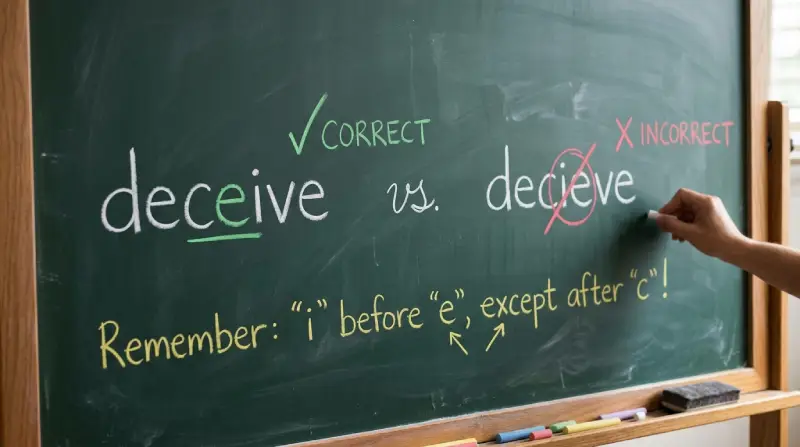
The correct spelling is deceive. The word decieve is a common spelling mistake and should not appear in formal writing, school assignments, emails, or professional documents. Fortunately, a simple spelling rule can help you remember the correct form.
Quick Answer: Deceive or Decieve?
Deceive is the correct spelling. It means to make someone believe something that is not true, often by lying, hiding information, or misleading them.
Decieve is incorrect because it places the i before the e in a word that follows the familiar “i before e, except after c” spelling pattern.
- Correct: She did not want to deceive her friends.
- Incorrect: She did not want to decieve her friends.
Remember to write deceive, with e before i after the letter c.
What Does Deceive Mean?
The verb deceive means to mislead someone, make someone believe something false, or cause someone to misunderstand the truth. Deception can involve direct lies, misleading statements, or hiding important facts.
People may use this word when discussing dishonesty, trust, relationships, business practices, or misleading information.
Examples:
- He tried to deceive his parents about where he had been.
- The advertisement was designed to deceive customers.
- You should never deceive someone who trusts you.
- The magician used clever tricks to deceive the audience.
In each sentence, deceive describes an action that causes someone to believe something that is not true.
Why Is Decieve Incorrect?
The spelling decieve is incorrect because it does not follow the standard spelling of the English word. The correct form is deceive, with the letters e and i in that order after c.
This mistake often happens because English contains many words with similar vowel combinations. Writers may remember the sound of a word but confuse the order of its letters.
To avoid this error, remember the correct spelling whenever you write about misleading someone or telling a lie.
Deceive vs. Decieve: Key Differences
| Feature | Deceive | Decieve |
|---|---|---|
| Spelling status | Correct | Incorrect |
| Part of speech | Verb | Not a standard English word |
| Meaning | To mislead or trick someone | No standard definition |
| Example | He tried to deceive me. | Incorrect spelling |
| Suitable for formal writing | Yes | No |
The main difference is simple: deceive is the accepted spelling, while decieve is a misspelling.
How to Remember the Correct Spelling of Deceive
Use these simple techniques to remember deceive and avoid writing decieve.
1. Remember “I Before E, Except After C”
A familiar English spelling guideline says “i before e, except after c.” The word deceive follows the second part of this pattern because the e comes before the i after c.
Other examples include:
- Receive
- Conceive
- Perceive
- Receipt
Although this guideline has exceptions in English, it works for these words.
2. Connect Deceive With Receive
Both deceive and receive contain the letter sequence cei.
Remembering these words together can help you recall the correct spelling when you are writing quickly.
3. Practice Writing the Word
Write deceive several times and use it in a sentence. Repeated practice can help you recognize the correct letter order automatically.
For example: “I would never deceive someone who trusts me.”
Common Words Related to Deceive
Learning related words can strengthen your vocabulary and help you use deceive correctly.
| Word | Meaning | Example |
|---|---|---|
| Deception | The act of misleading someone | The deception damaged their friendship. |
| Deceptive | Likely to mislead | The offer sounded deceptive. |
| Deceiver | A person who misleads others | He was known as a deceiver. |
| Deceived | Misled someone in the past | She felt deceived by the promise. |
| Deceiving | Misleading someone | He was deceiving his customers. |
Notice that these words share the same spelling pattern as deceive. Learning them together makes the correct spelling easier to remember.
Examples of Deceive in Sentences
Here are additional examples showing how to use deceive in everyday English.
- Never deceive people who place their trust in you.
- The company attempted to deceive customers with false claims.
- He thought he could deceive everyone, but the truth eventually emerged.
- Appearances can sometimes deceive even experienced observers.
- She refused to deceive her teacher about the missing assignment.
- The fake website was created to deceive unsuspecting visitors.
- It is wrong to deceive someone for personal gain.
- The evidence showed that the seller had tried to deceive the buyer.
- He apologized because he did not want to deceive his family again.
- A confident appearance can deceive people about someone’s true intentions.
These examples demonstrate that deceive can describe dishonesty in personal, professional, and everyday situations.
Synonyms for Deceive
Several English words have meanings similar to deceive. However, their precise meanings can vary depending on context.
- Mislead: To cause someone to believe something incorrect.
- Trick: To fool someone, often through a clever action.
- Fool: To make someone believe something untrue.
- Dupe: To trick someone into believing or doing something.
- Beguile: To charm or influence someone, sometimes deceptively.
- Delude: To cause someone to hold a false belief.
For example, “The seller tried to mislead the buyer” expresses a meaning similar to “The seller tried to deceive the buyer.”
Frequently Asked Questions
1. Is Deceive or Decieve Correct?
Deceive is correct. Decieve is a common misspelling and is not accepted as the standard spelling of this English word.
2. What Does Deceive Mean?
To deceive means to mislead someone or make them believe something that is not true. It often involves lying, hiding facts, or creating a false impression.
3. Why Do People Spell Deceive Incorrectly?
People often write decieve because they confuse the order of the letters e and i. Remembering the spelling of receive can help prevent this mistake.
4. How Do You Spell Deceive in American English?
The correct American English spelling is deceive. The spelling is also the standard form in British English.
5. What Is the Past Tense of Deceive?
The past tense is deceived. For example, “He deceived his friends by hiding the truth.”
6. What Is the Difference Between Deceive and Deception?
Deceive is a verb that describes the act of misleading someone. Deception is a noun that describes the act or practice of misleading someone.
Conclusion
When choosing between deceive vs. decieve, always use deceive. It is the correct spelling in American and British English, while decieve is a common spelling error.
To remember the correct form, think of words such as receive, conceive, and perceive. They share the same cei letter sequence. With this simple spelling tip and regular practice, you can avoid this mistake and write with greater confidence.

Olivia Smith is a US English writer and language enthusiast who specializes in spelling, word choice, and commonly confused words. She creates clear, practical guides that help readers understand the correct spelling, meaning, and usage of English words.
At GrammarPool.com, Olivia focuses on spelling-choice topics, common spelling mistakes, and easy-to-understand explanations for everyday English users. Her writing is designed to make confusing word choices simple, accurate, and easy to remember.
Expertise: US English, spelling, word choice, commonly confused words, grammar, and language usage.