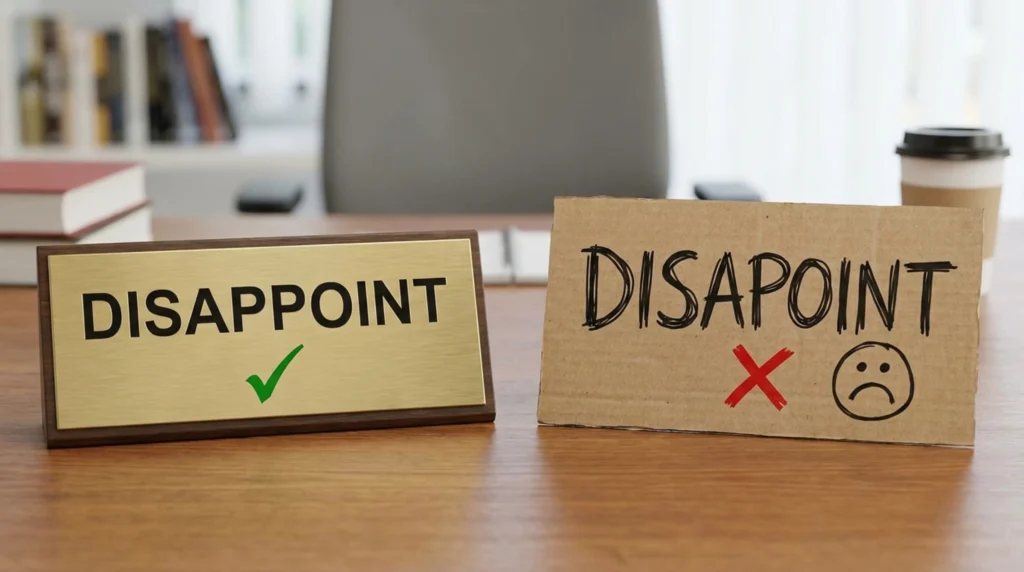
Disappoint is the correct spelling in American English. Disapoint is a misspelling because the word requires two p’s. Use disappoint when you mean to let someone down, fail to meet expectations, or cause someone to feel unhappy.
For example: “I don’t want to disappoint my parents.”
The easiest way to remember the correct spelling is that disappoint contains double p: dis + appoint. If you are writing an email, school assignment, blog post, or everyday message, always use disappoint, not disapoint.
Disappoint vs. Disapoint: Quick Answer
| Word | Correct or Incorrect? | Meaning |
|---|---|---|
| Disappoint | Correct | To let someone down or fail to meet expectations |
| Disapoint | Incorrect | A misspelling of disappoint |
Remember: Disappoint has two p’s, while disapoint has only one.
What Does Disappoint Mean?
Disappoint is a verb that means to make someone feel sad, unhappy, or dissatisfied because something did not happen as expected or did not meet their hopes, wishes, or expectations. It can also mean to prevent a plan or hope from becoming reality.
definition in the Cambridge English Dictionary
+1
Examples:
- “I never want to disappoint my family.” This means the speaker wants to meet their family’s expectations.
- “The movie did not disappoint.” This means the movie was as good as expected or better.
- “The canceled trip will disappoint the children.” This means the children will feel sad because the trip will not happen.
- “We worked hard, but the results disappointed us.” This means the results did not meet expectations.
Why Is Disappoint the Correct Spelling?
The correct spelling is disappoint, with two p’s. The spelling disapoint leaves out one of those letters, making it incorrect in standard English.
A useful way to remember the spelling is to recognize the word appoint inside disappoint.
- Appoint = to assign someone to a position or responsibility.
- Disappoint = to fail to meet someone’s hopes or expectations.
Although the meanings differ, remembering that appoint contains two p’s can help you spell disappoint correctly.
Disappoint vs. Disapoint Examples in Sentences
The following examples show how to use the correct spelling in everyday writing.
| Incorrect Sentence | Correct Sentence |
|---|---|
| I don’t want to disapoint you. | I don’t want to disappoint you. |
| She did not want to disapoint her parents. | She did not want to disappoint her parents. |
| The performance may disapoint the audience. | The performance may disappoint the audience. |
| I was afraid I would disapoint my teacher. | I was afraid I would disappoint my teacher. |
| The team did not disapoint its fans. | The team did not disappoint its fans. |
In every example, use disappoint because it is the standard English spelling.
Different Forms of Disappoint
The word disappoint has several related forms. Each one has a specific grammatical function.
| Word | Part of Speech | Meaning |
|---|---|---|
| Disappoint | Verb | To fail to meet expectations |
| Disappoints | Verb | The present-tense form used with he, she, or it |
| Disappointed | Verb or adjective | Failed to meet expectations, or feeling let down |
| Disappointing | Verb or adjective | Causing dissatisfaction or sadness |
| Disappointment | Noun | The feeling or experience of being let down |
| Disappointingly | Adverb | In a way that fails to meet expectations |
Examples:
- Disappoint: I hope I do not disappoint you.
- Disappoints: The team’s performance often disappoints its supporters.
- Disappointed: She felt disappointed by the result.
- Disappointing: The final score was disappointing.
- Disappointment: Missing the opportunity was a major disappointment.
- Disappointingly: The event was disappointingly short.
Notice that these related words retain the same spelling pattern with double p.
Synonyms and Related Words for Disappoint
Several words express similar ideas, but their meanings can differ slightly depending on the situation.
- Let down: To fail someone who trusts or depends on you.
- Displease: To make someone unhappy or dissatisfied.
- Upset: To cause emotional distress or unhappiness.
- Dissatisfy: To fail to meet someone’s needs or expectations.
- Frustrate: To prevent someone from achieving a goal.
- Dishearten: To reduce someone’s confidence, hope, or enthusiasm.
- Dismay: To cause worry, sadness, or disappointment.
- Fail: To be unsuccessful in meeting a goal or requirement.
These words can sometimes replace disappoint, but they are not always interchangeable. For example, frustrate emphasizes an obstacle, while disappoint emphasizes unmet expectations.
Merriam-Webster Thesaurus
+1
Common Spelling Mistakes Related to Disappoint
People sometimes misspell disappoint by leaving out a letter or confusing it with a related word.
| Incorrect Spelling | Correct Spelling |
|---|---|
| Disapoint | Disappoint |
| Disapointed | Disappointed |
| Disapointing | Disappointing |
| Disapointment | Disappointment |
To avoid these mistakes, remember that the correct forms all retain double p.
Frequently Asked Questions
Is Disappoint or Disapoint Correct?
Disappoint is correct. Disapoint is a misspelling because it contains only one p instead of two.
Why Does Disappoint Have Two P’s?
Disappoint retains the double p found in appoint. Remembering the spelling of appoint makes it easier to spell disappoint correctly.
What Does Disappoint Mean?
Disappoint means to fail to meet someone’s expectations or to make someone feel unhappy because something did not happen as hoped.
How Do You Use Disappoint in a Sentence?
You can write, “I don’t want to disappoint my friends.” Here, disappoint means to let your friends down or fail to meet their expectations.
What Is the Difference Between Disappoint and Disappointed?
Disappoint is the base verb, while disappointed is its past-tense and past-participle form. Disappointed can also describe a person’s feelings, as in “I feel disappointed.”
What Are the Correct Spellings of Disappointing and Disappointment?
The correct spellings are disappointing and disappointment. Both words contain double p, just like disappoint.
Conclusion
Disappoint is the correct spelling, while disapoint is incorrect in standard English. The word means to let someone down, fail to meet expectations, or cause unhappiness.
Whenever you write this word or one of its related forms, remember the double p in disappoint, disappointed, disappointing, and disappointment. This simple spelling rule will help you write with greater accuracy, clarity, and confidence.

Olivia Smith is a US English writer and language enthusiast who specializes in spelling, word choice, and commonly confused words. She creates clear, practical guides that help readers understand the correct spelling, meaning, and usage of English words.
At GrammarPool.com, Olivia focuses on spelling-choice topics, common spelling mistakes, and easy-to-understand explanations for everyday English users. Her writing is designed to make confusing word choices simple, accurate, and easy to remember.
Expertise: US English, spelling, word choice, commonly confused words, grammar, and language usage.