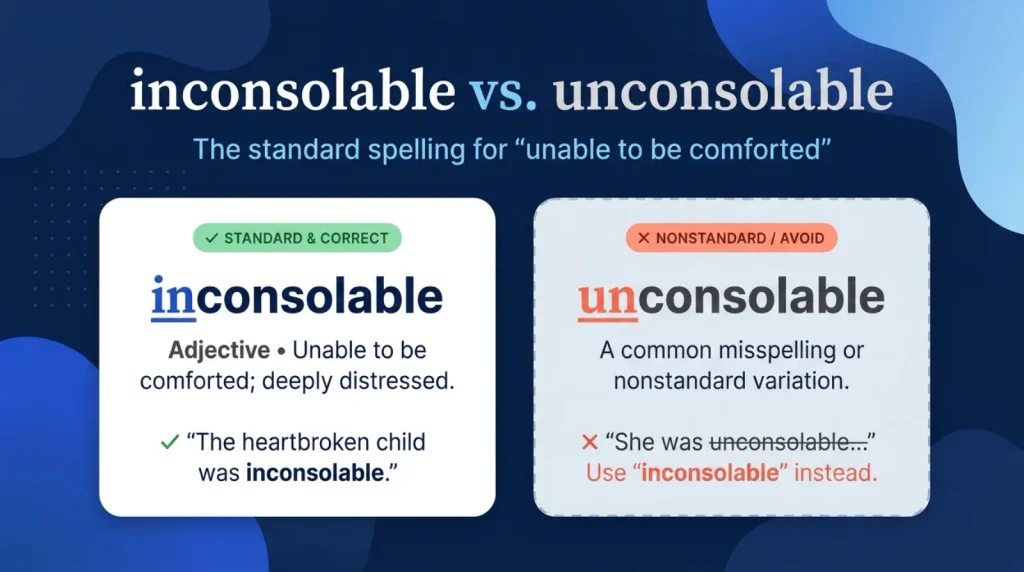
When comparing inconsolable vs. unconsolable, inconsolable is the standard, widely accepted word in modern American English. It describes someone who is so upset, grieving, or distressed that they cannot be comforted. Unconsolable is also a recorded English word, but it is much less common. In most everyday, academic, and professional writing, inconsolable is the better choice.
Understanding the difference helps you choose the most natural word when describing grief, sadness, disappointment, or emotional distress.
What Does Inconsolable Mean?
Inconsolable is an adjective that describes a person who cannot be comforted or reassured, especially because of intense sadness or grief.
When someone is inconsolable, ordinary attempts to make them feel better do not seem to help. They may continue crying, struggle to speak, or remain deeply distressed despite receiving support from others.
For example:
- After learning that her beloved dog had died, Emma was inconsolable.
- The child became inconsolable when his parents left the hospital.
- Even after receiving reassuring news, he remained inconsolable over the loss of his closest friend.
- Her family tried to comfort her, but she was too inconsolable to respond.
In each sentence, the word emphasizes the intensity of the person’s emotional distress and the difficulty of providing comfort.
How Is Inconsolable Used in a Sentence?
The adjective inconsolable usually appears after a linking verb such as be, become, remain, or seem. It can also appear before a noun.
Common sentence patterns include:
- Subject + linking verb + inconsolable
- Subject + linking verb + inconsolable + noun
Examples:
- The mother was inconsolable after hearing the news.
- He became inconsolable when his best friend moved away.
- The inconsolable child refused to leave his father’s side.
- She seemed inconsolable throughout the funeral.
- The family remained inconsolable for hours after the unexpected loss.
The word is particularly common in descriptions of bereavement, heartbreak, serious disappointment, and other emotionally difficult experiences.
However, it does not necessarily mean that a person will never recover. It describes their emotional state at a particular time, not a permanent inability to feel better.
What Does Unconsolable Mean?
Unconsolable is an adjective with essentially the same meaning as inconsolable: unable to be consoled or comforted.
The two words overlap in meaning, but they differ considerably in how commonly they are used. Inconsolable is the established, more natural choice for most contemporary English writing, while unconsolable is comparatively rare.
For example:
- The child appeared unconsolable after losing his favorite toy.
- She felt unconsolable following the sudden breakup.
- His parents tried everything, but he remained unconsolable.
- The grieving family seemed unconsolable after the funeral.
These sentences communicate the intended meaning, but many American English editors would choose inconsolable instead.
Is Unconsolable a Misspelling?
Not necessarily. Unconsolable is a recognized word, not simply a typographical error. However, its relative rarity makes it a less suitable choice when you want conventional, natural-sounding American English.
This distinction matters because two words can both exist without being equally common or equally appropriate in every context.
For instance, an editor may accept unconsolable in a literary passage while preferring inconsolable in a news report, school essay, or general-interest article.
If your goal is clear communication rather than unusual wording, choose inconsolable.
Inconsolable vs. Unconsolable: The Main Difference
The central difference is not their basic meaning but their frequency and conventional usage.
| Feature | Inconsolable | Unconsolable |
|---|---|---|
| Part of speech | Adjective | Adjective |
| Meaning | Unable to be comforted | Unable to be comforted |
| Standard American English | Preferred choice | Less common alternative |
| Everyday conversation | Natural and familiar | Understandable but unusual |
| Professional writing | Generally preferred | Usually replaced by inconsolable |
| Emotional contexts | Grief, sadness, distress | Similar contexts |
| Best general recommendation | Use this word | Use selectively |
The distinction is similar to other situations in English where two forms communicate the same idea but one has become the conventional choice.
You do not need to invent a difference in meaning to distinguish these words. Their practical difference lies primarily in usage.
When Should You Use Inconsolable?
Choose inconsolable when you want to describe someone who cannot be comforted despite other people’s attempts to help.
It works in several contexts.
1. Grief and Bereavement
This is one of the clearest contexts for inconsolable.
Examples:
- After her grandmother passed away, Maya was inconsolable.
- The family was inconsolable when the funeral ended.
- He became inconsolable after learning that his longtime friend had died.
The word conveys a depth of sorrow that simpler terms such as sad or upset might not fully express.
2. Children and Family Situations
Parents and caregivers frequently use inconsolable to describe a child who cannot be soothed.
Examples:
- The baby was inconsolable despite being fed and held.
- Our toddler became inconsolable when his favorite blanket went missing.
- Her daughter was inconsolable after waking from a frightening dream.
In these situations, the word describes behavior and emotional distress without necessarily suggesting a permanent problem.
3. Romantic Relationships
The adjective can also describe intense heartbreak.
Examples:
- He was inconsolable after his fiancée called off the wedding.
- She felt inconsolable when she discovered that the relationship was over.
- For several days, Daniel remained inconsolable after the breakup.
The term is stronger than disappointed because it suggests that ordinary reassurance does little to ease the person’s feelings.
4. Professional and Journalistic Writing
Inconsolable is suitable for news reports, biographies, personal essays, and other formal or semi-formal writing.
Examples:
- Relatives described the victim’s mother as inconsolable.
- The athlete was inconsolable after missing the decisive penalty.
- In her memoir, the author recalled feeling inconsolable after the loss of her childhood home.
Although the word often appears in serious contexts, it can also describe intense disappointment in sports, school, or everyday life.
When Can You Use Unconsolable?
You can use unconsolable when you intentionally want the less common alternative and the surrounding sentence makes its meaning clear.
For example:
- The young boy appeared unconsolable after his parents announced their separation.
- She described herself as unconsolable during the first week after the loss.
- His brother tried to cheer him up, but he remained unconsolable.
These examples are understandable because the word shares the core meaning of inconsolable.
Nevertheless, using the more familiar form usually makes the writing sound more natural. In an edited article, a school assignment, or an SEO-focused grammar guide, consistency with standard usage is generally more valuable than choosing a rarer synonym without a specific reason.
Why Do Inconsolable and Unconsolable Both Exist?
English uses several prefixes to form words with negative or opposite meanings. Two common examples are in- and un-.
The prefix in- appears in words such as:
- Incapable: not capable
- Inaccurate: not accurate
- Inappropriate: not appropriate
- Inconsolable: not able to be consoled
The prefix un- appears in words such as:
- Unable: not able
- Uncertain: not certain
- Uncomfortable: not comfortable
- Unconsolable: not able to be consoled
However, English does not allow writers to exchange in- and un- freely in every word. Established vocabulary and conventional usage determine which forms people generally recognize and prefer.
For example, inaccurate is the usual word, rather than unaccurate. Similarly, uncomfortable is standard, rather than incomfortable in ordinary modern American English.
The existence of both inconsolable and unconsolable does not mean that every negative prefix can be substituted for another. It simply means that both forms are available, although one is much more conventional.
Common Mistakes With Inconsolable vs. Unconsolable
Understanding the basic meaning is straightforward, but several mistakes can arise when choosing between these words.
Mistake 1: Assuming Unconsolable Is Always Incorrect
Because unconsolable is uncommon, some writers assume that it is automatically a misspelling.
Incorrect claim: “Unconsolable is not a real English word.”
Better explanation: Unconsolable is a recognized alternative, but inconsolable is the standard choice in most contemporary writing.
This distinction helps avoid overstating the rule.
Mistake 2: Treating the Words as Different in Meaning
Some writers may assume that inconsolable describes extreme grief while unconsolable describes ordinary sadness.
There is no established general distinction of that kind.
Less accurate explanation: “Inconsolable means deeply sad, but unconsolable means slightly upset.”
Better explanation: Both words express the inability to be comforted. Their main practical difference is conventionality and frequency.
Mistake 3: Replacing Inconsolable With an Unfamiliar Form During Editing
Writers sometimes change familiar words to make their writing sound more sophisticated. However, an unusual alternative does not necessarily improve the sentence.
Less natural for a general audience:
“The child remained unconsolable after the accident.”
More conventional:
“The child remained inconsolable after the accident.”
Both communicate the same basic idea, but the second is the safer editorial choice.
Mistake 4: Using Inconsolable When a Weaker Word Is More Accurate
Not every sad or disappointed person is inconsolable.
For example:
- Overstated: “I was inconsolable because the store had run out of my favorite snack.”
- More proportionate: “I was disappointed because the store had run out of my favorite snack.”
The stronger adjective should match the situation. Otherwise, the sentence may exaggerate the person’s reaction.
How to Remember the Difference Quickly
Use these two simple strategies.
Memory trick 1: Choose the familiar form.
When you mean “unable to be comforted,” remember inconsolable as your default spelling. It is the form most readers will expect.
Memory trick 2: Test the sentence with “unable to be comforted.”
Replace the adjective with the phrase unable to be comforted.
- – “She was inconsolable after the loss.”
- She was unable to be comforted after the loss.
- – “She was unconsolable after the loss.”
- She was unable to be comforted after the loss.
Both sentences preserve the basic meaning. Since the substitution test does not distinguish their meanings, use conventionality to make the final decision: choose inconsolable for ordinary writing.
Inconsolable vs. Unconsolable in Real-World Contexts
The following examples demonstrate how the preferred word works naturally in different situations.
Scenario 1: A Text Message Between Friends
Alex: How is Sarah doing after losing her cat?
Mia: She’s still inconsolable. Her cat had been with her since childhood.
Alex: That’s heartbreaking. I hope she has people around her who can support her.
Here, inconsolable communicates intense grief without suggesting that Sarah will feel this way forever.
Scenario 2: A Workplace Email
Subject: Support for a Colleague
Hi everyone,
Many of us know that Jordan is dealing with a difficult family loss. Jordan has been inconsolable since receiving the news, so please give them time and space while offering support where appropriate.
Thank you for being considerate during this difficult period.
The adjective fits a professional message, although sensitive workplace communication should avoid sharing private details without permission.
Scenario 3: A Newspaper-Style Report
The team captain struggled to hold back tears after the final whistle. Despite his teammates’ attempts to comfort him, he remained inconsolable following the unexpected championship defeat.
This example shows that inconsolable is not restricted to bereavement. It can describe an intense emotional reaction to a major disappointment.
Related Words and Common Confusions
Several related adjectives can help you express different degrees or types of distress more precisely.
Inconsolable vs. Uncontrollable
Inconsolable means unable to be comforted. Uncontrollable means unable to be controlled or restrained.
For example:
- The grieving mother was inconsolable.
- The child burst into uncontrollable laughter.
A person can experience uncontrollable crying and be inconsolable at the same time, but the words describe different aspects of the situation.
Inconsolable vs. Consolable
Consolable means capable of being comforted, while inconsolable means unable to be comforted.
Examples:
- After a short conversation, the child became consolable.
- Even with support from her family, she remained inconsolable.
These words form a direct contrast and are useful when describing whether reassurance helps someone recover emotionally.
Inconsolable vs. Devastated
Devastated means extremely upset, shocked, or emotionally overwhelmed. Inconsolable specifically emphasizes the inability to receive comfort.
For example:
- He was devastated when his application was rejected.
- He was inconsolable after losing the person who had supported him throughout his life.
Someone may be devastated but still respond to reassurance. The word inconsolable places greater emphasis on the failure of comfort to ease the distress.
Inconsolable vs. Heartbroken
Heartbroken describes profound emotional pain, especially following loss or disappointment. Inconsolable describes a state in which comfort does not seem to help.
For example:
- She was heartbroken when her relationship ended.
- She was inconsolable when she learned that reconciliation was impossible.
Both words can describe the same person, but they focus on different aspects of the experience.
Frequently Asked Questions
Is Inconsolable or Unconsolable Correct?
Both are recognized English words with essentially the same meaning. However, inconsolable is the standard, more widely used choice in contemporary American English.
Is Unconsolable a Real Word?
Yes. Unconsolable is a recognized word meaning unable to be comforted. It is much less common than inconsolable, so writers generally prefer the latter.
What Does Inconsolable Mean in Simple Words?
Inconsolable means so sad or upset that other people cannot make you feel better. For example, a child who continues crying despite repeated attempts to comfort them may be described as inconsolable.
Can You Use Inconsolable for Happiness or Excitement?
Usually, no. The word traditionally describes distress, especially grief or sadness. For overwhelming happiness or excitement, expressions such as beside oneself with joy or overwhelmed with excitement are more appropriate.
What Is the Opposite of Inconsolable?
Depending on the context, consolable is the most direct opposite. Other possibilities include comforted, reassured, and soothed, which describe someone who has received comfort or experienced relief.
Conclusion
- Inconsolable: The standard, widely preferred adjective meaning unable to be comforted.
- Unconsolable: A recognized but much less common alternative with essentially the same meaning.
- Part of speech: Both words are adjectives.
- Meaning difference: No established general difference in meaning.
- Best choice for American English: Use inconsolable in everyday conversation, schoolwork, professional communication, and most published writing.
Final verdict: When deciding between inconsolable vs. unconsolable, choose inconsolable unless you have a specific stylistic reason to use the rarer alternative. It is the clearer, more conventional choice for modern American English.

Olivia Smith is a US English writer and language enthusiast who specializes in spelling, word choice, and commonly confused words. She creates clear, practical guides that help readers understand the correct spelling, meaning, and usage of English words.
At GrammarPool.com, Olivia focuses on spelling-choice topics, common spelling mistakes, and easy-to-understand explanations for everyday English users. Her writing is designed to make confusing word choices simple, accurate, and easy to remember.
Expertise: US English, spelling, word choice, commonly confused words, grammar, and language usage.