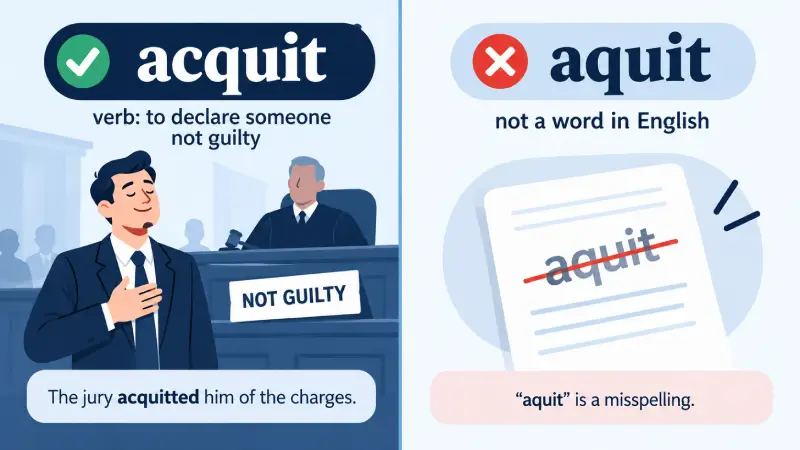
If you are wondering whether to write ditto or diddo, the correct standard English spelling is ditto. The word ditto means “the same as what was said, written, or mentioned before.” Diddo is a common misspelling of ditto, not a standard alternative spelling in modern American English.
For example, if your coworker says, “I enjoyed the presentation,” you can reply, “Ditto!” to mean that you enjoyed it too. Whether you are texting a friend, taking notes, or writing a sentence, use ditto when you want to express agreement or indicate that something is repeated.
Ditto vs. Diddo: The Main Difference
The difference between ditto vs. diddo is a matter of spelling, not a difference in meaning. Ditto is an established English word, while diddo is generally an incorrect spelling used by people who misremember the word or spell it as they think it sounds.
Although the two forms look similar, only ditto is appropriate in standard American English writing.
- Ditto: The correct spelling; means “the same as before” or “I agree.”
- Diddo: A misspelling of ditto in ordinary English usage.
Correct: “I would like a cup of coffee, please.” “Ditto,” said Mark.
Incorrect: “I would like a cup of coffee, please.” “Diddo,” said Mark.
In the correct example, Mark uses ditto to indicate that he wants the same thing. The second example communicates the intended idea, but the spelling is not standard.
What Does Ditto Mean?
Ditto is a word used to indicate that something is the same as something mentioned earlier. Depending on the sentence, it can express agreement, repeat information, or refer to an identical item.
In American English, people commonly use ditto in casual conversations, text messages, workplace discussions, lists, and written records.
1. Ditto as a Word of Agreement
In everyday conversation, ditto means “I feel the same way,” “I agree,” or “the same applies to me.”
For example:
- “I’m exhausted after that long meeting.” “Ditto!”
- “I love this restaurant.” “Ditto. The food is excellent.”
- “I can’t wait for the weekend.” “Ditto!”
- “That was the best concert I’ve ever attended.” “Ditto. I’d see that band again.”
- “I think we made the right decision.” “Ditto. I’m happy with the result.”
In these examples, ditto allows someone to agree without repeating the entire statement. It is usually informal, so a more explicit expression may work better in formal business correspondence.
2. Ditto as a Way to Avoid Repetition
The word can also replace information that has already appeared in a sentence, paragraph, or list.
For example:
– The first report covered sales in January; the second report covered sales in February, and the third did ditto for March.
A more natural version would be: “The first report covered January sales, the second covered February sales, and the third did the same for March.”
Other examples include:
- The first team completed its review, and the second team did ditto.
- Monday was unusually busy; Tuesday was ditto.
These sentences are understandable, but the phrasing is awkward. In polished writing, use did the same, repeated the process, or likewise when those expressions fit the context.
More natural examples are:
- The first store offered free delivery, and the second did the same.
- The company expanded in California and did likewise in Texas.
- Sales increased in April. Ditto for May.
3. Ditto as a Noun
Ditto can function as a noun referring to the same thing or another copy of something.
Examples:
- “I’ll have another sandwich, please.” “One ditto coming up.”
- She ordered a blue notebook, and I bought a ditto for my sister.
- The inventory sheet used the word ditto to avoid repeating the same entry.
The first two examples illustrate informal or context-dependent uses. In ordinary American English, people more commonly say another one, a copy, or the same thing. The third example describes the word’s use in recording repeated information.
4. Ditto as a Verb
Ditto can also be a verb meaning to repeat, copy, or agree with another person’s statement or action.
Its standard verb forms include:
- Present tense: ditto
- Third-person singular: dittoes or, in some dictionaries, dittos
- Past tense: dittoed
- Present participle: dittoing
Examples:
- I completely ditto your recommendation.
- The second speaker dittoed the first speaker’s argument.
- Rather than develop a new plan, the manager dittoed the previous team’s approach.
The verb is relatively uncommon in everyday professional writing. Writers generally prefer repeat, copy, agree with, or follow the same approach because those expressions are more precise.
When Should You Use Ditto?
Use ditto when you want to express agreement, indicate that something is repeated, or refer to the same item mentioned previously.
The best choice depends on the situation.
| Situation | Example | Is ditto appropriate? |
|---|---|---|
| Casual conversation | “I’m ready to leave.” “Ditto!” | Yes |
| Text messages | “I miss everyone.” “Ditto ❤️” | Yes |
| Informal online comments | “This is my favorite song.” “Ditto!” | Yes |
| Lists and records | A ditto mark repeats an entry above | Yes, when the format permits it |
| Formal business email | “I agree with your recommendation.” | Prefer explicit wording |
| Academic writing | “The same result occurred in the second trial.” | Usually clearer |
| Spelling a word correctly | “Please write diddo.” | No; use ditto |
The key is that ditto is a real word with several established functions. Diddo does not serve as a standard alternative in these contexts.
Ditto vs. Diddo: Common Spelling Mistakes
People may write diddo because they remember the sound of the word but not its exact spelling. Recognizing the mistake can help you avoid it in future writing.
Mistake 1: Replacing the T With a D
The most direct error is substituting the letter d for the first t in the second half of the word.
- Incorrect: “I agree with your opinion. Diddo!”
- Correct: “I agree with your opinion. Ditto!”
How to avoid it: Remember the spelling as D-I-T-T-O. The word contains two consecutive t letters, not a d followed by a d.
Mistake 2: Spelling the Word as It Sounds
When people speak quickly, the middle consonants may not sound as distinct as they look in writing. A person who has heard the word more often than they have read it may guess the spelling incorrectly.
- Incorrect: “Ditto, I feel exactly the same.”
- Correct: “Ditto, I feel exactly the same.”
The sentence itself does not change; only the spelling of the word needs attention.
How to avoid it: Learn the written form as a complete word rather than trying to reconstruct it from pronunciation.
Mistake 3: Accepting an Unnoticed Typing Error
Typing quickly on a phone or computer can introduce mistakes. Spell-checkers may catch diddo, but you should not assume that every writing tool will flag every unusual spelling.
- Incorrect: “My answer is diddo.”
- Correct: “My answer is ditto.”
How to avoid it: Reread short replies before sending them, especially when a single word carries the entire meaning of your message.
Mistake 4: Treating Diddo as an Alternative Spelling
A person may see diddo in an informal online conversation and assume that it is an accepted spelling variant.
- Incorrect: “Both ditto and diddo are standard spellings.”
- Correct: “Ditto is the standard spelling in ordinary English.”
How to avoid it: Distinguish between a spelling that appears online and a spelling accepted in standard English. Informal posts can contain typos, playful spellings, and personal writing habits.
How to Remember Ditto vs. Diddo
Two simple techniques can help you remember the correct spelling.
Memory Trick 1: Remember the Double T
The correct word is ditto, with two t letters in the middle.
Think of the sequence this way:
DI + TTO = DITTO
When you mean “the same as before,” write ditto, not diddo.
Memory Trick 2: Substitute “The Same”
Try replacing the word with the phrase the same.
For example:
- “I feel the same way.” → “Ditto!”
- “She ordered the same thing.” → “She ordered a ditto.” (Possible in limited contexts, but the same thing is more natural.)
If your intended meaning is agreement or sameness, ditto may be the word you want. The substitution test helps you identify the meaning, while remembering the double t helps you spell it correctly.
Ditto vs. Diddo in Real-World Examples
The following short scenarios show how the correct spelling works in everyday communication.
Scenario 1: A Text Message Between Friends
Emma: “I’m so happy that we finally finished the project.”
Liam: “Ditto! Now we can relax this weekend.”
Here, Liam uses ditto to express the same feeling as Emma. The response is short, friendly, and natural.
Scenario 2: A Workplace Conversation
Manager: “I think we should review the proposal before sending it to the client.”
Colleague: “Agreed. I’ll check the budget figures, too.”
Although the colleague could reply “Ditto,” the more specific response explains what they agree to do. In workplace communication, explicit language can prevent misunderstandings.
Scenario 3: A Personal List
Suppose you are recording the same address for several people in a handwritten list. You might use a ditto mark to show that an entry repeats the address above it, provided the list’s format allows that convention.
In a spreadsheet or database, however, repeating the full address is often safer. It makes each row easier to understand when someone sorts, filters, copies, or exports the information.
Related Word Confusions
Understanding ditto also helps clarify a few related expressions.
Ditto vs. Same
Both words can communicate similarity or agreement, but they do not always work in the same grammatical position.
- Ditto: “I enjoyed the movie.” “Ditto!”
- Same: “I had the same experience.”
Ditto often works as a short response. Same typically appears in a larger phrase or sentence, although informal speakers also use it alone.
Ditto vs. Likewise
Both can express that something applies in a similar way, but likewise often sounds more formal.
- Ditto: “I appreciate your help.” “Ditto!”
- Likewise: “I appreciate your help.” “Likewise, it was a pleasure working with you.”
Use likewise when you want a polished response in professional or formal situations. Use ditto when a brief, informal expression fits the conversation.
Ditto vs. Ditto Mark
The word ditto and a ditto mark are related, but they are not identical.
The word is written as ditto. A ditto mark is a symbol used in some lists or tables to indicate that the information above should be repeated. The symbol and its placement may vary according to the format.
For example, a list might use a ditto mark beneath a previously written word instead of writing that word again. In digital documents, repeating the complete entry is often clearer.
Ditto vs. Copy
A copy is a reproduction of an original item, while ditto can mean the same thing as something previously mentioned.
- “Please send me a copy of the report.”
- “I agree with your assessment. Ditto!”
The first sentence requests a duplicate document. The second expresses agreement. Although ditto can also refer to duplication, the words are not interchangeable in every situation.
Are There Any Exceptions to the Ditto vs. Diddo Rule?
In standard American English, there is no ordinary spelling exception that makes diddo an accepted replacement for ditto.
However, context matters when interpreting unusual spellings. Someone might deliberately use Diddo as a character name, username, fictional term, brand name, or playful personal spelling. Such a use does not make it the standard spelling of the English word.
For example:
- “Diddo is the character’s nickname in the story.” This may be correct if Diddo is the character’s actual name.
- “I agree with you. Diddo!” This is a misspelling if the writer intends the ordinary word ditto.
Capitalization and creative naming do not change the standard spelling of the word itself.
Frequently Asked Questions
Is Ditto or Diddo Correct?
Ditto is the correct spelling in standard English. Diddo is generally a misspelling when used to mean “the same as before” or “I agree.”
What Does Ditto Mean in Texting?
In texting, ditto usually means “same here,” “I agree,” or “I feel the same way.” For example, if a friend writes, “I’m excited about the trip,” you can reply, “Ditto!”
Is Diddo a Real Word?
Diddo is not the standard spelling of the ordinary English word ditto. It may appear as a name or a deliberately invented spelling, but use ditto for the conventional meaning.
How Do You Spell Ditto Correctly?
Spell it D-I-T-T-O. Remember that the word contains two consecutive t letters in the middle.
Is Ditto Formal or Informal?
Ditto is common in informal conversation and can also appear in lists, records, and other contexts involving repetition. In formal writing, phrases such as I agree, the same applies, or likewise may communicate the intended meaning more clearly.
Quick Reference: Ditto vs. Diddo
- Correct spelling: Ditto
- Incorrect standard spelling: Diddo
- Meaning: The same as before, likewise, or I agree
- Common use: Text messages, conversations, and references to repeated information
- Memory trick: Remember the double T in D-I-T-T-O.
Conclusion
When choosing between ditto vs. diddo, always use ditto for the standard English word meaning “the same as before” or “I agree.” It can function as a short expression of agreement, refer to repeated information, or serve as a noun or verb in appropriate contexts.
Although diddo may appear in casual writing or as a deliberately chosen name, it is not a standard alternative spelling. Remember the two t letters in ditto, and you can avoid this common spelling mistake in texts, emails, schoolwork, and professional writing.

Olivia Smith is a US English writer and language enthusiast who specializes in spelling, word choice, and commonly confused words. She creates clear, practical guides that help readers understand the correct spelling, meaning, and usage of English words.
At GrammarPool.com, Olivia focuses on spelling-choice topics, common spelling mistakes, and easy-to-understand explanations for everyday English users. Her writing is designed to make confusing word choices simple, accurate, and easy to remember.
Expertise: US English, spelling, word choice, commonly confused words, grammar, and language usage.