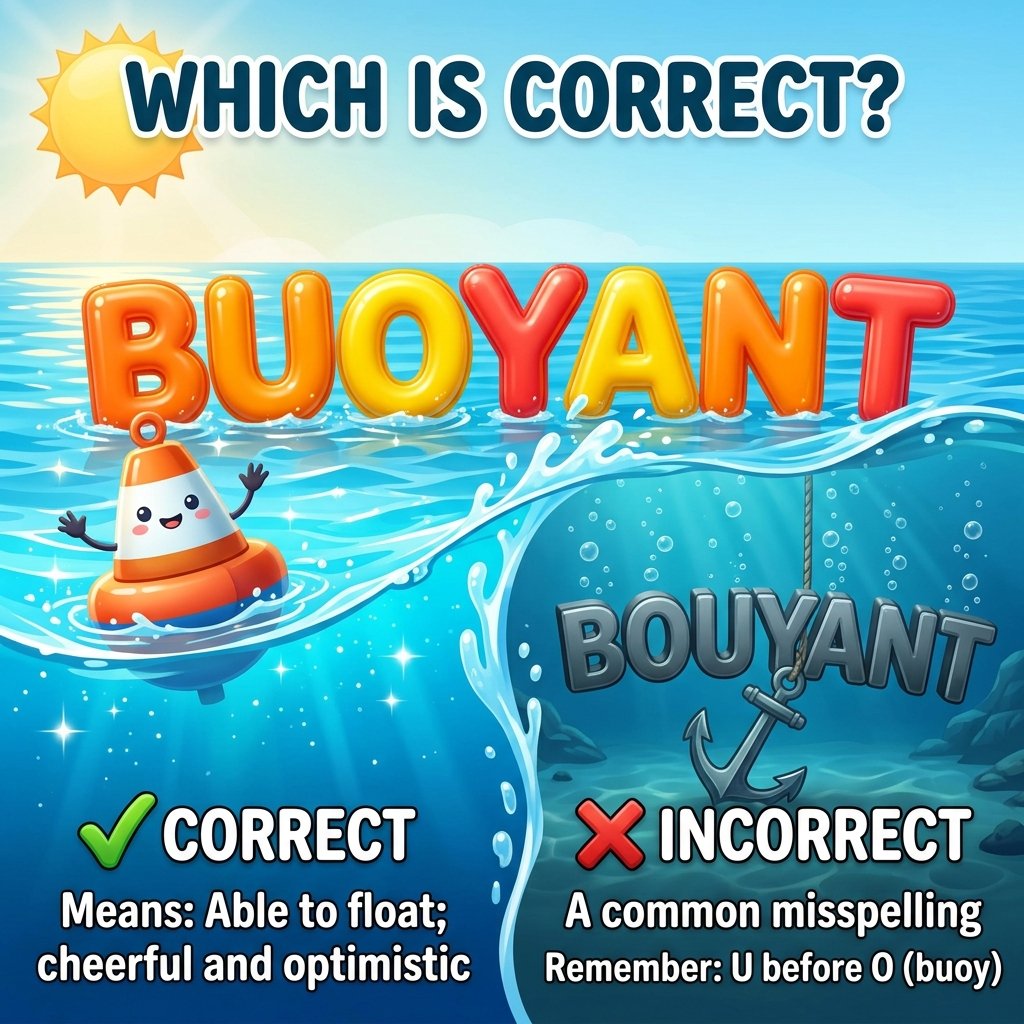
When comparing buoyant vs. bouyant, only one spelling is correct: buoyant. The word bouyant is a common misspelling that you should avoid in school assignments, professional writing, and everyday communication.
The confusion often occurs because the letters in buoyant appear in an unusual order. English spelling can be tricky, especially when a word contains several vowels together. However, learning the correct spelling and meaning of buoyant can help you avoid this mistake in the future.
In this guide, you will learn the difference between buoyant and bouyant, understand what buoyant means, explore example sentences, and discover simple techniques to remember the correct spelling.
Quick Answer:
Buoyant is the correct spelling in American and British English. Bouyant is incorrect and does not represent a standard alternative spelling.
- Correct: The buoyant boat remained on the surface of the water.
- Incorrect: The bouyant boat remained on the surface of the water.
Use buoyant when describing something that floats, stays afloat, or shows a cheerful and optimistic attitude.
What Does Buoyant Mean?
The word buoyant is an adjective with several related meanings. It commonly describes something that can float or rise in a liquid or a person who feels cheerful, hopeful, and confident.
In science, buoyancy refers to the upward force a fluid exerts on an object. An object may float when the buoyant force balances its weight. In everyday English, however, buoyant can also describe a positive mood, a lively atmosphere, or a resilient economy.
Here are some examples:
- The buoyant material helped the life jacket keep the swimmer afloat.
- Despite the difficult situation, she remained buoyant and optimistic.
- Investors were encouraged by the buoyant stock market.
- The balloon appeared buoyant as it rose into the air.
In each sentence, buoyant describes the ability to float, a positive emotional state, or an upward or resilient trend.
What Does Bouyant Mean?
Bouyant is a misspelling of buoyant. It is not an accepted standard spelling in American or British English.
Writers may accidentally rearrange the letters because they expect the word to contain the sequence ou rather than uo. However, the correct spelling places the u before the o.
For example:
- Incorrect: The bouyant object floated across the pool.
- Correct: The buoyant object floated across the pool.
Another example:
- Incorrect: Her bouyant personality lifted everyone’s spirits.
- Correct: Her buoyant personality lifted everyone’s spirits.
Always use buoyant when referring to floating objects, positive moods, or resilient conditions.
Why Is Buoyant the Correct Spelling?
The correct spelling is buoyant, with the letters arranged as b-u-o-y-a-n-t.
The word comes from buoy, a floating object used to mark a location in water or provide a navigational reference. Adding the suffix -ant gives us buoyant, an adjective associated with floating or being able to stay afloat.
The spelling follows this pattern:
Buoy + ant = Buoyant
Although this breakdown is useful for remembering the word, the spelling is not bouyant. The u comes before the o, just as it does in buoy.
Remembering the base word buoy is one of the easiest ways to spell buoyant correctly.
Buoyant vs. Bouyant: Key Differences
| Feature | Buoyant | Bouyant |
|---|---|---|
| Spelling status | Correct | Incorrect |
| Meaning | Able to float or cheerful and optimistic | No standard meaning |
| Standard English usage | Accepted | Not accepted |
| Letter order | U comes before O | O comes before U |
| Suitable for formal writing | Yes | No |
| Example | The buoyant raft stayed afloat. | Incorrect spelling |
The most important difference is the order of the letters u and o. Write buoyant, not bouyant.
Examples of Buoyant in Sentences
Reading examples can help you understand how to use buoyant naturally in different contexts.
Buoyant in Science and Everyday Life
The buoyant boat floated easily on the calm lake.
The life jacket kept the swimmer buoyant in the water.
Cork is a buoyant material that can float on water.
The buoyant ball rose to the surface after being pushed underwater.
Air trapped inside the object made it more buoyant.
Buoyant to Describe Emotions
She maintained a buoyant attitude despite the setbacks.
His buoyant personality made everyone feel welcome.
The team remained buoyant after its difficult start.
Her buoyant mood improved after receiving good news.
The children were buoyant and excited about their upcoming trip.
Buoyant in Business and Economics
Consumer confidence remained buoyant throughout the holiday season.
A buoyant housing market attracted new investors.
The company maintained a buoyant outlook for the coming year.
Strong sales helped create a buoyant business environment.
Economists described the market as buoyant because demand remained strong.
These examples show that buoyant can describe physical floating, emotional positivity, and economic strength.
Common Mistakes to Avoid
Even experienced writers sometimes misspell unfamiliar words. Understanding these common errors can help you use buoyant correctly.
1. Switching the U and O
Incorrect: The bouyant device helped the boat remain stable.
Correct: The buoyant device helped the boat remain stable.
Remember that buoyant begins with the letter sequence buo, not bou.
2. Using Bouyant in Professional Writing
Incorrect: The company reported a bouyant economic outlook.
Correct: The company reported a buoyant economic outlook.
Always check the spelling before submitting a report, publishing an article, or sending a formal email.
3. Confusing Buoyant With Buoy
The words buoy and buoyant are related, but they serve different grammatical purposes.
- Buoy: A floating object that marks a location in water.
- Buoyant: An adjective describing something that floats or a person or situation that seems cheerful or optimistic.
Example: The buoy helped sailors navigate, while its buoyant structure kept it floating.
4. Assuming the Misspelling Is an Alternative
Some English words have accepted spelling variations. However, bouyant is not a recognized alternative to buoyant.
Use buoyant consistently in American English, British English, academic writing, and professional communication.
How to Remember the Correct Spelling of Buoyant
Use these simple strategies to avoid confusing buoyant with bouyant.
- Remember the base word: Start with buoy, then connect it to buoyant.
- Memorize the first four letters: The correct sequence is b-u-o-y.
- Think about floating: A buoy floats on water, and something buoyant can float.
- Write it several times: Practicing buoyant in short sentences can reinforce the correct letter order.
- Use a spell-checker: A spelling tool can flag bouyant and suggest the correct spelling.
A simple memory trick is to remember that buoy comes first in buoyant. If you can spell buoy correctly, you have a useful starting point for spelling buoyant.
Buoyant vs. Bouyant in American and British English
There is no spelling difference between American and British English for this word. Both varieties use buoyant.
Examples:
- American English: The market remained buoyant despite economic uncertainty.
- British English: The market remained buoyant despite economic uncertainty.
The spelling stays the same regardless of the audience or location. Therefore, you should not use bouyant when writing for either American or British readers.
Related Words: Buoy, Buoyancy, and Buoyantly
Learning related words can help you understand the spelling and meaning of buoyant more clearly.
| Word | Part of Speech | Meaning | Example |
|---|---|---|---|
| Buoy | Noun or verb | A floating marker or the act of supporting something | The buoy marked the safe channel. |
| Buoyant | Adjective | Able to float or cheerful and optimistic | The buoyant material stayed afloat. |
| Buoyancy | Noun | The ability to float or the upward force exerted by a fluid | The experiment measured the object’s buoyancy. |
| Buoyantly | Adverb | In a buoyant, cheerful, or floating manner | She spoke buoyantly about her plans. |
Notice that all four words preserve the spelling sequence buoy. Recognizing this pattern makes it easier to spell related terms correctly.
Frequently Asked Questions
1. Is Buoyant or Bouyant Correct?
Buoyant is correct. Bouyant is a common misspelling and should not be used in standard English writing.
2. Why Is Buoyant Spelled With U Before O?
The word is related to buoy, which is spelled with u before o. The adjective buoyant retains that letter order.
3. What Does Buoyant Mean?
Buoyant means able to float or stay afloat. It can also describe someone who feels cheerful and optimistic or a market that shows strength and resilience.
4. Is Bouyant Ever Correct in British English?
No. Bouyant is not a standard British English spelling. British English uses buoyant, just like American English.
5. What Is the Difference Between Buoyant and Buoyancy?
Buoyant is an adjective that describes something able to float or a positive mood. Buoyancy is a noun referring to the ability to float or the upward force exerted by a fluid.
6. How Can I Remember the Spelling of Buoyant?
Remember the word buoy and keep its first four letters in the same order: b-u-o-y. Then add -ant to form buoyant.
Conclusion
When comparing buoyant vs. bouyant, the correct spelling is buoyant. It describes something that can float, a cheerful attitude, or a strong and resilient market. The spelling bouyant is incorrect in standard English.
To avoid this mistake, remember the related word buoy and keep the letters u and o in the correct order. Whether you are writing a science report, a business article, or an everyday message, using buoyant will make your writing clearer and more accurate.

Olivia Smith is a US English writer and language enthusiast who specializes in spelling, word choice, and commonly confused words. She creates clear, practical guides that help readers understand the correct spelling, meaning, and usage of English words.
At GrammarPool.com, Olivia focuses on spelling-choice topics, common spelling mistakes, and easy-to-understand explanations for everyday English users. Her writing is designed to make confusing word choices simple, accurate, and easy to remember.
Expertise: US English, spelling, word choice, commonly confused words, grammar, and language usage.