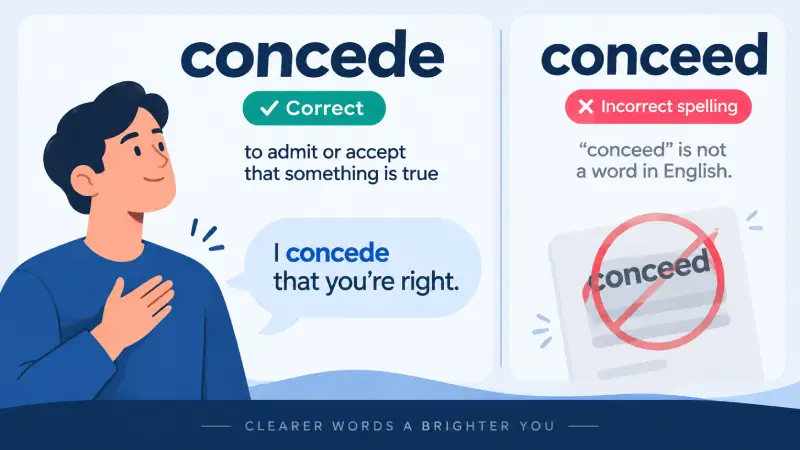
Concede is the correct spelling. Conceed is a misspelling and is not the standard spelling of the English verb. If you mean to admit that something is true, accept defeat, or give something up, use concede.
- Correct: The team had to concede defeat.
- Incorrect: The team had to conceed defeat.
The confusion usually comes from the pronunciation and from the fact that English verbs often form past-tense and related forms by adding -ed. However, the base verb is spelled concede, with one e after the c and another e at the end.
What Is the Correct Spelling: Concede or Conceed?
The correct spelling is concede.
Concede is a verb with several closely related meanings. It can mean to admit that something is true, acknowledge that someone else has won an argument or competition, or allow someone to have or gain something.
Conceed is not the standard spelling of this verb.
| Spelling | Correct? | Function |
|---|---|---|
| concede | Yes | Standard English verb |
| conceed | No | Common misspelling of concede |
The correct forms include:
- concede
- conceded
- conceding
- concession
- concededly (rare)
The important spelling pattern is that concede ends in -cede, not -ceed.
What Does “Concede” Mean?
Concede is a verb. Its meaning changes slightly according to the situation, but its central idea is accepting or admitting something that may not be in your favor.
1. To admit that something is true
You can concede a point when you admit that another person is correct about something.
I concede that your argument is stronger.
This does not necessarily mean you agree with everything the other person says. You may accept one particular point while continuing to disagree about the larger issue.
For example:
She conceded that the original estimate was too low, but she still defended the overall plan.
Here, she admits one fact without abandoning her entire position.
2. To admit defeat
Concede can mean to accept that you have lost a competition, argument, election, or other contest.
The candidate conceded after the final results were announced.
In sports, a losing team may also concede defeat:
The team finally conceded defeat in the final minutes.
This use is especially common in journalism and formal reporting.
3. To give something to someone
Concede can also mean to allow another person to have something or to accept that they deserve a particular point.
The company conceded several demands during the negotiations.
Here, the company gave ground rather than admitting that it was completely wrong.
4. In sports, to allow a goal or point
In sports, concede can mean to allow an opposing team or player to score.
The goalkeeper conceded two goals in the first half.
This meaning is particularly common in soccer and other sports reporting.
Why Is “Conceed” Wrong?
The spelling conceed looks plausible because English contains words ending in -ceed, such as:
- proceed
- succeed
- exceed
That pattern can cause people to incorrectly assume that concede follows the same spelling.
But these are different words with different spellings:
concede ✅
conceed ❌
The correct ending is:
-cede
not:
-ceed
A useful way to remember the word is to focus on the spelling of the base verb:
con + cede = concede
Once you know concede, its common forms become easier to recognize:
concede → conceded → conceding
Concede vs. Conceded vs. Conceding
Some spelling mistakes occur when people change concede into another form.
Concede
Use concede as the base form.
I refuse to concede that the plan has failed.
They may concede the match if the score becomes impossible to overcome.
Conceded
The past tense and past participle are conceded.
The manager conceded that the decision was difficult.
The candidate conceded the election.
Notice that conceded has -ceded, not -ceeded.
Correct: conceded
Incorrect: conceeded
Conceding
The -ing form is conceding.
He is conceding too much during the negotiation.
By conceding that point, she made her larger argument more convincing.
The final e in concede is dropped before -ing:
concede → conceding
When to Use “Concede”
Use concede when someone:
- admits a fact or point
- accepts that another person is right about something
- accepts defeat
- gives up a demand or advantage during negotiations
- allows an opponent to score in a sporting event
Everyday conversation
I concede that you had a better idea.
Okay, I concede the point.
He eventually conceded that he had misunderstood the instructions.
She wouldn’t concede that anything had gone wrong.
School and academic writing
The author concedes that the evidence is limited.
The researcher conceded that further study is necessary.
Although the essay supports the proposal, it concedes that some risks remain.
The writer can concede an opposing argument without abandoning the main position.
Professional writing
The company conceded several points during the contract negotiations.
Our team must concede that the original deadline was unrealistic.
The manager conceded that the process needed improvement.
The report concedes that costs could increase next year.
News and formal writing
The candidate conceded after the remaining votes could no longer change the result.
The government conceded that the policy had produced unexpected problems.
The defending team conceded three goals before halftime.
Concede vs. Conceed: Side-by-Side Comparison
| Feature | Concede | Conceed |
|---|---|---|
| Standard English spelling | Yes | No |
| Part of speech | Verb | Not the standard verb |
| Means “admit” | Yes | No |
| Means “accept defeat” | Yes | No |
| Means “give ground” | Yes | No |
| Used in sports | Yes | No |
| Common spelling error | No | Yes |
| Correct past tense | conceded | conceeded ❌ |
The main rule is straightforward: concede is the correct spelling in standard English.
Common Mistakes With Concede
Mistake 1: Adding an extra “e”
Wrong:
She decided to conceed the argument.
Right:
She decided to concede the argument.
The word has -cede, not -ceed.
Mistake 2: Misspelling the past tense
Wrong:
The player conceeded defeat.
Right:
The player conceded defeat.
The correct sequence is:
concede → conceded
There is no second e before the d.
Mistake 3: Confusing “concede” with “succeed”
Because succeed and exceed contain -ceed, some writers transfer that spelling to concede.
Compare:
- succeed ✅
- exceed ✅
- proceed ✅
- concede ✅
Do not assume that words with similar sounds must have the same spelling pattern.
Mistake 4: Using “conceed” in formal writing
A spelling error that looks small can reduce the credibility of a professional document.
Wrong:
The report conceeds that the original estimate was inaccurate.
Right:
The report concedes that the original estimate was inaccurate.
This distinction matters particularly in academic papers, business reports, applications, and published content.
Concede vs. Admit
Concede and admit can overlap, but they are not identical in every context.
Admit is the broader and more common word for acknowledging that something is true.
He admitted that he had made a mistake.
Concede often suggests that the admission gives some advantage to another person or side, or that the speaker is accepting a point after resistance.
He conceded that his opponent had a stronger argument.
You can often use admit in place of concede, but concede can emphasize yielding a point in a disagreement or contest.
Concede vs. Acknowledge
Acknowledge means to recognize or accept the existence, importance, or truth of something.
The company acknowledged the problem.
Concede can carry a stronger sense of giving ground.
The company conceded that the previous estimate was inaccurate.
The second sentence suggests that the company is giving up its previous position on that specific point.
Concede vs. Surrender
These words are related when discussing defeat, but they are not interchangeable in every situation.
Concede means to acknowledge defeat or accept that the other side has won.
The candidate conceded the election.
Surrender usually means to give up completely, often in a physical conflict or under pressure.
The soldiers were ordered to surrender.
Someone can concede a contest without literally surrendering themselves or their possessions.
Concede vs. Confess
Confess usually involves admitting something one has done, especially something wrong, secret, or embarrassing.
He confessed that he had broken the vase.
Concede is broader and does not necessarily involve wrongdoing.
She conceded that her colleague had a better solution.
You can concede a point without confessing to any mistake or misconduct.
How to Remember “Concede”
The easiest memory trick is:
CONCEDE has CEDE at the end.
Think:
con + cede = concede
You can also associate concede with cede, a word meaning to give or transfer something.
That makes the spelling easier to remember:
cede → concede
Not:
ceed → conceed
Another useful reminder is:
You concede a point, not “conceed” a point.
If you see conceed, stop and check it. In ordinary English writing, you almost certainly need concede.
In Context: Real-World Examples
Text message
A: I think the first design looks better.
B: I still prefer the second one, but I concede that the first has better colors.
Here, concede means to admit that the other person has a valid point.
Professional email
After reviewing the updated figures, we concede that the original projection was too optimistic. We recommend using the revised estimate for the next report.
The writer acknowledges that the earlier position was not accurate.
Sports report
The home team controlled possession for most of the match but conceded two goals during the final fifteen minutes.
Here, conceded means allowed the opposing team to score.
News-style context
After the remaining votes were counted, the candidate conceded the race and congratulated the winner.
Here, conceded means accepted defeat.
Common Forms of Concede
Knowing the word family can help prevent spelling mistakes.
| Form | Example |
|---|---|
| concede | They may concede the point. |
| concedes | She concedes that the evidence is weak. |
| conceded | He conceded defeat. |
| conceding | They are conceding too much. |
| concession | The agreement included several concessions. |
| concessionary | The company offered concessionary terms. |
The noun concession is especially useful to remember because it shares the same conces- spelling pattern.
The union made several concessions during the negotiations.
Is “Conceed” Ever Correct?
For the ordinary English verb meaning “admit,” “accept defeat,” or “give ground,” conceed is not a standard spelling.
If you see conceed in a sentence such as:
The team had to conceed defeat.
it should be corrected to:
The team had to concede defeat.
Unlike some spelling pairs in English, this is not a US-versus-UK difference. Concede is the standard spelling in both American and British English.
Frequently Asked Questions
Concede is correct. Conceed is a misspelling when you mean the English verb meaning “to admit,” “accept defeat,” or “give up something.”
Concede means to admit that something is true, acknowledge a point, accept defeat, give ground in negotiations, or allow an opponent to score in sports.
No. The correct past-tense spelling is conceded, with one e before the d.
The team conceded defeat.
Both can mean acknowledging something as true, but concede often suggests giving ground in an argument, negotiation, competition, or disagreement. Admit is more general.
Yes. Concede is a verb.
She conceded that he was right.
Quick-Reference Takeaway
Concede ✅ = correct spelling
Conceed ❌ = misspelling
Remember:
CONCEDE = CON + CEDE
Use concede when you mean admit a point, accept defeat, give ground, or allow an opponent to score.
Examples:
- I concede that you are right.
- The candidate conceded the election.
- The team conceded two goals.
- The company conceded several demands.
The spelling never changes to conceed. The correct forms are concede, concedes, conceded, and conceding.

Olivia Smith is a US English writer and language enthusiast who specializes in spelling, word choice, and commonly confused words. She creates clear, practical guides that help readers understand the correct spelling, meaning, and usage of English words.
At GrammarPool.com, Olivia focuses on spelling-choice topics, common spelling mistakes, and easy-to-understand explanations for everyday English users. Her writing is designed to make confusing word choices simple, accurate, and easy to remember.
Expertise: US English, spelling, word choice, commonly confused words, grammar, and language usage.