Have you ever wondered whether to write definitely or definatley? These spellings look similar, and the word can be tricky to type correctly. However, only one spelling is accepted in standard American English.
The correct spelling is definitely. The word definatley is a common misspelling caused by mixing up the letters near the end of the word. Whether you are writing a school assignment, email, blog post, or professional document, learning the correct spelling will help you communicate more confidently.
Quick Answer: Definitely or Definatley?
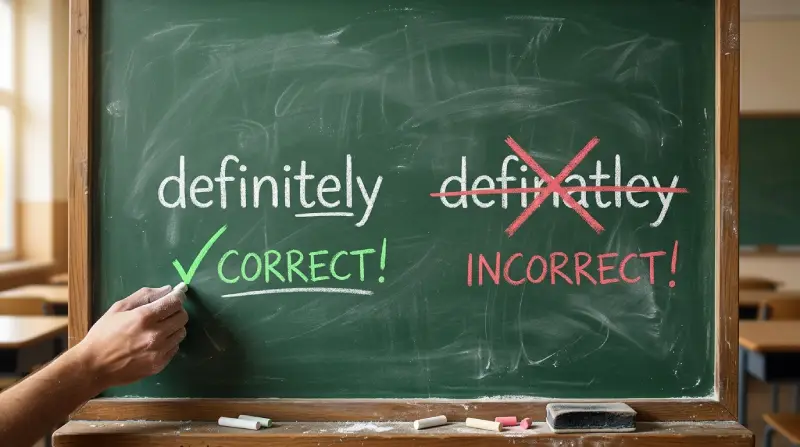
Definitely is the correct spelling. It is an adverb that means certainly, without doubt, or in a way that leaves no uncertainty.
Definatley is incorrect because the letters are arranged in the wrong order.
Examples:
- Correct: I will definitely attend the meeting.
- Incorrect: I will definatley attend the meeting.
- Correct: She is definitely the right person for the job.
Remember to write definitely, with the ending -tely, not -atley.
What Does Definitely Mean?
The word definitely means certainly, unquestionably, or without doubt. People use it to express confidence, confirm information, or emphasize that something is true.
For example, if you say, “I will definitely call you tomorrow,” you are expressing a firm intention to make the call.
Here are more examples:
- I definitely want to visit New York someday.
- This is definitely the best option for our project.
- She will definitely appreciate your help.
- We should definitely check the instructions before starting.
In each sentence, definitely emphasizes certainty or confidence.
Why Is Definatley Incorrect?
The spelling definatley is incorrect because it rearranges letters in the middle and ending of the word. The standard spelling is definitely, which follows the structure of definite with the adverb ending -ly.
This mistake often occurs when people type quickly or rely on how a word sounds instead of remembering its exact letter sequence.
To avoid the error, remember the correct spelling:
D-E-F-I-N-I-T-E-L-Y
Notice the sequence -nitely near the end. Writing the word correctly a few times can help you recognize the pattern automatically.
Definitely vs. Definatley: Key Differences
| Feature | Definitely | Definatley |
|---|---|---|
| Spelling status | Correct | Incorrect |
| Part of speech | Adverb | Not a standard English word |
| Meaning | Certainly or without doubt | No standard definition |
| Letter order | Correct | Incorrect |
| Example | I will definitely come. | Incorrect spelling |
| Suitable for formal writing | Yes | No |
The main difference is simple: definitely is correct, while definatley is a misspelling.
How to Remember the Correct Spelling of Definitely
Use these simple strategies to remember definitely and avoid writing definatley.
1. Remember the Word Definite
The word definitely comes from definite with the addition of -ly. Remembering the base word can make the full spelling easier.
- Definite: We need a definite answer.
- Definitely: I will definitely answer your question.
Both words contain the same core spelling.
2. Break Definitely Into Smaller Parts
You can think of the word as definite + ly = definitely.
This method helps you remember the correct letter order rather than guessing based on pronunciation.
Write the word slowly if you find it difficult:
DEFINITE + LY = DEFINITELY
3. Practice With a Simple Sentence
Choose a sentence that you can remember easily, such as:
“I will definitely remember how to spell definitely.”
Writing this sentence several times reinforces the correct spelling. You can also use the word in messages or short paragraphs to build familiarity.
Common Words Related to Definitely
Learning related words can improve your spelling and vocabulary.
| Word | Meaning | Example |
|---|---|---|
| Definite | Clear, certain, or specific | We need a definite answer. |
| Definitely | Certainly or without doubt | I will definitely attend. |
| Definition | An explanation of a word or concept | Check the definition first. |
| Define | To explain the meaning of something | Please define the term. |
| Definitive | Conclusive or authoritative | The report offered a definitive conclusion. |
| Definiteness | The quality of being clear or specific | The proposal lacked definiteness. |
Although these words share a related root, they serve different grammatical purposes. Learning their forms together can help you avoid spelling mistakes.
Examples of Definitely in Sentences
Here are ten examples showing how to use definitely correctly in everyday English.
- I will definitely finish the assignment tonight.
- She definitely knows the answer to that question.
- We should definitely visit the museum during our trip.
- He is definitely interested in learning English.
- This recipe is definitely worth trying.
- They will definitely arrive before the event begins.
- You should definitely read the instructions carefully.
- That was definitely one of the funniest movies I have seen.
- I would definitely recommend this book to my friends.
- She definitely improved her writing skills through regular practice.
Each sentence uses definitely to express certainty or strong confidence.
Synonyms for Definitely
Several words have meanings similar to definitely. The best alternative depends on the context.
- Certainly: Without doubt or hesitation.
- Surely: With confidence that something is true or will happen.
- Absolutely: Completely or without reservation.
- Undoubtedly: In a way that leaves no reasonable doubt.
- Clearly: In a way that is easy to recognize or understand.
- Unquestionably: Without reasonable grounds for disagreement.
For example, “I will definitely attend the event” can become “I will certainly attend the event.”
However, these words are not interchangeable in every sentence, so choose the one that best communicates your intended meaning.
Definitely vs. Definite: What Is the Difference?
Although these words are related, they have different grammatical functions.
Definite is an adjective. It describes a noun and means clear, specific, or certain.
Example: We have a definite plan for the weekend.
Definitely is an adverb. It modifies a verb, adjective, or statement to express certainty.
Example: We will definitely follow the plan.
Remembering this distinction can help you choose the correct word and spell it accurately.
Frequently Asked Questions
1. Is Definitely or Definatley Correct?
Definitely is correct. Definatley is a common misspelling caused by placing the letters in the wrong order.
2. What Does Definitely Mean?
Definitely means certainly, unquestionably, or without doubt. For example, “I will definitely help you” expresses a firm intention to help.
3. Why Do People Spell Definitely Incorrectly?
People often misspell definitely because they type quickly or confuse the letter sequence near the end. Remembering the base word definite can help prevent this mistake.
4. How Do You Spell Definitely in American English?
The correct American English spelling is definitely. It is also the standard spelling in British English.
5. What Is an Easy Trick to Remember Definitely?
Remember definite + ly = definitely. Connecting the word to definite makes the correct spelling easier to recall.
6. What Is the Difference Between Definitely and Definite?
Definite is an adjective that describes something clear or certain. Definitely is an adverb that expresses certainty, as in “I will definitely attend.”
Conclusion
When choosing between definitely vs. definatley, always use definitely. The second spelling is incorrect because its letters are arranged improperly.
To remember the correct form, start with definite and add -ly to create definitely. With this simple technique and regular practice, you can avoid this common spelling mistake and write with greater confidence.

Olivia Smith is a US English writer and language enthusiast who specializes in spelling, word choice, and commonly confused words. She creates clear, practical guides that help readers understand the correct spelling, meaning, and usage of English words.
At GrammarPool.com, Olivia focuses on spelling-choice topics, common spelling mistakes, and easy-to-understand explanations for everyday English users. Her writing is designed to make confusing word choices simple, accurate, and easy to remember.
Expertise: US English, spelling, word choice, commonly confused words, grammar, and language usage.