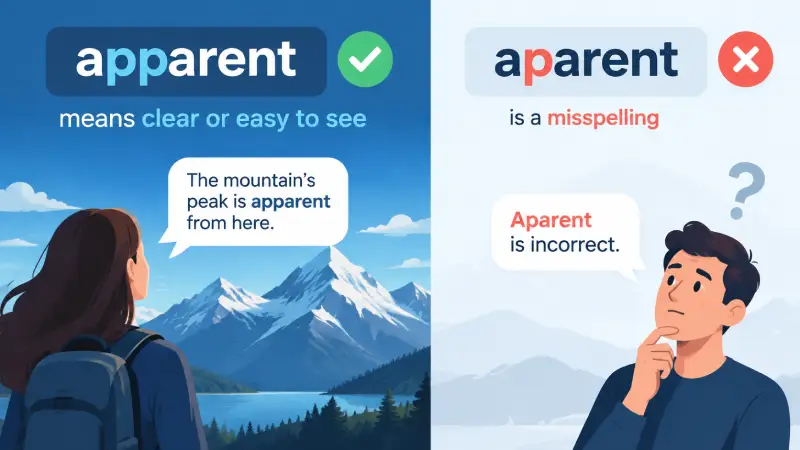
Apparent is the correct spelling in standard American English. Aparent is incorrect when you mean the adjective apparent.
The word apparent can describe something that is easy to see or understand, or something that seems to be true based on the information available. For example:
It became apparent that the meeting had been canceled.
The most common spelling mistake is leaving out the second p:
- Correct: apparent
- Incorrect: aparent
This is a spelling issue, not a difference between two English words. There is no standard US-English meaning that makes aparent the appropriate choice.
What Does Apparent Mean?
Apparent is an adjective. It has two closely related uses.
First, it can mean obvious, clear, or easy to notice.
The damage to the roof was apparent after the storm.
In this sentence, the damage was clearly visible.
Second, apparent can mean seeming or appearing to be true, even though the situation may be more complicated.
Her apparent confidence disappeared when the interview began.
Here, her confidence seemed real at first, but the sentence leaves room for a different reality.
This distinction matters because apparent does not always mean unquestionably true. Depending on context, it can describe something that is obvious or something that merely appears to be the case.
Apparent vs. Aparent: The Basic Difference
| Word | Correct? | Part of Speech | Meaning |
|---|---|---|---|
| apparent | Yes | Adjective | Obvious, clear, visible, or seeming |
| aparent | No | — | Misspelling of apparent |
The spelling difference is only one letter, but that missing p makes aparent nonstandard.
A useful way to see the correct spelling is:
ap + parent = apparent
The word has two p’s immediately after the initial a:
a-p-p-a-r-e-n-t
Not:
a-p-a-r-e-n-t
Why Is Apparent Spelled With Two Ps?
The double p is part of the established spelling of apparent. The word entered English through French and ultimately traces back to Latin apparens, related to the verb apparere, meaning “to appear.” The spelling has been established in English as apparent.
You do not need to memorize the etymology to spell the word correctly. The important practical point is that apparent always contains two consecutive p’s in standard English.
Think:
APParent
The beginning looks like app, which helps distinguish it from the common misspelling aparent.
When to Use Apparent
1. When something is obvious or clear
Use apparent when a fact or situation has become easy to recognize.
The reason for the delay was immediately apparent.
It was apparent that the team needed more time.
The mistake became apparent during the final review.
The difference in quality was apparent from the beginning.
After several tests, the problem became apparent to the engineers.
In these examples, apparent means something like obvious or clear.
2. When something seems to be true
Apparent can also describe something that appears to be true, without necessarily confirming that it really is.
The company’s apparent success did not tell the whole story.
His apparent interest in the project faded quickly.
There was an apparent conflict between the two reports.
Her apparent reluctance may have been caused by uncertainty.
The apparent simplicity of the task was misleading.
Here, the word signals that the appearance or evidence may not tell the complete story.
3. In professional and academic writing
Apparent is particularly useful when you want to describe an observation without making an unnecessarily absolute claim.
For example:
There is an apparent connection between the two findings.
This is more cautious than:
There is a definite connection between the two findings.
The writer is saying that the connection seems clear from the available information while leaving room for further investigation.
Natural Example Sentences With Apparent
Here are examples from different contexts.
Everyday English
It was apparent from her expression that something was wrong.
The stain became apparent when the sunlight hit the wall.
Work and business
The benefits of the new system quickly became apparent to the staff.
An apparent error in the report needs to be corrected before publication.
School and academic writing
The results made the difference between the two groups apparent.
The author’s main argument becomes apparent in the final section.
News and formal writing
The full impact of the decision was not immediately apparent.
Officials said the cause of the outage was still unclear despite an apparent failure in the system.
Everyday conversation
It was pretty apparent that he had forgotten about the appointment.
The apparent problem turned out to be something else entirely.
These examples show that apparent works in casual, professional, academic, and formal contexts.
When Is Aparent Correct?
In standard English, aparent is not the correct spelling of the adjective apparent.
For example:
Wrong: The reason was aparent to everyone.
Right: The reason was apparent to everyone.
Another example:
Wrong: Her aparent confidence impressed the interviewers.
Right: Her apparent confidence impressed the interviewers.
The missing p is a spelling error rather than a meaningful grammatical variation.
Common Mistakes With Apparent
Mistake 1: Writing “aparent”
This is the most direct spelling error.
Wrong:
The problem was aparent immediately.
Right:
The problem was apparent immediately.
If you are unsure, check whether the word contains app at the beginning.
Mistake 2: Writing “apparant”
Another common mistake changes the ending.
Wrong:
The difference was apparant.
Right:
The difference was apparent.
The ending is -ent, not -ant.
The correct spelling is:
a-p-p-a-r-e-n-t
Mistake 3: Writing “aparent” because of pronunciation
In normal speech, the repeated p may not feel prominent. As a result, someone who learns the word primarily through listening may leave out one of the letters when writing it.
If you know the word from speech but are unsure about its spelling, remember the visual pattern:
APPARENT
The first four letters are:
A-P-P-A
Mistake 4: Confusing apparent with appearance
These words are related, but they serve different grammatical functions.
Apparent is an adjective:
The apparent problem was easy to identify.
Appearance is a noun:
The problem’s appearance was unusual.
Do not use one simply because they sound related.
Mistake 5: Treating apparent as always meaning “certain”
This is a usage mistake rather than a spelling mistake.
Compare:
The cause of the problem was apparent.
This can mean the cause was obvious.
But:
His apparent confidence disappeared later.
Here, apparent can mean that the confidence seemed to exist.
Context determines whether the word emphasizes obviousness or appearance.
Apparent vs. Obvious
Apparent and obvious are often interchangeable, but they can have slightly different effects.
Obvious usually expresses a stronger sense that something is unmistakably clear.
It was obvious that the machine was broken.
Apparent can sound more neutral and is especially useful in formal writing.
It became apparent that the machine was malfunctioning.
Also, apparent has the additional sense of something that seems to be true.
The company’s apparent advantage disappeared later.
You would not normally use obvious in exactly the same way here.
Apparent vs. Evident
Evident is another close synonym.
The benefits were apparent after several months.
The benefits were evident after several months.
Both can mean that something is clear or noticeable.
However, apparent can sometimes emphasize what appears to be the case, while evident generally emphasizes that something can be clearly recognized from evidence or observation.
When you need to communicate uncertainty about an appearance, apparent is often the better choice.
Apparent vs. Seeming
Seeming and apparent can overlap when describing something that appears to be true.
His apparent lack of interest surprised us.
His seeming lack of interest surprised us.
Both suggest that the person’s lack of interest may not be the complete reality.
However, apparent is much more common and versatile in modern standard English.
Apparent vs. Apparently
These words are related but have different parts of speech.
Apparent is an adjective:
The error was apparent.
Apparently is an adverb:
Apparently, the error occurred during the final update.
Use apparent to modify a noun or describe a subject. Use apparently to modify a verb, adjective, or entire statement.
Compare:
Her apparent confidence surprised me.
Apparently, she was confident about the result.
How to Remember the Correct Spelling
The easiest memory trick is:
Remember “APP”
APPARENT begins with APP.
Think of the spelling as:
APP + ARENT
The first three letters are A-P-P.
If you write APARENT, one P is missing.
Another useful visual reminder is to connect it with other common English words beginning with app-:
- apparent
- appear
- appearance
- application
- appreciate
You do not need to memorize a complicated spelling rule. Just remember that apparent has two Ps.
Apparent in Real-World Context
Scenario 1: A workplace conversation
“Why was the report rejected?”
“The reason became apparent after we checked the figures. Two sections contained incorrect data.”
Here, apparent means clear or easy to understand.
Scenario 2: A text exchange
Sam: Is everything okay with Alex?
Mia: Apparently not. His apparent frustration during the meeting was pretty noticeable.
The first use, apparently, is an adverb. The second, apparent, is an adjective.
Scenario 3: An article-style passage
The company initially appeared to be expanding rapidly. However, its apparent growth masked several financial difficulties. Once the quarterly figures were released, those problems became more apparent.
This passage demonstrates both major ideas associated with the word: something that seems to be true and something that later becomes clear.
Does Apparent Mean “Obvious” or “Seeming”?
It can mean either, depending on context.
When something is apparent, it may be:
- Clearly visible or understood
- Seeming to be true or real
Compare these sentences:
The damage was apparent immediately.
Here, the damage was obvious.
The company’s apparent success was short-lived.
Here, the success appeared to be real, but the sentence suggests that the appearance may have been misleading.
This is one of the most important meaning distinctions to understand when using apparent accurately.
FAQs
Not as the standard English spelling of apparent. If you mean “obvious,” “clear,” or “seeming,” the correct spelling is apparent.
It is apparent, with two Ps. Aparent is a spelling mistake in standard English.
Apparent is an adjective meaning clear or obvious in some contexts and seeming or appearing to be true in others.
Yes. Apparent is an adjective. For example: “The cause of the problem was apparent.”
Apparent is an adjective, while apparently is an adverb. Compare “the apparent cause” with “apparently, the cause was different.”
Conclusion
Apparent = correct spelling
Aparent = incorrect spelling
Remember:
APPARENT → two Ps
Use apparent when something is:
- obvious or clear: “The mistake was apparent.”
- seeming or appearing true: “His apparent confidence was misleading.”
The correct spelling is always:
A-P-P-A-R-E-N-T

Olivia Smith is a US English writer and language enthusiast who specializes in spelling, word choice, and commonly confused words. She creates clear, practical guides that help readers understand the correct spelling, meaning, and usage of English words.
At GrammarPool.com, Olivia focuses on spelling-choice topics, common spelling mistakes, and easy-to-understand explanations for everyday English users. Her writing is designed to make confusing word choices simple, accurate, and easy to remember.
Expertise: US English, spelling, word choice, commonly confused words, grammar, and language usage.