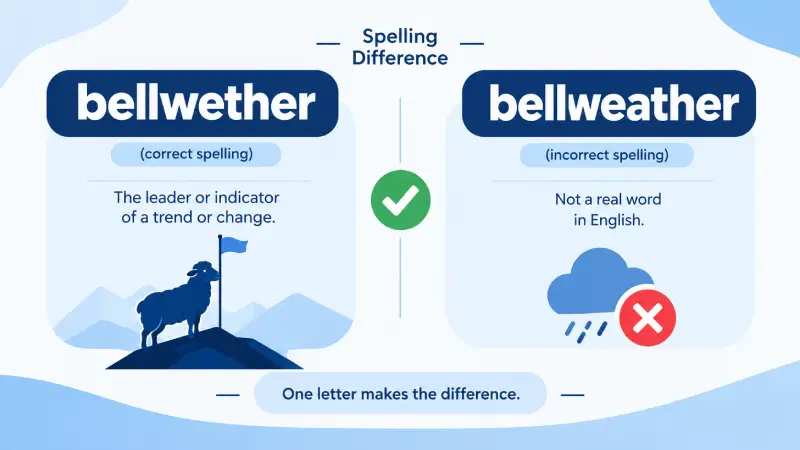
Bellwether is the correct spelling. Bellweather is a common misspelling.
The word bellwether is a noun that originally referred to a sheep wearing a bell that led a flock. Today, it is more often used figuratively for a person, group, company, trend, or event that serves as a reliable indicator of what is likely to happen next.
For example:
The company is considered a bellwether for the technology industry.
The spelling bellweather looks reasonable because the word contains weather, but that is not its origin or correct spelling. The correct form is bellwether, with wether rather than weather.
Bellwether vs Bellweather: Quick Answer
| Word | Correct? | Meaning |
|---|---|---|
| bellwether | ✅ Correct | A person, group, thing, or trend that indicates what is likely to happen next |
| bellweather | ❌ Incorrect | Common misspelling of bellwether |
If you are writing for a US English audience, use bellwether.
What Does Bellwether Mean?
Bellwether is a noun with both a historical and a modern figurative meaning.
Historically, a bellwether was a wether, or castrated male sheep, that wore a bell and led a flock. The bell made it easier for shepherds to identify and follow the lead sheep.
Over time, the word developed a broader meaning. Today, a bellwether is something that provides an indication of future developments, trends, or changes.
For example:
- The stock is a bellwether for the technology sector.
- The election was viewed as a bellwether for the country.
- Consumer spending can be a bellwether of economic health.
- The company has become a bellwether in the industry.
In each example, the bellwether is viewed as an indicator of something larger.
Bellwether in Simple English
You can think of bellwether as meaning:
“Something that gives you a clue about what is coming next.”
It does not necessarily predict the future with certainty. Instead, it is considered a useful sign or indicator of a broader trend.
Is Bellwether or Bellweather Correct?
Bellwether is correct.
Bellweather is incorrect when you intend to use the standard English word meaning an indicator or leader.
The confusion happens because weather is a very familiar English word. People may naturally combine bell + weather and assume that bellweather is the correct spelling.
However, the word is actually formed from bell + wether.
Correct:
bellwether
Incorrect:
bellweather
The key difference is the extra a in weather.
Why Is Bellwether Spelled With Wether?
The spelling makes more sense when you know the word’s history.
A wether is a castrated male sheep. A shepherd could place a bell around the neck of this sheep because it led or stayed at the front of the flock.
That produced the term bellwether.
So:
bell + wether = bellwether
The word weather has a completely different meaning. It refers to atmospheric conditions, such as rain, snow, wind, heat, and sunshine.
Therefore, bellweather is not the historical construction of the word.
Bellwether Meaning and Usage
Modern English usually uses bellwether in a figurative sense.
It can describe several types of indicators.
1. A Market Indicator
A company or stock can be called a bellwether when its performance gives clues about the condition of a larger market or industry.
Example:
The company’s quarterly results are a bellwether for the retail sector.
This means the company’s results may indicate how other retailers are performing.
2. A Political Indicator
A state, district, or election can be described as a bellwether when its results are thought to reflect broader political trends.
Example:
The district has long been considered a bellwether in national elections.
Here, the district’s voting pattern may provide clues about the wider political environment.
3. A Business or Industry Leader
A company can become a bellwether when its actions or performance influence or reflect an entire industry.
Example:
The manufacturer is a bellwether for the automotive industry.
The company is viewed as an important indicator of industry conditions.
4. A Social or Cultural Trend
A product, behavior, or event may also serve as a bellwether for changing public preferences.
Example:
The popularity of electric vehicles may be a bellwether of changing consumer habits.
The trend provides an indication of where consumer behavior may be heading.
Bellwether Examples in Sentences
Here are several natural examples of the correct spelling:
- The company’s sales are a bellwether for the broader retail market.
- The small state is often viewed as a bellwether in presidential elections.
- Housing prices can be a bellwether of economic conditions.
- The new product became a bellwether for changing consumer preferences.
- The newspaper has served as a bellwether of public opinion.
- Investors watched the company’s earnings as a bellwether for the technology sector.
- The team’s performance became a bellwether for the league’s changing competitive balance.
- Her decision was seen as a bellwether of a larger cultural shift.
Notice that bellwether is generally used as a noun.
Bellwether as a Metaphor
One reason bellwether appears frequently in formal writing is that it works well as a metaphor.
The original image is a sheep wearing a bell and leading a flock. In modern usage, the idea of a “leader” or “indicator” has become more important than the literal sheep.
For example:
The city is a bellwether for emerging restaurant trends.
The city does not literally lead a flock. Instead, its restaurant trends may provide an early indication of what could become popular elsewhere.
This figurative meaning is now much more common than the original literal meaning.
Common Mistakes With Bellwether
Because bellwether is not an everyday word for many readers, several spelling errors can occur.
1. Bellweather
Incorrect: bellweather
Correct: bellwether
This is the most obvious spelling confusion.
The incorrect version adds the a found in weather.
2. Bellwhether
Some writers may also confuse wether with whether.
Incorrect: bellwhether
Correct: bellwether
Remember that whether is used when discussing alternatives or possibilities.
For example:
I don’t know whether she will come.
That has nothing to do with bellwether.
3. Bell Weather
Writing the term as two separate words is also incorrect when you mean the established noun.
Incorrect: bell weather
Correct: bellwether
The standard form is one word.
Bellwether vs Weather
Understanding the difference between wether and weather can make this spelling easier to remember.
| Word | Meaning | Example |
|---|---|---|
| wether | A castrated male sheep | The shepherd watched the wether closely. |
| weather | Atmospheric conditions | The weather is sunny today. |
| bellwether | An indicator or leader | The company is a bellwether for the industry. |
The word bellwether contains wether, not weather.
How to Remember the Spelling of Bellwether
A simple memory trick is:
Bell + Wether = Bellwether
Think about the original meaning:
A wether is a sheep.
A bellwether is a wether wearing a bell.
So when you see bellwether, remember:
The sheep wears the bell.
Do not add the a from weather.
Another useful trick is to break the word into two parts:
BELL + WETHER
Not:
BELL + WEATHER
This makes the correct spelling much easier to recall.
Bellwether vs Bellweather in American English
In American English, bellwether is the standard spelling.
There is no standard US English distinction where bellweather has a separate meaning. If you use bellweather when referring to an indicator or trend, most readers will understand what you intended, but they will recognize it as a spelling error.
For professional writing, academic work, business content, news writing, and other formal contexts, use bellwether.
When Should You Use Bellwether?
Use bellwether when you want to describe something that serves as an indicator of a larger development.
Common contexts include:
- Bellwether stock
- Bellwether company
- Bellwether state
- Bellwether district
- Bellwether industry
- Bellwether market
- Bellwether product
- Bellwether trend
- Bellwether election
For example:
The company’s results are closely watched because it is a bellwether stock.
This means investors consider the company’s performance a useful indicator of broader market or industry conditions.
Bellwether in Business Writing
The word is particularly useful when discussing companies and markets.
Consider this sentence:
The retailer is a bellwether for consumer spending.
The writer is saying that the retailer’s performance can provide clues about consumer spending more generally.
Another example:
Analysts viewed the earnings report as a bellwether for the entire industry.
Here, the report is considered an indicator of what may happen across the industry.
Because bellwether has a specific meaning, it can be more precise than simply saying something is “important.”
Bellwether in Political Writing
The term is also common in political discussions.
A particular location may be called a bellwether if its voting behavior has historically provided clues about broader election results.
For example:
The county is considered a bellwether because its voters often reflect national trends.
The term does not mean that the county always determines the election. Instead, it suggests that the county’s results may be a useful indicator.
Bellwether vs Indicator
Bellwether and indicator are related, but they are not always interchangeable.
An indicator is something that shows or suggests a condition or trend.
A bellwether is often a person, group, organization, place, product, or event whose behavior or performance is viewed as an indicator of something broader.
For example:
Rising unemployment is an indicator of economic weakness.
But:
The company is a bellwether for the technology industry.
The first sentence describes a sign. The second describes a specific entity that serves as a broader signal.
Is Bellwether a Noun or an Adjective?
Bellwether is primarily a noun.
Examples:
- The company is a bellwether.
- The state became a political bellwether.
- Investors follow the stock as a bellwether.
It is also commonly used before another noun in compounds and noun phrases:
- bellwether company
- bellwether stock
- bellwether state
- bellwether election
- bellwether indicator
In these phrases, bellwether modifies the following noun, but dictionaries generally classify the word itself as a noun.
Bellwether Plural Form
The plural form is bellwethers.
Singular:
The company is a bellwether.
Plural:
Several companies have become bellwethers for the industry.
Simply add -s to form the plural.
Real-World Scenarios
Understanding how the word works in context makes its meaning easier to remember.
Scenario 1: Technology
A major technology company’s sales rise sharply before a broader technology boom.
You could say:
The company’s sales are a bellwether for the technology market.
Scenario 2: Elections
A particular county has frequently voted in line with national election outcomes.
You could say:
The county is a political bellwether.
Scenario 3: Consumer Behavior
A popular product category becomes successful before similar products take off elsewhere.
You could say:
The product became a bellwether for changing consumer preferences.
Scenario 4: Economy
A major retailer reports unusually strong sales, giving analysts clues about consumer confidence.
You could say:
The retailer’s earnings are a bellwether for consumer spending.
FAQs
Yes. Bellwether is the correct spelling. Bellweather is a misspelling.
A bellwether is a person, group, company, place, event, or trend that serves as an indicator of broader developments or future trends.
Because the word comes from bell + wether. A wether is a castrated male sheep. Weather is a different word referring to atmospheric conditions.
Not as the standard spelling of the noun meaning an indicator or leader. In that context, use bellwether.
Remember bell + wether. A wether is a sheep, and the original bellwether was a sheep wearing a bell.
The plural is bellwethers.
Conclusion
Bellwether is the correct spelling, while bellweather is a common misspelling.
The easiest way to remember the difference is to focus on wether, not weather. A wether is a castrated male sheep, and historically a bellwether was a sheep that wore a bell and led a flock.
Today, bellwether usually has a figurative meaning. It describes something that acts as an indicator of a larger trend or development. You may see the word in discussions about business, politics, markets, economics, technology, and consumer behavior.
So, when you mean an indicator or trend-setter, always choose:
✅ Bellwether
❌ Bellweather

Olivia Smith is a US English writer and language enthusiast who specializes in spelling, word choice, and commonly confused words. She creates clear, practical guides that help readers understand the correct spelling, meaning, and usage of English words.
At GrammarPool.com, Olivia focuses on spelling-choice topics, common spelling mistakes, and easy-to-understand explanations for everyday English users. Her writing is designed to make confusing word choices simple, accurate, and easy to remember.
Expertise: US English, spelling, word choice, commonly confused words, grammar, and language usage.