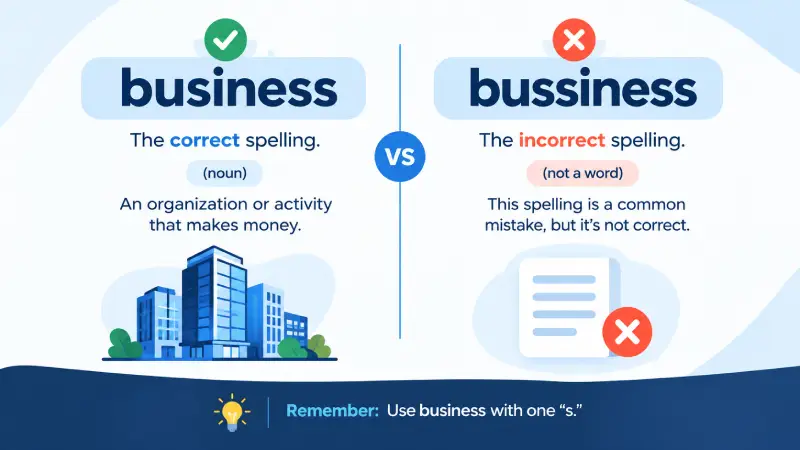
Business is the correct spelling. Bussiness is a misspelling and is not the standard spelling of the English word.
Use business when you mean a company, commercial activity, a profession or field of work, someone’s affairs, or a matter that needs attention. The word is a noun, and its standard spelling is B-U-S-I-N-E-S-S. Merriam-Webster and American Heritage both list business as the standard English form.
The Rule: Business Is Correct, Bussiness Is Not
This is a spelling issue, not a difference between two valid words.
The correct spelling is:
Business ✅
The incorrect spelling is:
Bussiness ❌
The most common mistake is adding an extra s after bus. The word is spelled:
B-U-S-I-N-E-S-S
not:
B-U-S-S-I-N-E-S-S
Although business contains two s letters near the end, they are not placed together after bus. The correct sequence is bus + iness, visually:
BUSINESS
The pronunciation can make the spelling even more confusing. In American English, business is commonly pronounced approximately BIZ-nəs, rather than sounding like every letter in the spelling is pronounced separately. Merriam-Webster gives the pronunciation as ˈbiz-nəs and lists the word as a noun.
That means you should not try to spell the word only from its pronunciation.
What Does Business Mean?
Business has several common meanings, but they all use the same spelling.
1. Business as a company or commercial enterprise
A business can be an organization that sells products or services.
She owns a small clothing business.
His family runs a construction business.
The business opened a second location downtown.
Their business provides accounting services to local companies.
American Heritage defines business in part as a commercial enterprise or establishment, while Merriam-Webster includes a commercial or industrial enterprise among its meanings.
2. Business as commercial activity
The word can also describe buying, selling, trading, or other commercial activity.
Online business has changed the way many companies reach customers.
The store gets most of its business from local residents.
Business was slow during the winter.
The company hopes to attract more business this year.
Here, business does not necessarily refer to one particular company. It can refer to the amount or type of commercial activity taking place.
3. Business as a profession or field
You can use business to describe a particular area of work or commercial activity.
She works in the publishing business.
He has spent years in the technology business.
They are both interested in the restaurant business.
She wants to study business in college.
This use is especially common in phrases such as the music business, the insurance business, the real estate business, and the restaurant business.
4. Business as someone’s concern or affairs
Business can also refer to something that concerns a person.
That’s none of your business.
I don’t want to discuss my personal business at work.
She prefers to keep her family business private.
In the familiar expression none of your business, the word does not mean a company. It means something that is another person’s private concern. Merriam-Webster and American Heritage both recognize this meaning.
5. Business as a matter or task
The word can also refer to an issue, matter, or task that needs attention.
We have some important business to discuss.
Let’s get down to business.
The meeting covered several pieces of business.
We still have one item of business to finish.
This explains expressions such as business as usual and unfinished business.
Why Is Business Spelled This Way?
The spelling of business does not closely match its modern pronunciation, which makes it a common spelling problem.
The word comes from Middle English forms related to busy, ultimately developing through the noun-forming -ness pattern. Merriam-Webster traces business to Middle English bisynesse, from bisy meaning “busy,” and dates its first known use to the 14th century.
For modern writers, however, the historical development is less important than remembering the established spelling.
A useful visual breakdown is:
BUS + INESS = BUSINESS
Do not turn the middle of the word into BUSS.
Compare:
business ✅
bussiness ❌
The spelling business is used in American English and does not change simply because the word appears in a different context.
Business vs. Bussiness: Side-by-Side Comparison
| Feature | Business | Bussiness |
|---|---|---|
| Standard English spelling | Yes | No |
| Correct in American English | Yes | No |
| Part of speech | Noun | Not a standard English word |
| Meaning | Company, commercial activity, profession, affair, matter, etc. | None as a standard English spelling |
| Correct letter order | B-U-S-I-N-E-S-S | B-U-S-S-I-N-E-S-S |
| Suitable for formal writing | Yes | No |
| Suitable for school writing | Yes | No |
| Suitable for professional writing | Yes | No |
There is no situation in ordinary standard English where you should choose bussiness instead of business.
Examples of Correct Business Usage
Everyday English
- I need to take care of some business before dinner.
- Her family owns a small business.
- The store is open for business.
- That’s none of your business.
- We should get down to business.
- He is thinking about starting his own business.
School and academic writing
- Small businesses contribute to local economies.
- She plans to study business after high school.
- The report examines how technology affects modern business.
- The students created a business plan for their project.
- Business management requires strong organizational skills.
Professional writing
- Our business has expanded into three new markets.
- The company wants to increase business from existing customers.
- Please send the updated business proposal by Friday.
- We discussed several important items of business during the meeting.
- The new strategy could help the business reduce operating costs.
Formal writing
- The agreement protects both parties’ business interests.
- The report examines changes in international business.
- The organization has developed a sustainable business model.
- The board reviewed the company’s business operations.
Common Mistakes With Business
Mistake 1: Adding an extra S
This is the defining spelling error in bussiness.
Wrong: She owns a successful bussiness.
Right: She owns a successful business.
Remember that the letters immediately after bu are s-i, not s-s.
Mistake 2: Writing Bussiness in a business name
Someone may accidentally use the misspelling in a website, résumé, presentation, business plan, or social media profile.
Wrong: Welcome to our new Bussiness website.
Right: Welcome to our new Business website.
This matters particularly in professional writing because a spelling error in a company description can make otherwise polished material look careless.
Mistake 3: Misspelling the plural
The plural of business is businesses.
Wrong: Several new bussinesses opened downtown.
Right: Several new businesses opened downtown.
Notice that the plural adds -es to the correct spelling.
Mistake 4: Using the pronunciation to guess the spelling
The word is pronounced roughly like BIZ-nəs, so a writer may not naturally hear all the letters in the spelling.
Wrong: The bizness is growing quickly.
Right: The business is growing quickly.
Biz is a real informal word meaning business, but it is not the standard spelling of business in formal writing. Merriam-Webster lists biz as an informal noun meaning “business.”
Mistake 5: Adding the extra S when typing quickly
The error can happen when someone mentally divides the word as bus + siness.
Wrong: The company expanded its bussiness operations.
Right: The company expanded its business operations.
A quick visual check of the middle of the word can catch this mistake.
How to Remember Business Fast
The easiest trick is to focus on the middle:
BUSINESS
Think:
BUS + INESS
Do not write:
BUS + SINESS
Another useful memory trick is to remember that business contains the word bus at the beginning, followed by iness:
BUSINESS
You can also connect it with related words:
- business
- businesses
- businessman
- businesswoman
- businesslike
- businessperson
The spelling begins with business, not bussiness.
Business in Real-World Context
A text exchange
Alex: Are you still working on your new business?
Jordan: Yes. I’m finishing the website tonight.
Alex: Nice. I hope the business takes off quickly.
Here, business refers to a commercial enterprise.
A professional email
We appreciate your business and look forward to working with you again. Please contact our customer service team if you have any questions about your order.
This is a common professional use of business to mean a customer’s commercial dealings with a company.
An article-style context
Small businesses continue to adapt to changing customer expectations. Many owners are investing in online services, digital marketing, and flexible payment options to remain competitive.
In this context, businesses refers to commercial organizations rather than one particular company.
Business vs. Biz
Biz is worth mentioning because it can look like another spelling of business, but the two forms have different levels of formality.
Business is the standard form and should be used in formal, academic, professional, and general writing.
Biz is an informal noun meaning business. Merriam-Webster lists it as an informal word and provides examples such as “the film biz.”
For example:
She works in the music business.
is appropriate in virtually any context.
She works in the music biz.
is more casual and conversational.
This does not make bussiness acceptable. Biz is an established informal word, while bussiness is simply a misspelling.
Business vs. Businesses
Another useful distinction is between business and businesses.
Business is singular:
The business is growing.
Businesses is plural:
Several businesses are growing.
The plural form changes the ending:
business → businesses
Do not write:
businesses → bussinesses
The spelling error remains incorrect when the word becomes plural.
Business vs. Busy
The words business and busy are related historically, but they have different grammatical functions today.
Busy is an adjective meaning occupied or actively engaged.
I’m busy right now.
Business is a noun with meanings including commercial activity, an enterprise, an affair, or a matter.
I have some business to finish.
Their relationship can help explain why the spelling of business does not simply look like the pronunciation of busy. The modern words have developed different forms and uses.
Is Bussiness Ever Correct?
In standard English writing, bussiness is not the correct spelling of business.
If you are writing an essay, résumé, email, website, report, business plan, application, or professional document, use business.
A separate proper name, username, brand, or account could theoretically contain the letters bussiness by deliberate choice. That does not make it the standard English spelling of the noun.
For normal English usage, the rule is simple:
business is correct.
bussiness is incorrect.
FAQs
Business is correct. Bussiness is a misspelling.
The pronunciation of business is much shorter than its spelling, and writers may incorrectly insert an extra s after bus. The correct spelling is B-U-S-I-N-E-S-S.
Spell it business: B-U-S-I-N-E-S-S. A useful reminder is BUS + INESS, not BUS + SINESS.
The plural is businesses.
The city has several new businesses.
Biz is a recognized informal word meaning business, but it is not normally appropriate as a replacement for business in formal writing. Bussiness, however, is simply a misspelling.
Conclusion
Business is the correct spelling, while bussiness is a misspelling. The word business is a noun that can refer to a company, commercial activity, profession, personal concern, or matter requiring attention. The most reliable way to avoid the error is to remember the exact sequence B-U-S-I-N-E-S-S. If you are writing for school, work, a website, or any professional audience, always use business.

Olivia Smith is a US English writer and language enthusiast who specializes in spelling, word choice, and commonly confused words. She creates clear, practical guides that help readers understand the correct spelling, meaning, and usage of English words.
At GrammarPool.com, Olivia focuses on spelling-choice topics, common spelling mistakes, and easy-to-understand explanations for everyday English users. Her writing is designed to make confusing word choices simple, accurate, and easy to remember.
Expertise: US English, spelling, word choice, commonly confused words, grammar, and language usage.