
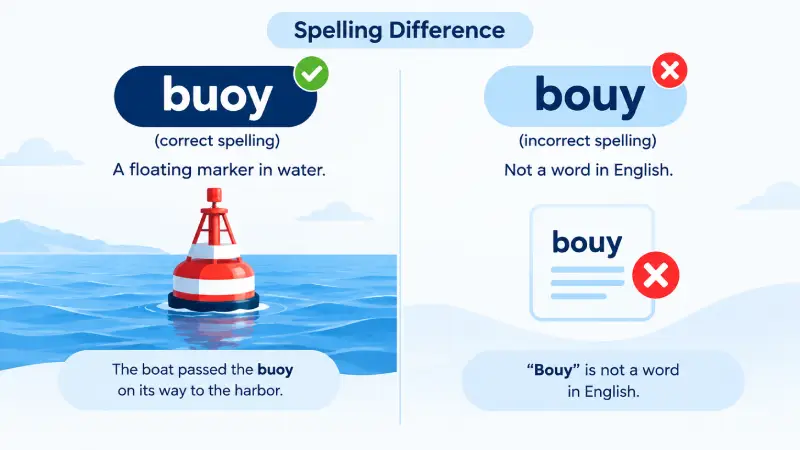
Buoy is the correct spelling. Bouy is a misspelling and is not a standard English word. Use buoy when referring to a floating object in water or when using the verb meaning to keep something afloat, support something, or encourage someone.
The confusion mainly comes from the unusual order of the vowels in buoy. The correct spelling is B-U-O-Y, not B-O-U-Y.
The Rule: Buoy Is Correct, Bouy Is Not
The issue here is spelling, not grammar or a difference in meaning between two valid English words.
Buoy is a standard English word with both noun and verb uses. Bouy is simply a misspelling of buoy. It does not function as a separate standard English word with its own definition.
As a noun, buoy refers to a floating object placed in water. A buoy may mark a channel, indicate a hazard, identify a particular location, help with navigation, or serve another purpose. American Heritage defines it as a float placed in water and usually moored for purposes such as marking a location or recording oceanographic information.
For example:
The captain steered the boat around the red buoy.
Here, buoy is a noun because it names a physical object.
As a verb, buoy can mean to keep something afloat or support it physically. It can also mean to support, encourage, or lift someone’s spirits in a figurative sense. American Heritage lists meanings including keeping something afloat, maintaining something at a high level, and heartening or inspiring someone.
For example:
The encouraging news buoyed the team’s confidence.
Here, buoyed is a verb meaning that the good news increased or supported the team’s confidence.
The important point is that the spelling remains buoy in both uses.
Why Is Buoy Spelled B-U-O-Y?
The spelling buoy is unusual because its vowel sequence does not look the way many English speakers expect.
A reader may naturally be tempted to write bouy, especially after hearing the word pronounced. However, the established spelling is B-U-O-Y.
The American Heritage Dictionary gives the word as buoy and traces it through Middle English boie and Old French boue, with a probable Germanic origin. The modern spelling therefore should not be reconstructed simply from the way the word sounds.
This is an important spelling lesson: English spelling does not always allow you to predict the correct letter order from pronunciation alone.
The safest form to memorize is:
BUOY = B + U + O + Y
Not:
BOUY = B + O + U + Y
The same spelling buoy is used in related words such as buoyant and buoyancy, which can also help reinforce the correct letter sequence.
What Does Buoy Mean?
The word buoy has several closely related uses.
1. Buoy as a noun
A buoy is a floating object placed in water for a particular purpose. Depending on the situation, it may mark a navigation channel, warn boaters about a hazard, identify an area, or serve a scientific or practical function.
Examples:
- The fisherman tied his boat near the buoy.
- A yellow buoy marked the swimming area.
- The sailor watched the buoy as the boat entered the channel.
- We could see several buoys floating offshore.
- The Coast Guard replaced the damaged buoy.
- The map showed the location of each navigation buoy.
The word also appears in expressions such as life buoy, which refers to a floating device designed to help keep a person afloat.
2. Buoy as a verb
As a verb, buoy can describe physically keeping something afloat.
For example:
The air inside the chamber buoyed the platform above the water.
It can also have a figurative meaning. To buoy someone can mean to encourage, hearten, or give that person greater confidence or hope.
Examples:
- Her coach’s encouragement buoyed her confidence.
- The strong sales figures buoyed the company’s outlook.
- His friends’ support buoyed him during a difficult week.
- The unexpected victory buoyed the players’ morale.
- Positive feedback buoyed the writer’s enthusiasm.
- The good news buoyed investors’ optimism.
Notice that the verb can be used with forms such as buoy, buoys, buoyed, and buoying.
Buoy vs. Bouy: Side-by-Side Comparison
| Feature | Buoy | Bouy |
|---|---|---|
| Standard spelling | Yes | No |
| Standard English word | Yes | No |
| Noun | Yes | No |
| Verb | Yes | No |
| Main physical meaning | Floating marker or device | No standard meaning |
| Figurative meaning | Support or encourage | No standard meaning |
| Correct letter order | B-U-O-Y | B-O-U-Y |
| Use in American English | Yes | No |
| Recommended in formal writing | Yes | No |
There is therefore no meaning-based choice between the two forms. You do not choose buoy for one situation and bouy for another. You simply use buoy.
Examples of Correct Usage
Everyday and conversational English
We passed a buoy while kayaking along the coast.
Don’t swim beyond the orange buoy.
The boat was anchored close to a small buoy.
I saw a buoy floating near the dock.
The children learned what the different buoys meant.
School and academic writing
The researchers placed a buoy in the ocean to collect environmental data.
A buoy can provide useful information about conditions on the water.
The diagram shows a boat approaching a navigation buoy.
The instructor explained how buoys help mark safe routes for vessels.
Professional and technical writing
The maintenance crew inspected the navigation buoy before reopening the channel.
The damaged buoy was removed and replaced with a new marker.
The research team deployed a buoy to monitor conditions offshore.
Improved consumer demand buoyed the company’s quarterly outlook.
Formal and figurative writing
The award buoyed her spirits after several disappointing setbacks.
The additional funding buoyed the nonprofit’s plans for expansion.
His words of encouragement buoyed the young athlete’s confidence.
The successful launch buoyed expectations for the company’s next project.
Common Mistakes With Buoy
Mistake 1: Reversing the vowels
The most common error is writing bouy instead of buoy.
Wrong: The boat passed a red bouy.
Right: The boat passed a red buoy.
The problem is the order of u and o.
Mistake 2: Spelling the word from pronunciation
Because the pronunciation does not make the spelling obvious, someone who hears the word may try to reconstruct it incorrectly.
Wrong: The sailor moved toward the bouy.
Right: The sailor moved toward the buoy.
When a word has an unusual spelling, pronunciation alone is not always a reliable spelling guide.
Mistake 3: Using bouy in professional writing
A misspelling can easily survive a quick draft, particularly when the writer is unfamiliar with maritime vocabulary.
Wrong: The report identified three damaged bouys.
Right: The report identified three damaged buoys.
The plural of buoy is buoys, not bouys.
Mistake 4: Confusing buoy with similar-looking words
English contains many words with ou, so bouy may look visually plausible. However, familiarity with other words should not change the established spelling of buoy.
Wrong: The warning bouy was visible from shore.
Right: The warning buoy was visible from shore.
Mistake 5: Carrying the misspelling into related forms
Once someone remembers the incorrect form bouy, they may produce related forms such as bouyed or bouyancy.
The correct forms are:
- buoy
- buoys
- buoyed
- buoying
- buoyant
- buoyancy
For example:
Wrong: The good news bouyed her spirits.
Right: The good news buoyed her spirits.
How to Remember Buoy Quickly
The simplest memory trick is to memorize the four letters in order:
BUOY
Think:
BU + OY
The U comes before the O.
A second useful connection is the word family:
buoy → buoyant → buoyancy
If you already know buoyant or buoyancy, the shared beginning can help you remember the spelling of buoy.
You can also associate the word with the phrase:
“A BUOY floats.”
The key is not to rely on the sound of the word. Remember its visual spelling instead.
Buoy in Real-World Context
A text exchange
Mia: Where should we meet at the lake?
Jordan: Near the orange buoy by the swimming area.
Mia: Got it. I’ll look for the orange buoy.
Both uses are straightforward. Buoy names a physical floating marker.
A professional email
The inspection team found that the navigation buoy had moved from its designated position after the storm. A replacement buoy will be installed before the channel reopens.
Here, buoy is used as a technical noun in a professional context.
An article-style context
Strong customer demand buoyed the company’s outlook for the second half of the year. Executives said the improved results gave the organization greater confidence in its expansion plans.
Here, buoyed is a figurative verb. It does not mean that customer demand physically floated the outlook. Instead, it means the demand supported or improved the company’s outlook.
Buoy, Buoyant, and Buoyancy
These related words are easy to confuse when spelling is the main concern, but they have different grammatical functions.
Buoy can be a noun or a verb.
The buoy marked the channel.
The good news buoyed her spirits.
Buoyant is an adjective. It can describe something that tends to float or something characterized by optimism, confidence, or strength.
The material is naturally buoyant.
Consumer confidence remained buoyant.
Buoyancy is a noun. It refers to the ability or tendency to float and can also describe a figurative quality of optimism or resilience.
The buoyancy of the material keeps the object above water.
Knowing this word family makes the spelling easier because all three forms preserve the buoy sequence.
Buoy vs. Boy
Buoy and boy can sound alike in one common pronunciation, but they are completely different words.
Boy refers to a male child or young male person.
The boy was playing near the beach.
Buoy refers to the floating object or, as a verb, to support or encourage.
The boat passed a buoy.
This is a good example of why pronunciation alone cannot determine spelling. When writing, the surrounding meaning tells you which word you need.
Buoy vs. Buy
Buy is also a different word.
Buy is a verb meaning to obtain something by paying for it.
We need to buy a new life jacket.
Buoy refers to the floating object or means to support or encourage.
The boat passed a buoy.
Although buy and buoy may sound similar in some pronunciations, their meanings and spellings are different.
Buoy vs. Buoyancy
These words belong to the same word family but are not interchangeable.
Buoy can name a floating object or function as a verb.
The buoy was visible from the shore.
Buoyancy is a noun describing the tendency or ability to float, as well as certain figurative qualities.
The material has excellent buoyancy.
A sentence requiring the name of the object needs buoy, not buoyancy.
Is There an Exception for Bouy?
For standard English spelling, there is no usage exception in which bouy becomes the correct spelling of the English word buoy.
You may encounter Bouy as part of a proper name, place name, surname, or another name from outside ordinary English vocabulary. Such a proper name would need to be preserved as written. That does not make bouy an alternative spelling of the standard English word buoy.
For ordinary American English writing, use buoy.
FAQs
Buoy is correct. Bouy is a misspelling when you mean the floating object or the verb meaning to support or encourage.
The unusual vowel order makes the word easy to misspell. People may write bouy because that sequence looks familiar and may seem more natural when trying to spell the word from its pronunciation.
The correct spelling is B-U-O-Y. Remember that the U comes before the O.
As a noun, a buoy is a floating object used in water for purposes such as marking locations, navigation, or safety. As a verb, buoy can mean to keep something afloat or to support, encourage, or lift someone’s spirits.
Bouy is not the standard spelling of the English word buoy. It is generally treated as a misspelling of buoy.
Conclusion
- Buoy = correct spelling.
- Bouy = misspelling.
- Buoy can be a noun meaning a floating marker or device.
- Buoy can also be a verb meaning to keep afloat, support, encourage, or uplift.
- The correct letter order is B-U-O-Y.
- The plural is buoys.
- Related forms include buoyed, buoying, buoyant, and buoyancy.
- The easiest memory trick is: U comes before O in BUOY.
- In standard American English, always write buoy, not bouy.

Olivia Smith is a US English writer and language enthusiast who specializes in spelling, word choice, and commonly confused words. She creates clear, practical guides that help readers understand the correct spelling, meaning, and usage of English words.
At GrammarPool.com, Olivia focuses on spelling-choice topics, common spelling mistakes, and easy-to-understand explanations for everyday English users. Her writing is designed to make confusing word choices simple, accurate, and easy to remember.
Expertise: US English, spelling, word choice, commonly confused words, grammar, and language usage.

ACHA