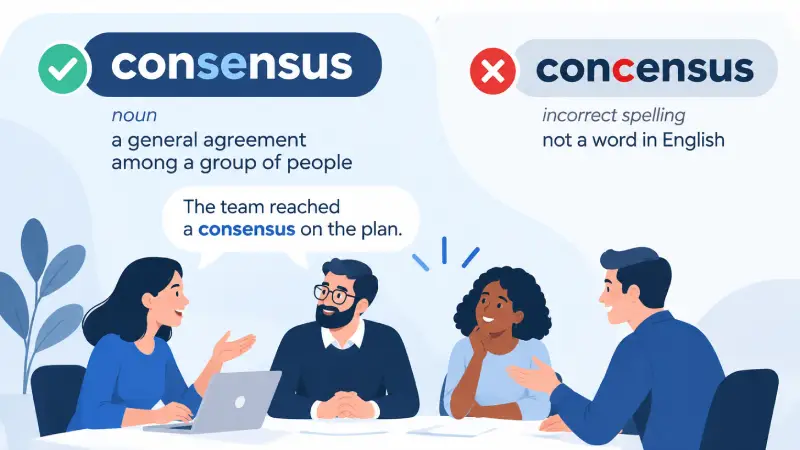
Consensus is the correct spelling, while concensus is a misspelling. Use consensus when you mean general or broad agreement among a group of people.
- Correct: The committee reached a consensus on the proposal.
- Incorrect: The committee reached a concensus on the proposal.
Although the two spellings look almost identical, concensus is not an alternative spelling of consensus. In both American and British English, the standard spelling is consensus.
SEO Meta Description: Consensus vs. concensus: Learn the correct spelling, meaning, usage, examples, and easy ways to remember the difference.
What Is the Correct Spelling: Consensus or Concensus?
The correct spelling is consensus.
Consensus is a noun that means general agreement among members of a group. For instance, a committee may reach a consensus after discussing several proposals. Likewise, researchers may develop a consensus when evidence supports a broadly shared conclusion.
By contrast, concensus is a common spelling mistake. Therefore, if you are writing an essay, report, article, email, or other professional content, choose consensus.
| Spelling | Correct? | Meaning |
|---|---|---|
| consensus | ✅ Yes | General or broad agreement |
| concensus | ❌ No | Misspelling of consensus |
The correct spelling is:
C-O-N-S-E-N-S-U-S
The most important part to remember is the middle:
S-E-N-S
So:
con-SENS-us ✅
not:
con-CENS-us ❌
What Does “Consensus” Mean?
Consensus means a general agreement or shared position among members of a group.
For example:
After several hours of discussion, the board reached a consensus.
In this sentence, the board members have arrived at a position that they generally accept.
However, consensus does not necessarily mean unanimous agreement. Some members may still have reservations while accepting the group’s overall decision.
For example:
The committee reached a consensus, although two members remained concerned about the cost.
This sentence works because consensus can describe broad agreement without requiring every individual to have exactly the same opinion.
Furthermore, consensus can describe agreement about a decision, opinion, interpretation, policy, or course of action.
Why Is “Consensus” the Correct Spelling?
The English word consensus comes from the Latin consensus, meaning agreement or concurrence. The modern English spelling retains the sens sequence.
Consequently, the standard spelling is:
con + sensus = consensus
The incorrect form concensus changes the internal letters and creates a spelling that does not represent the standard English word.
A useful visual comparison is:
- CONSENSUS ✅
- CONCENSUS ❌
Notice that the correct word contains S immediately after CON.
Therefore, when you are unsure, focus on the first seven letters:
CONSENS
Once you remember that pattern, the rest of the word becomes much easier to spell correctly.
Is Consensus a Noun?
Yes. Consensus is a noun.
Because it is a noun, it commonly appears after verbs and expressions associated with agreement.
For example:
- reach a consensus
- build a consensus
- develop a consensus
- find a consensus
- establish a consensus
- seek a consensus
- lack consensus
Consider these examples:
The researchers reached a consensus.
The negotiators worked to build a consensus.
The organization is trying to develop a consensus.
The committee lacked consensus on the issue.
Thus, understanding the grammatical role of consensus can also help you recognize how naturally it fits into a sentence.
When Should You Use “Consensus”?
Use consensus when you are describing broad agreement within a group.
In Everyday Conversation
Although consensus sounds somewhat formal, it can still appear in ordinary conversation.
We finally reached a consensus about where to eat.
Everyone had a different preference at first; however, we eventually found a consensus.
There seems to be a consensus that the new schedule works better.
The group couldn’t reach a consensus, so we postponed the decision.
In casual speech, agreement may sound more natural in some situations. Nevertheless, consensus is completely appropriate when the idea of group agreement is important.
In School Writing
In academic and school writing, consensus is particularly useful when discussing researchers, authors, experts, or groups.
The researchers reached a consensus after reviewing the evidence.
The article discusses the growing consensus among experts.
Although some students disagreed, the class reached a consensus.
The author explains why there is no clear consensus on the issue.
Because the word is precise and formal, it works well in essays and research-based assignments.
In Professional Writing
Similarly, consensus is common in business communication.
The management team reached a consensus on the revised schedule.
Before we proceed, we need a consensus among the department heads.
After reviewing the proposals, the executives developed a consensus.
The meeting ended without a clear consensus.
Here, the word emphasizes a shared position among several decision-makers.
In Government and Public Policy
Consensus is also common when discussing lawmakers, committees, governments, and public policy.
Lawmakers struggled to reach a consensus on the proposed legislation.
After several negotiations, the committee reached a consensus.
A broader consensus has emerged around the proposal.
The policy does not yet have enough support to create a national consensus.
In these examples, consensus highlights the process of developing broad agreement among different groups or individuals.
In Academic and Scientific Writing
Scientific and academic writing frequently uses consensus when describing broad agreement among researchers.
There is a growing scientific consensus on the subject.
Researchers have not yet reached a complete consensus.
The evidence has contributed to a broader consensus among specialists.
Although some researchers disagree, a general consensus has emerged.
Importantly, scientific consensus should not automatically be interpreted as unanimous agreement. Instead, it generally describes a broad position supported by available evidence and shared by a substantial body of experts.
Consensus vs. Concensus: Side-by-Side Comparison
| Feature | Consensus | Concensus |
|---|---|---|
| Standard spelling | ✅ Yes | ❌ No |
| Part of speech | Noun | Not the standard noun spelling |
| Means general agreement | Yes | No |
| Used in American English | Yes | No |
| Used in British English | Yes | No |
| Common in academic writing | Yes | No |
| Common in professional writing | Yes | No |
| Common spelling error | No | Yes |
As the table shows, this is not a case where both forms have different meanings. Instead, consensus is the standard word, while concensus is a misspelling.
Why Do People Spell It “Concensus”?
There are several reasons this error occurs.
Pronunciation Can Be Misleading
First, the pronunciation does not always make the spelling obvious. When people hear consensus spoken quickly, they may not clearly identify the letters in the middle.
As a result, someone spelling the word from memory might write concensus.
However, pronunciation alone is not always a reliable guide to English spelling. Therefore, remembering the visual form of the word is more useful.
The Two Forms Look Very Similar
Second, consensus and concensus differ by only one letter.
Compare:
consensus
concensus
Because the overall shape remains familiar, the error can easily survive a quick proofreading check.
Other “Con-” Words Create Confusion
Third, English has many words beginning with con- followed by c:
- concrete
- concern
- conclude
- concede
- concentrate
Consequently, a writer may assume that concensus follows the same pattern.
It does not.
The correct internal spelling is SENS, not CENS.
Common Mistakes: Wrong → Right
Mistake 1: Writing “concensus”
Wrong:
The committee reached a concensus on the issue.
Right:
The committee reached a consensus on the issue.
The difference is the letter immediately after con.
Mistake 2: Writing “conceeded”
Another common error occurs when writers combine the spelling problem with the word concede.
Wrong:
The report conceeded that the evidence was limited.
Right:
The report conceded that the evidence was limited.
This is a different spelling issue. Concede and consensus are separate words and should not be confused.
Mistake 3: Leaving out the second “s”
Some writers produce consenus.
Wrong:
The group reached a consenus.
Right:
The group reached a consensus.
The word contains two s letters around en:
S-E-N-S
Mistake 4: Adding an extra “e”
Another possible typo is:
Wrong:
The researchers reached a conceensus.
Right:
The researchers reached a consensus.
The standard spelling contains no c after con and no extra e.
How to Remember the Spelling of Consensus
The easiest memory trick is:
Consensus has SENS in the middle.
Break the word into three visual parts:
CON + SENS + US
That produces:
CONSENSUS
Another memory aid is to connect consensus with the idea of a shared sense of agreement.
Although sense and consensus are not synonyms, the spelling connection can help you remember the middle letters:
SENS → consensus
So, whenever you hesitate between the two spellings, ask:
Does the middle contain SENS?
If yes, you have:
- consensus ✅
Consensus vs. Agreement
- Consensus and agreement are closely related. However, they are not always interchangeable.
Agreement is the broader term.
We reached an agreement about the price.
Here, the word could refer to an arrangement between two people or organizations.
By comparison:
The committee reached a consensus about the proposal.
This sentence emphasizes a shared position among members of a group.
Furthermore, agreement can refer to a formal contract:
The two companies signed an agreement.
In that context, consensus would not normally be an appropriate replacement.
Consensus vs. Unanimous
Another important distinction is between consensus and unanimous.
Consensus means broad or general agreement.
Unanimous means everyone agrees.
For example:
The committee reached a consensus, although two members still had concerns.
This means the group generally accepted the decision.
By contrast:
The committee reached a unanimous decision.
This means every member agreed.
Therefore, do not automatically use unanimous whenever you see consensus. The two concepts overlap, but they are not identical.
Consensus vs. Majority
Similarly, consensus is different from majority.
A majority means more than half of a group.
A majority of the board voted for the proposal.
However, a majority vote does not necessarily create consensus. Some members may strongly disagree.
By contrast:
The board reached a consensus on the proposal.
This suggests a broader shared position.
Thus, a decision can have majority support without having genuine consensus.
“Reach a Consensus” or “Build a Consensus”?
Both phrases are standard.
Reach a consensus
Use reach a consensus when you want to emphasize arriving at a shared position.
After several meetings, the committee reached a consensus.
Build a consensus
Use build a consensus when you want to emphasize the process of creating broad agreement.
The negotiators worked together to build a consensus.
Similarly, you may encounter:
- develop a consensus
- establish a consensus
- seek a consensus
- maintain a consensus
- lack consensus
These expressions are especially common in formal and professional writing.
Is “General Consensus” Correct?
Yes. General consensus is a well-established phrase in English.
Some people consider the phrase potentially repetitive because consensus already describes general agreement. Nevertheless, general consensus is widely used and clearly understood.
For example:
There is a general consensus that the proposal needs revision.
The adjective general can emphasize that the agreement is broad rather than absolute.
Therefore, there is no need to automatically treat general consensus as an error.
Consensus in Different Real-World Contexts
Business Meetings
After reviewing the budget, the department heads reached a consensus on the spending plan.
Here, the word describes a shared decision among several professionals.
Scientific Research
Researchers have reached a broad consensus about the interpretation of the available evidence.
Here, consensus refers to a generally shared position among researchers.
Government
Lawmakers continued negotiating because they had not yet reached a consensus.
In this context, consensus refers to political agreement.
Education
The faculty reached a consensus on the revised grading policy.
Here, the word describes agreement among members of an educational institution.
Everyday Decisions
We couldn’t agree on a movie at first, but eventually we reached a consensus.
Although agreement might sound more conversational, consensus still works because several people are trying to settle on one shared choice.
In Context: Natural Examples
Text Message
A: Are we all okay with meeting Saturday?
B: Saturday works for me.
C: Same here.
A: Great. Looks like we have a consensus.
Here, the group has reached a shared decision.
Professional Email
After reviewing everyone’s feedback, we reached a consensus on the revised project timeline. Therefore, the updated schedule will be included in the final report.
In this example, consensus describes agreement among coworkers, while therefore clearly connects the decision to the next action.
Article-Style Context
Researchers have not reached a complete consensus on the issue. Nevertheless, a growing number of studies support the explanation, and broader agreement has emerged among specialists.
Here, the wording makes an important distinction: broad agreement can exist even when complete agreement has not been reached.
Related Words and Forms
Learning related forms can make the spelling of consensus easier to remember.
Consensual
Consensual is an adjective meaning involving the agreement or consent of the people involved.
The decision was consensual.
Although it is related to consensus, it serves a different grammatical function.
Consensus-Based
Consensus-based describes a process or system that relies on general agreement.
The organization uses a consensus-based decision-making process.
Consensus-Driven
Consensus-driven describes an approach that places strong emphasis on developing group agreement.
The team follows a consensus-driven approach to major decisions.
These forms all reinforce the consens- spelling pattern.
Is “Concensus” Ever Correct?
For the standard English noun meaning general agreement, concensus is not a correct alternative spelling.
It is also not a difference between American and British English.
Both use:
consensus ✅
Therefore, if you are writing for a US audience, use consensus. If you are writing for a British audience, use consensus as well.
The spelling does not change by region.
Frequently Asked Questions
Is it consensus or concensus?
Consensus is correct. Concensus is a misspelling.
What does consensus mean?
Consensus means general or broad agreement among members of a group.
Does consensus mean everyone agrees?
Not necessarily. Consensus usually means broad agreement, whereas unanimous means that everyone agrees.
What is the plural of consensus?
Consensus is commonly used as a plural in some contexts, while consensuses can be used when referring to multiple distinct consensuses.
Is “reach a consensus” correct?
Yes. Reach a consensus is a standard expression meaning to arrive at general agreement.
Quick-Reference Takeaway
Consensus ✅ = correct spelling
Concensus ❌ = misspelling
Remember the middle letters:
CON + SENS + US = CONSENSUS
Use consensus when you mean general or broad agreement among a group.
- The committee reached a consensus.
- There is broad consensus among researchers.
- The team could not reach a consensus.
- The leaders worked to build a consensus.
If you remember SENS in the middle, you can quickly avoid the common mistake:
consensus, not concensus.

Olivia Smith is a US English writer and language enthusiast who specializes in spelling, word choice, and commonly confused words. She creates clear, practical guides that help readers understand the correct spelling, meaning, and usage of English words.
At GrammarPool.com, Olivia focuses on spelling-choice topics, common spelling mistakes, and easy-to-understand explanations for everyday English users. Her writing is designed to make confusing word choices simple, accurate, and easy to remember.
Expertise: US English, spelling, word choice, commonly confused words, grammar, and language usage.