
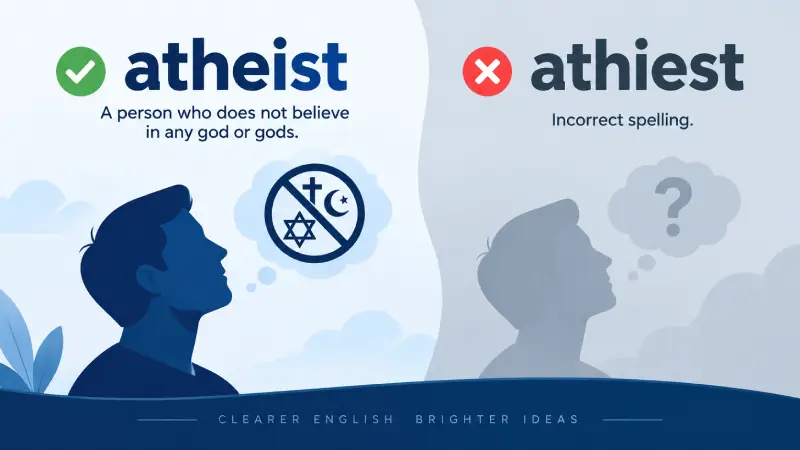
Atheist is the correct spelling. Athiest is a common misspelling. An atheist is a person who does not believe in the existence of a god or gods. The key spelling point is the order of the letters e and i: atheist, not athiest.
What Does Atheist Mean?
Atheist is a noun and can also be used as an adjective.
As a noun, atheist refers to a person who does not believe in the existence of a god or gods.
He identifies as an atheist.
The author was an outspoken atheist.
As an adjective, atheist describes something related to atheism or an atheist perspective.
The book explores atheist philosophy.
She writes from an atheist perspective.
The related noun atheism refers to the lack of belief in the existence of a god or gods.
Atheist vs. Athiest: The Basic Difference
| Word | Correct? | Part of Speech | Meaning |
|---|---|---|---|
| atheist | Yes | Noun, adjective | A person who does not believe in a god or gods; related to atheism |
| athiest | No | Not standard English | Common misspelling of atheist |
There is no standard English meaning that makes athiest correct. If you are referring to a person who does not believe in a god or gods, the correct spelling is atheist.
Why Is Atheist Spelled That Way?
The spelling becomes easier to remember when you recognize the structure of the word.
Atheist is built around athe-, which is related to the Greek word atheos, meaning “without a god” or “godless.”
The important spelling sequence is:
A-T-H-E-I-S-T
The e comes before the i.
A common mistake reverses those two vowels:
A-T-H-I-E-S-T
That produces athiest, which is not the standard spelling.
So the simplest spelling rule is:
Atheist = E before I
Do not let the pronunciation cause you to reverse the vowels.
When Is Atheist Correct?
1. When referring to a person
Use atheist when a person does not believe in the existence of a god or gods.
My friend is an atheist.
The novelist described himself as an atheist.
She became an atheist after years of questioning her beliefs.
The speaker openly discussed his experience as an atheist.
The group included people with different religious and nonreligious perspectives, including several atheists.
The plural form is atheists, with an s added to the end.
2. When describing a perspective or position
Atheist can function as an adjective when it describes a viewpoint, argument, organization, or other noun.
The professor discussed several atheist arguments.
The article examines atheist perspectives on religion.
He published an atheist critique of the philosophical argument.
This adjective use is less common than the noun use in ordinary conversation, but it is standard.
3. In academic and philosophical writing
The word appears frequently in discussions of philosophy, religion, ethics, and worldview.
The philosopher developed an atheist argument about the origin of morality.
The course compares religious, agnostic, and atheist positions.
The essay considers whether morality requires belief in a deity.
In these contexts, atheist should still be spelled with e-i, never i-e.
Natural Example Sentences With Atheist
Here are examples from different contexts.
Everyday English
He told his friends that he was an atheist.
Her brother is an atheist, but he enjoys learning about different religions.
School and academic writing
The class examined both religious and atheist perspectives on the question.
The philosopher’s atheist position influenced his approach to ethics.
Professional and formal writing
The author has publicly identified as an atheist.
The organization includes members with religious, agnostic, and atheist backgrounds.
General writing
Being an atheist does not by itself determine a person’s political or ethical views.
The novel features an atheist character who frequently discusses philosophy with his religious friends.
These examples also show why context matters. Atheist describes a position concerning belief in gods; it does not automatically tell you what a person believes about every other philosophical or moral question.
When Is Athiest Correct?
For standard English, athiest is not the correct spelling.
For example:
Wrong:
He is an athiest.
Correct:
He is an atheist.
Another example:
Wrong:
The author presents an athiest perspective.
Correct:
The author presents an atheist perspective.
The problem is simply the order of e and i.
The Most Common Spelling Mistake
The biggest problem with atheist is vowel reversal.
Correct:
ATHEIST
Incorrect:
ATHIEST
Compare the middle letters:
- atheist: …ei…
- athiest: …ie…
The correct sequence is ei.
This mistake is understandable because English has many words with confusing vowel patterns. However, atheist does not follow the common mistaken spelling athiest.
Atheist vs. Atheism
- Atheist and atheism are closely related but have different grammatical functions.
- Atheist usually refers to a person:
She is an atheist.
Atheism refers to the position, belief system, or lack of belief in gods:
He studies atheism and the history of religious philosophy.
A simple way to remember the difference is:
atheist = person
atheism = position or concept
Compare:
The atheist discussed atheism during the lecture.
Here, the first word identifies the person, while the second refers to the concept.
Atheist vs. Agnostic
Atheist and agnostic are not simply two spellings of the same idea. They describe different positions.
An atheist does not believe in the existence of a god or gods.
An agnostic generally holds that the existence or nonexistence of a god or gods is unknown or cannot be known.
The distinction can become more nuanced because people may describe their own positions in different ways. Someone can also use both terms, such as agnostic atheist, to communicate both a lack of belief and uncertainty about whether the existence of gods can be known.
Therefore, do not automatically replace atheist with agnostic. They address different aspects of belief and knowledge.
Atheist vs. Theist
Atheist and theist are useful contrasts.
A theist believes in the existence of a god or gods.
An atheist does not believe in the existence of a god or gods.
For example:
The discussion included both theist and atheist philosophers.
The two words share the ending -theist, which comes from a root associated with God or deity.
This connection can also help with spelling.
Atheist vs. Anti-theist
Anti-theist is another related but distinct term.
An atheist is defined by a lack of belief in gods.
An anti-theist generally goes further by opposing theism or religious belief as harmful or undesirable.
Therefore, calling someone an atheist does not necessarily mean that the person is opposed to religion.
These words should not be treated as interchangeable.
Common Mistakes With Atheist
Mistake 1: Writing “athiest”
Wrong:
She is an athiest.
Right:
She is an atheist.
Remember that e comes before i in the middle of atheist.
Mistake 2: Writing “atheisim”
The related noun atheism is sometimes misspelled by adding an unnecessary i.
Wrong:
He wrote about atheisim.
Right:
He wrote about atheism.
The correct spelling is:
A-T-H-E-I-S-M
Mistake 3: Writing “atheisit”
Some writers add an extra i because the pronunciation is not enough to make the spelling obvious.
Wrong:
The article discusses an atheisit philosopher.
Right:
The article discusses an atheist philosopher.
The word ends in -ist, not -isit.
Mistake 4: Confusing atheist and theist
The two words are related but have opposite meanings concerning belief in gods.
Atheist: does not believe in the existence of a god or gods.
Theist: believes in the existence of a god or gods.
Choosing between them changes the meaning of the sentence.
Mistake 5: Treating atheist as a synonym for anti-religious
These terms should not automatically be treated as equivalent.
A person can be an atheist without being hostile toward religious people or religious institutions. The word describes a position concerning belief in gods, not a person’s entire attitude toward religion.
How to Remember Atheist vs. Athiest
The best memory trick is to focus on the middle vowels:
ATHEIST = E before I
Write it in chunks:
ATH + EI + ST
The important part is:
EI
Not:
IE
Another helpful connection is:
theist → atheist
Both contain theist:
- theist
- atheist
This can make the spelling easier to remember because the letters thei remain together.
You can also remember:
A-theist, not A-thiest.
The correct word contains “theist” after the initial a.
Is Atheist a Noun or an Adjective?
It can be both.
As a noun, it refers to a person:
The atheist joined the discussion.
As an adjective, it describes something associated with atheism or atheists:
The book presents an atheist perspective.
This is different from atheism, which is a noun referring to the position or concept.
Understanding the part of speech helps you choose the correct related word.
Is Atheist Capitalized?
Normally, atheist is lowercase.
He is an atheist.
The article discusses atheist philosophy.
It is not normally capitalized simply because it refers to a person’s religious or nonreligious position. Capitalization may change when the word appears at the beginning of a sentence or in a title according to the relevant title style.
Atheist in Real-World Context
Scenario 1: Text conversation
Alex: Does Maya follow a religion?
Chris: No, she identifies as an atheist, although she enjoys studying religious history.
The spelling is atheist, with e before i.
Scenario 2: Academic discussion
The professor asked students to compare the arguments of theist and atheist philosophers. The assignment focused on philosophical reasoning rather than asking students to adopt either position.
Here, atheist functions as an adjective describing philosophers.
Scenario 3: Article-style writing
The author identifies as an atheist but has written extensively about religion, ethics, and philosophy. In several essays, he examines how different worldviews approach questions of morality and meaning.
The word describes the author’s position concerning belief in gods. It does not, by itself, describe every aspect of the author’s worldview.
Does Atheist Mean Someone Who Hates Religion?
No. Atheist specifically refers to a lack of belief in the existence of a god or gods. The word itself does not necessarily indicate hostility toward religion, religious people, or religious institutions.
If a writer intends to describe opposition to religion or theism, a more specific term may be appropriate depending on the intended meaning.
Is “Atheist” a Religious Belief?
The answer depends on how the term is being discussed. In ordinary English, atheism refers to the lack of belief in the existence of gods, while atheist identifies a person who holds that position. It is more precise to describe the term according to its definition rather than automatically classifying it using a broader category.
FAQs
It is atheist. Athiest is a common misspelling caused by reversing the e and i.
The correct spelling is A-T-H-E-I-S-T. Remember the middle sequence EI.
An atheist is a person who does not believe in the existence of a god or gods.
Atheist can function as both a noun and an adjective. As a noun, it identifies a person; as an adjective, it describes something related to atheism or an atheist perspective.
An atheist does not believe in the existence of a god or gods, while an agnostic generally takes a position concerning whether the existence or nonexistence of gods can be known. The terms can overlap in some people’s self-descriptions.
Conclusion
Atheist is the correct spelling, while athiest is a misspelling. The word can be a noun meaning a person who does not believe in the existence of a god or gods, and it can also function as an adjective.
The easiest way to remember the spelling is:
ATHEIST = E before I
Always write atheist, not athiest.

Olivia Smith is a US English writer and language enthusiast who specializes in spelling, word choice, and commonly confused words. She creates clear, practical guides that help readers understand the correct spelling, meaning, and usage of English words.
At GrammarPool.com, Olivia focuses on spelling-choice topics, common spelling mistakes, and easy-to-understand explanations for everyday English users. Her writing is designed to make confusing word choices simple, accurate, and easy to remember.
Expertise: US English, spelling, word choice, commonly confused words, grammar, and language usage.
Pingback: Controversy vs. Contraversy: Which Spelling Is Correct?