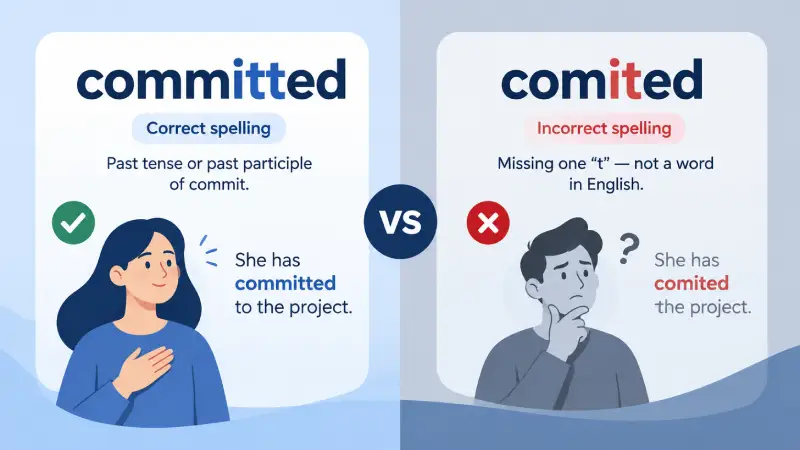
Is it committed or comited? The correct spelling is committed. Comited is a misspelling.
The word committed is the past tense and past participle of commit. It can mean that someone carried out an action, made a serious mistake, promised dedication to something, or agreed to a responsibility. It is also commonly used as an adjective to describe someone who is dedicated to a person, goal, cause, or activity.
The spelling challenge comes from the doubled t. When you add -ed to commit, the final consonant is doubled:
commit → committed
Not:
comited
Is It Committed or Comited?
Committed is the correct spelling.
Comited is incorrect in standard English.
| Spelling | Correct? | Meaning |
|---|---|---|
| Committed | ✅ Yes | Past tense/past participle of “commit”; also an adjective meaning dedicated |
| Comited | ❌ No | Common misspelling of “committed” |
Examples:
- She committed to the project.
- He committed a serious error.
- They committed themselves to helping the community.
- She is deeply committed to her work.
In every standard English context, the spelling requires two m’s and two t’s:
committed
How Do You Spell Committed?
The correct spelling is:
C-O-M-M-I-T-T-E-D
A useful way to understand the word is to start with the base verb:
commit
Then form the past tense:
commit → committed
The final t doubles before -ed is added, while the existing m remains doubled.
Therefore:
commit + ed → committed
This gives the correct spelling:
committed
Why Is Committed Spelled With Two T’s?
The spelling comes from an important English spelling rule involving short verbs that end in a single consonant after a stressed short vowel.
The verb commit ends with:
-mit
When forming committed, the final consonant t is doubled before adding -ed.
So:
commit → committed
The same pattern appears in other forms:
- permit → permitted
- omit → omitted
- submit → submitted
- admit → admitted
However, commit is especially easy to misspell because the word already contains a double m and then gains another doubled consonant pattern.
That gives:
co + mm + i + tt + ed
Therefore, remember that committed contains both mm and tt.
Why Do People Spell Committed as Comited?
The misspelling comited usually happens when someone removes one of the repeated consonants.
Because English pronunciation does not clearly announce every written letter, it can be easy to forget one of the t’s.
A person may think:
commit + ed = comited
However, standard English spelling requires:
commit → committed
The same issue occurs with other words that double a final consonant before adding -ed.
For example:
- admit → admitted
- submit → submitted
- permit → permitted
- commit → committed
Learning the pattern can make the spelling much easier.
What Does Committed Mean?
Committed has several meanings depending on context.
Most commonly, it is the past tense or past participle of commit.
For example:
He committed a serious mistake.
Here, committed means he carried out or made the action.
It can also mean that someone dedicated themselves to a goal or responsibility:
She committed herself to improving her skills.
In addition, committed can function as an adjective:
She is a committed employee.
Here, committed means dedicated, loyal, or strongly devoted.
Therefore, context determines the exact meaning.
Committed as the Past Tense of Commit
The verb commit has several meanings. Its past tense is committed.
For example:
The company committed to improving customer service.
The action happened in the past.
Similarly:
He committed the mistake without realizing it.
The sentence describes something that he did.
Other examples include:
- The team committed to the new strategy.
- She committed herself to the training program.
- They committed additional resources to the project.
- The organization committed funds to the initiative.
In each case, committed is the past form of commit.
Committed as a Past Participle
Committed also works as the past participle of commit.
It can appear with auxiliary verbs such as has, have, or had.
Examples:
She has committed to the plan.
They have committed significant resources to the project.
He had committed himself to finishing the work.
The spelling remains the same:
committed
The grammatical structure changes, but the spelling does not.
Committed as an Adjective
Committed can also function as an adjective meaning dedicated, devoted, or strongly determined.
For example:
She is a committed teacher.
This means she is dedicated to her work as a teacher.
Similarly:
He is a committed athlete.
This suggests that he takes his training and goals seriously.
Other examples include:
- a committed employee
- a committed volunteer
- a committed student
- a committed supporter
- a committed professional
- a committed leader
In these cases, committed describes a person’s level of dedication.
Committed to Something
One of the most common structures is:
committed to + noun
or:
committed to + -ing verb
For example:
She is committed to her education.
Here, to is followed by a noun.
You can also say:
She is committed to improving her English.
Here, to is followed by the -ing form.
This is an important grammar point because learners sometimes incorrectly use the infinitive after committed to.
Incorrect:
She is committed to improve her English. ❌
Correct:
She is committed to improving her English. ✅
Therefore, when committed to means dedicated to something, use a noun or -ing form after to.
Committed to a Person
Committed can describe dedication within a relationship.
For example:
He is committed to his family.
This means he is dedicated to supporting and caring for his family.
Similarly:
She is committed to her partner.
The phrase can indicate loyalty, dedication, or seriousness about a relationship.
The exact meaning depends on context, but the spelling remains committed.
Committed to a Goal
People can also be committed to goals, plans, projects, or personal improvement.
Examples include:
She is committed to reaching her goal.
He remained committed to learning new skills.
The team is committed to improving its performance.
They are committed to completing the project on time.
In each example, committed expresses dedication.
Committed a Crime
Another important use occurs when committed means carried out an illegal or harmful act.
For example:
The suspect committed a crime.
You might also see:
He committed fraud.
The person committed the offense several years ago.
In this structure, committed is the past tense of commit, and it does not mean “dedicated.”
Context makes the meaning clear.
Committed a Mistake or Error
The verb commit can also be used with certain nouns relating to mistakes.
For example:
She committed an error.
He committed a serious mistake.
However, in everyday American English, made a mistake is often more natural than committed a mistake.
For example:
I made a mistake.
This sounds more natural in ordinary conversation.
Still, commit an error can appear in formal or technical contexts.
Committed in Business English
Committed is common in professional and business communication.
For example:
The company is committed to providing excellent customer service.
Another example:
Our team remains committed to meeting the deadline.
It can also describe resources:
The company committed additional funds to the project.
These uses are common in business reports, company statements, and professional communication.
Committed in Academic Writing
Academic writing frequently uses committed when describing dedication or actions.
For example:
The researchers committed significant resources to the study.
You might also write:
The university is committed to supporting student research.
When the word means dedication, it often appears with to:
The institution is committed to improving educational outcomes.
This structure is grammatically standard.
Committed vs. Dedicated
Committed and dedicated can have similar meanings when describing a person’s attitude.
For example:
She is committed to her work.
She is dedicated to her work.
Both sentences suggest that she takes her responsibilities seriously.
However, committed can emphasize a firm decision or ongoing obligation, while dedicated often emphasizes devotion and effort.
The best choice depends on the exact context.
Committed vs. Determined
These words also overlap.
Determined focuses strongly on a person’s intention to achieve something.
Committed emphasizes dedication or an ongoing obligation.
Compare:
He is determined to win.
This emphasizes his strong desire and intention.
He is committed to improving his performance.
This emphasizes his dedication to the process or goal.
Both can describe motivated people, but their emphasis differs.
Common Mistakes With Committed
The most common spelling mistake is:
❌ comited
The correct spelling is:
✅ committed
Here are more examples:
❌ She comited herself to the project.
✅ She committed herself to the project.
❌ He is comited to his studies.
✅ He is committed to his studies.
❌ The company comited more resources to the program.
✅ The company committed more resources to the program.
❌ They have comited to the plan.
✅ They have committed to the plan.
The key is to remember both repeated consonants:
MM + TT
How to Remember the Spelling of Committed
A simple memory trick is:
Commit has two M’s and committed has two M’s and two T’s.
Start with:
COMMIT
Then add -ED while doubling the final T:
COMMIT → COMMITTED
Think:
CO + MM + I + TT + ED
This visual pattern makes the spelling easier to remember.
You can also compare related forms:
- commit
- commits
- committing
- committed
Notice that committed has the doubled t:
committed
Commit, Committed, and Committing
The verb changes spelling depending on the form.
| Form | Example |
|---|---|
| Commit | I will commit to the plan. |
| Commits | She commits to her goals. |
| Committed | She committed to the plan. |
| Committing | She is committing to the project. |
The spelling changes when the suffix is added, but the double m remains.
Pay particular attention to the past tense:
commit → committed
and the present participle:
commit → committing
Both forms double the final consonant.
Is Comited Ever Correct?
In standard English, comited is not the correct spelling of committed.
If you are writing an essay, professional email, report, article, application, or school assignment, use committed.
The incorrect spelling may appear online because of typing errors or spelling mistakes. However, that does not make comited a standard English word.
Therefore:
committed = correct
comited = incorrect
Committed vs. Comited: Quick Comparison
| Feature | Committed | Comited |
|---|---|---|
| Standard spelling | ✅ Yes | ❌ No |
| Related verb | Commit | Commit |
| Part of speech | Verb form / adjective | Misspelling |
| Common meaning | Dedicated or carried out an action | No standard meaning |
| Correct example | She is committed to her goal. | She is comited to her goal. ❌ |
The most important spelling point is that committed contains two m’s and two t’s.
FAQs
Is committed the correct spelling?
Yes. Committed is the correct spelling. Comited is a misspelling.
Is comited a word?
No. Comited is not the standard English spelling. The correct form is committed.
How do you spell committed?
The correct spelling is:
C-O-M-M-I-T-T-E-D
Remember the double m and double t.
What does committed mean?
Committed can mean that someone carried out an action, dedicated themselves to something, or showed strong loyalty or dedication.
What is the difference between committed and dedicated?
Both can describe someone who is devoted to a goal or responsibility. Committed can emphasize a firm decision or obligation, while dedicated often emphasizes devotion and effort.
What is the past tense of commit?
The past tense of commit is committed.
For example:
She committed to the project.
What is the difference between commit and committed?
Commit is the base form of the verb.
Committed is its past tense and past participle.
For example:
They commit to the plan every year.
They committed to the plan last year.
Should I say committed to doing or committed to do?
When committed to means dedicated to something, use a noun or an -ing form.
Correct:
She is committed to improving her skills.
Not:
She is committed to improve her skills.
How can I remember the spelling of committed?
Remember:
COMMIT → COMMITTED
The final t doubles before -ed, giving committed. The word therefore contains MM and TT.
Quick-Reference Takeaway
- ✅ Committed = correct spelling
- ❌ Comited = incorrect spelling
- Committed is the past tense and past participle of commit.
- Committed can also be an adjective meaning dedicated or devoted.
- The spelling contains two m’s and two t’s.
- Commit → committed
- With the dedication meaning, use committed to + noun/-ing.
- Remember: COMMIT → COMMITTED.
Conclusion
The correct spelling is committed, not comited. The word can describe an action that someone carried out, or it can describe someone who is dedicated to a person, goal, responsibility, or cause.
The easiest way to remember the spelling is to start with the verb:
COMMIT → COMMITTED
The final t doubles before -ed, so the finished word contains both MM and TT:
C-O-M-M-I-T-T-E-D
Although comited is a common spelling mistake, it is not the standard English form. Therefore, whenever you write this word, remember the double m and double t in committed.

Olivia Smith is a US English writer and language enthusiast who specializes in spelling, word choice, and commonly confused words. She creates clear, practical guides that help readers understand the correct spelling, meaning, and usage of English words.
At GrammarPool.com, Olivia focuses on spelling-choice topics, common spelling mistakes, and easy-to-understand explanations for everyday English users. Her writing is designed to make confusing word choices simple, accurate, and easy to remember.
Expertise: US English, spelling, word choice, commonly confused words, grammar, and language usage.