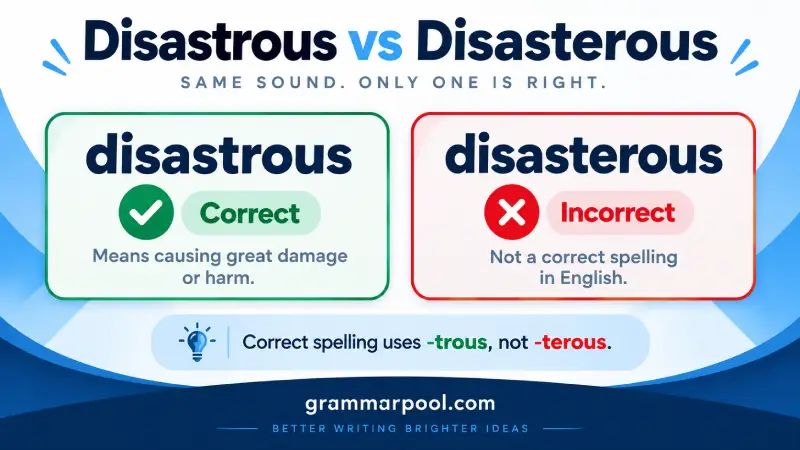
Is it disastrous or disasterous? The correct spelling is disastrous. Disasterous is a common misspelling.
The word disastrous is an adjective used to describe something that causes a disaster, has extremely bad results, or produces serious damage or failure. The spelling can be confusing because the word comes from disaster, but it does not simply add -ous to the complete spelling of “disaster.”
The correct form is:
disastrous
not:
disasterous
Is It Disastrous or Disasterous?
Disastrous is the correct spelling in standard English.
Disasterous is incorrect.
| Spelling | Correct? | Meaning |
|---|---|---|
| Disastrous | ✅ Yes | Causing great harm, damage, failure, or very bad results |
| Disasterous | ❌ No | Common misspelling of “disastrous” |
For example:
- The storm had disastrous consequences.
- The company suffered a disastrous financial loss.
- The decision proved disastrous.
- Poor planning can lead to disastrous results.
In each sentence, disastrous is the correct form.
What Does Disastrous Mean?
Disastrous means extremely bad, harmful, unsuccessful, or damaging.
It often describes something that produces serious negative consequences.
For example:
The hurricane had disastrous effects on the region.
This means the hurricane caused extremely serious damage or other harmful consequences.
Similarly:
The business made a disastrous decision.
Here, disastrous means the decision produced very bad results.
The word can describe events, decisions, mistakes, policies, performances, situations, or consequences.
How Do You Spell Disastrous?
The correct spelling is:
D-I-S-A-S-T-R-O-U-S
Notice that the word does not contain the extra e found in disaster before the ending.
Compare:
disaster
disastrous
The correct transformation is:
disaster → disastrous
not:
disaster → disasterous
This is the main spelling point to remember.
Why Is Disastrous Spelled Without “E”?
The spelling can seem confusing because disastrous is related to disaster.
However, English word formation does not always preserve every letter of the base word when a suffix is added.
In this case:
disaster → disastrous
The ending becomes:
-ous
and the resulting word is:
disastrous
There is no extra e between r and o.
Therefore, this is incorrect:
❌ disasterous
And this is correct:
✅ disastrous
Why Do People Spell Disastrous as Disasterous?
The misspelling disasterous is easy to understand because people naturally connect the adjective with the noun disaster.
When someone sees:
disaster
they may assume that adding -ous simply produces:
disaster + ous = disasterous
That looks logical, but English spelling does not always work through simple letter-by-letter addition.
The standard adjective is:
disastrous
The extra e is removed.
Pronunciation can also make the spelling difficult because the unstressed ending does not clearly reveal every letter.
Disastrous vs. Disaster
The words disastrous and disaster are closely related, but they have different grammatical functions.
Disaster is a noun.
The earthquake was a disaster.
Disastrous is an adjective.
The earthquake had disastrous consequences.
The noun names the event or situation.
The adjective describes something as extremely harmful, damaging, or unsuccessful.
Disastrous as an Adjective
Disastrous is an adjective, so it describes a noun.
For example:
The company experienced a disastrous year.
Here, disastrous describes the year.
Consider these additional examples:
- It was a disastrous mistake.
- The project had a disastrous outcome.
- They made a disastrous decision.
- The team suffered a disastrous defeat.
- The policy produced disastrous consequences.
- The accident had disastrous effects.
In each case, disastrous tells us that the result or situation was extremely bad.
Disastrous in Everyday English
You can use disastrous in both formal and everyday English.
For example:
Missing the last train was disastrous for our travel plans.
Another example:
The meal was disastrous.
In the second sentence, the speaker means that the meal went extremely badly.
However, disastrous is often stronger than simply saying something was bad.
Compare:
The meeting was bad.
with:
The meeting was disastrous.
The second sentence suggests a much more serious failure or negative outcome.
Disastrous vs. Terrible
Disastrous and terrible can overlap, but they are not always interchangeable.
Terrible is a broad adjective that can describe something very bad.
Disastrous specifically emphasizes severe damage, failure, or consequences.
For example:
The weather was terrible.
This means the weather was very bad.
By contrast:
The storm had disastrous consequences.
This emphasizes the serious harm caused by the storm.
Therefore, disastrous often works especially well when discussing results or consequences.
Disastrous vs. Catastrophic
Disastrous and catastrophic have similar meanings, although catastrophic can suggest an even more extreme level of destruction or harm.
For example:
The project was disastrous.
This means the project failed badly or had very poor results.
The earthquake was catastrophic.
This emphasizes enormous destruction or loss.
The words can overlap, but the exact choice depends on the severity and context.
Common Phrases With Disastrous
Learning common combinations can help you recognize and use the correct spelling.
Some common phrases include:
- disastrous consequences
- disastrous results
- disastrous effects
- disastrous decision
- disastrous mistake
- disastrous outcome
- disastrous failure
- disastrous consequences
- disastrous performance
- disastrous policy
- disastrous situation
- disastrous impact
For example:
The company faced disastrous consequences after the decision.
Similarly:
Poor preparation can have disastrous results.
These combinations are common in news, business, academic, and everyday writing.
Disastrous Consequences
One of the most common phrases is disastrous consequences.
It means that an action or event produces extremely harmful results.
For example:
Ignoring the warning could have disastrous consequences.
Another example:
The decision had disastrous consequences for the organization.
This phrase is particularly common when discussing serious mistakes or poor decisions.
Disastrous Results
Disastrous results refers to extremely poor outcomes.
For example:
The experiment produced disastrous results.
You could also say:
Poor planning led to disastrous results.
In both sentences, disastrous describes the severity of the outcome.
Disastrous Decision
A disastrous decision is a decision that produces very bad consequences.
For example:
The company made a disastrous decision by ignoring the warning signs.
Another example:
Choosing the wrong strategy proved disastrous.
Notice that disastrous can appear after linking verbs such as be, become, and prove.
Disastrous in Business Writing
Business writers often use disastrous when discussing major failures or serious financial consequences.
For example:
The company suffered disastrous losses after the failed expansion.
Another example:
The strategy had disastrous effects on the company’s finances.
Because the word is strong, it should be used when the situation genuinely involves severe negative consequences.
For less severe situations, words such as unfavorable, poor, or unsuccessful may be more precise.
Disastrous in Academic Writing
Academic writers can use disastrous when discussing serious outcomes, but the word should fit the evidence and tone.
For example:
The policy produced disastrous consequences for the affected communities.
However, academic writing often benefits from precise descriptions.
Instead of simply saying:
The results were disastrous.
a writer might explain:
The results showed a substantial decline in production and increased costs.
Specific evidence can make the statement clearer.
Disastrous in News Writing
News articles often use disastrous to describe severe outcomes from storms, accidents, policies, economic decisions, or other events.
For example:
The storm caused disastrous flooding across the region.
Another example:
The company described the quarter as disastrous after reporting major losses.
Because the word carries a strong meaning, writers should use it carefully and make sure the context supports it.
Common Mistakes With Disastrous
The most common spelling mistake is adding an unnecessary e:
❌ disasterous
✅ disastrous
Here are some examples:
❌ The decision had disasterous consequences.
✅ The decision had disastrous consequences.
❌ The storm caused disasterous damage.
✅ The storm caused disastrous damage.
❌ It was a disasterous mistake.
✅ It was a disastrous mistake.
❌ Poor planning can produce disasterous results.
✅ Poor planning can produce disastrous results.
The key is to remove the extra e before -ous.
How to Remember the Spelling of Disastrous
A simple memory trick is:
DISASTER loses the E before OUS.
Start with:
DISASTER
Then remember that the adjective is:
DISASTROUS
Think:
DISASTER → DISASTROUS
The e disappears.
You can also focus on the ending:
-TROUS
The correct word contains:
DISAS + TROUS
not:
DISAS + TEROUS
Another useful pair to remember is:
disaster → disastrous
If you see disasterous, stop and check whether the extra e belongs there. It does not.
Disaster, Disastrous, and Disastrously
These three related forms have different grammatical functions.
| Word | Part of speech | Example |
|---|---|---|
| Disaster | Noun | The flood was a disaster. |
| Disastrous | Adjective | The flood had disastrous effects. |
| Disastrously | Adverb | The project ended disastrously. |
This word family makes the spelling easier to understand.
For example:
The plan was a disaster.
The plan was disastrous.
The plan ended disastrously.
Notice that disastrous contains no extra e.
Is Disasterous Ever Correct?
In standard English, disasterous is not the correct spelling of the adjective.
If you are writing a school assignment, article, professional report, email, or other formal text, use disastrous.
The incorrect spelling may appear online because of spelling mistakes. However, its appearance in search results or informal writing does not make it a standard English form.
Therefore:
disastrous = correct
disasterous = incorrect
Disastrous vs. Disasterous: Quick Comparison
| Feature | Disastrous | Disasterous |
|---|---|---|
| Standard spelling | ✅ Yes | ❌ No |
| Part of speech | Adjective | Misspelling |
| Meaning | Extremely harmful, damaging, or unsuccessful | No standard meaning |
| Related noun | Disaster | Disaster |
| Common phrase | Disastrous consequences | Disasterous consequences ❌ |
| Correct example | The decision was disastrous. | The decision was disasterous. ❌ |
The main spelling rule is simple: disastrous does not contain the extra e.
FAQs
Is disastrous the correct spelling?
Yes. Disastrous is the correct spelling. Disasterous is a common misspelling.
Is disasterous a word?
No. Disasterous is not the standard spelling of the adjective. The correct form is disastrous.
How do you spell disastrous?
The correct spelling is:
D-I-S-A-S-T-R-O-U-S
Remember that there is no extra e between r and o.
What does disastrous mean?
Disastrous means extremely bad, damaging, harmful, or unsuccessful, especially when something produces serious negative consequences.
What is the difference between disaster and disastrous?
Disaster is a noun that names a catastrophic or highly damaging event or situation.
Disastrous is an adjective that describes something as extremely harmful, damaging, or unsuccessful.
Why is disastrous not spelled disasterous?
The standard adjective is formed as disastrous, not by simply attaching -ous to the unchanged spelling of disaster. The extra e is not retained.
What is the adverb form of disastrous?
The adverb is disastrously.
For example:
The project ended disastrously.
What is the difference between disastrous and catastrophic?
Both words describe extremely serious situations. Disastrous emphasizes very bad or damaging results, while catastrophic often emphasizes extreme destruction or harm.
How can I remember the spelling of disastrous?
Remember:
DISASTER → DISASTROUS
The e disappears before -ous.
Quick-Reference Takeaway
- ✅ Disastrous = correct spelling
- ❌ Disasterous = incorrect spelling
- Disastrous is an adjective.
- It means extremely harmful, damaging, or unsuccessful.
- The related noun is disaster.
- The related adverb is disastrously.
- Remember: DISASTER → DISASTROUS.
- Do not add an extra e before -ous.
Conclusion
The correct spelling is disastrous, not disasterous. The word describes something that causes serious harm, produces very bad results, or involves severe failure.
The easiest way to remember the spelling is to connect it directly with disaster:
DISASTER → DISASTROUS
The extra e is not used in the adjective. Therefore, when you mean extremely harmful, damaging, or unsuccessful, always choose disastrous.
Whether you are writing a school assignment, professional report, news article, or everyday message, disastrous is the standard English spelling.

Olivia Smith is a US English writer and language enthusiast who specializes in spelling, word choice, and commonly confused words. She creates clear, practical guides that help readers understand the correct spelling, meaning, and usage of English words.
At GrammarPool.com, Olivia focuses on spelling-choice topics, common spelling mistakes, and easy-to-understand explanations for everyday English users. Her writing is designed to make confusing word choices simple, accurate, and easy to remember.
Expertise: US English, spelling, word choice, commonly confused words, grammar, and language usage.