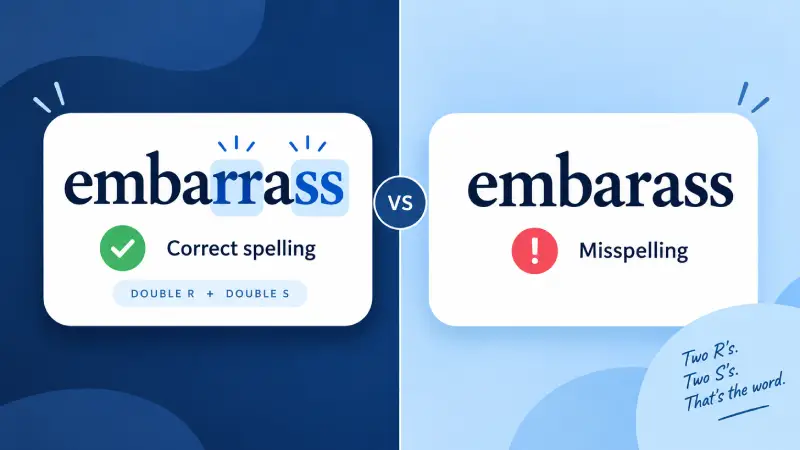
Embarrass is the correct spelling. Embarass is a misspelling.
If you are unsure whether to write embarrass or embarass, remember that the correct spelling has two r’s and two s’s:
embarrass
The word embarrass is a verb meaning to make someone feel uncomfortable, self-conscious, ashamed, or awkward. It can also describe the feeling of causing someone to experience an uncomfortable situation.
Quick answer:
✅ Embarrass = correct spelling
❌ Embarass = incorrect spelling
Is “embarrass” or “embarass” correct?
Embarrass is the standard English spelling.
Embarass is a common spelling mistake because it is easy to forget one of the repeated letters.
| Spelling | Correct? | Meaning |
|---|---|---|
| embarrass | ✅ Yes | To make someone feel awkward, uncomfortable, or self-conscious |
| embarass | ❌ No | Misspelling of embarrass |
For example:
I did not mean to embarrass you.
His joke could embarrass her in front of everyone.
Try not to embarrass yourself during the presentation.
The key spelling feature is the double r and double s:
emba + rr + a + ss
What does “embarrass” mean?
Embarrass is a verb that means to make someone feel uncomfortable, awkward, ashamed, or self-conscious.
For example:
Don’t embarrass your brother in front of his friends.
The sentence means that the speaker does not want the brother to feel uncomfortable or ashamed in front of other people.
The word can also describe a situation that causes discomfort:
The unexpected question embarrassed him.
Here, the unexpected question caused him to feel uncomfortable.
In another context, embarrass can mean to put someone in a difficult or awkward position:
The mistake embarrassed the company.
Therefore, the word can describe both personal discomfort and a situation that creates difficulty or awkwardness.
Why is “embarrass” spelled with two r’s and two s’s?
The most important spelling feature is the repeated consonants.
The correct form is:
E M B A R R A S S
It contains:
- RR after “a”
- SS at the end
The incorrect form embarass has only one r:
E M B A R A S S
That missing r makes the spelling incorrect.
A useful way to remember the word is:
EM + BARR + ASS
The middle barr contains rr, while the ending ass contains ss.
Therefore:
embarrass = RR + SS
How do you spell embarrass correctly?
Spell the word:
E-M-B-A-R-R-A-S-S
You can break it into parts:
em + barrass
Or simply remember:
Embarrass has two R’s and two S’s.
This is especially useful because many people remember the final ss but accidentally write only one r.
Compare the two forms:
embarrass ✅
embarass ❌
The correct form always contains rr.
Embarrass vs. embarrassed
- Embarrass and embarrassed are related forms of the same verb, but they serve different grammatical purposes.
- Embarrass is the base form:
I don’t want to embarrass him.
Embarrassed is the past tense and past participle:
I embarrassed him yesterday.
The adjective embarrassed can also describe someone’s emotional state:
She felt embarrassed after making the mistake.
Notice that embarrassed also keeps the double r and double s:
embarrass → embarrassed
The spelling becomes:
E-M-B-A-R-R-A-S-S-E-D
Embarrass vs. embarrassing
The same spelling pattern appears in embarrassing.
The correct form is:
embarrassing
not:
embarassing
The base word contains rr, so that spelling remains when -ing is added.
For example:
That was an embarrassing mistake.
He told an embarrassing story about his childhood.
I found the situation extremely embarrassing.
Remember:
embarrass → embarrassing
The double r remains.
Embarrass vs. embarrassment
Another related word is embarrassment.
The correct spelling is:
embarrassment
not:
embarassment
The same double r appears in the word:
E-M-B-A-R-R-A-S-S-M-E-N-T
For example:
She tried to hide her embarrassment.
His face showed obvious embarrassment.
The mistake caused considerable embarrassment.
Therefore, learning embarrass helps you spell several related forms correctly.
Examples of “embarrass” in sentences
Here are natural examples of embarrass in American English:
I didn’t mean to embarrass you in front of your coworkers.
Please don’t embarrass your sister at the party.
His question might embarrass the speaker.
The mistake could embarrass the entire team.
She tried not to embarrass her friend.
Nobody wants to embarrass themselves during a presentation.
The unexpected announcement seemed to embarrass him.
I hope this story doesn’t embarrass you.
These examples show that embarrass normally takes a person as its object.
How is “embarrass” used in everyday conversation?
Embarrass is common in everyday American English.
People often use it when talking about awkward situations involving friends, family members, coworkers, classmates, or public events.
For example:
My brother always tries to embarrass me.
Don’t embarrass yourself.
I didn’t want to embarrass her.
That question really embarrassed him.
The word can describe something serious or something relatively minor.
For instance, forgetting someone’s name might cause temporary embarrassment, while a public mistake might create a much stronger feeling.
Can “embarrass” describe yourself?
Yes. You can use embarrass with a reflexive pronoun such as myself, yourself, himself, or herself.
For example:
I don’t want to embarrass myself.
He embarrassed himself during the interview.
She worried that she might embarrass herself.
The expression embarrass yourself is particularly common.
It usually means doing or saying something that causes you to feel awkward, foolish, or uncomfortable in front of other people.
Embarrass vs. humiliate
- Embarrass and humiliate have related meanings, but they are not always equally strong.
- Embarrass usually refers to making someone feel awkward, uncomfortable, or self-conscious.
Humiliate generally suggests a much stronger loss of dignity or self-respect.
Compare:
I accidentally embarrassed him by mentioning his mistake.
The public insult humiliated him.
The first sentence describes an awkward situation. The second suggests a much more severe experience.
Therefore, embarrass is often the more neutral word.
Embarrass vs. ashamed
- Embarrass is also different from ashamed.
- Embarrass is a verb:
The mistake embarrassed me.
Ashamed is an adjective describing a person’s feeling:
I felt ashamed of my mistake.
Someone can feel embarrassed without feeling deeply ashamed.
For example:
I was embarrassed when I forgot her name.
This does not necessarily mean the person felt serious guilt or moral shame.
Common mistakes with embarrass
Mistake 1: Writing “embarass”
Incorrect:
I didn’t mean to embarass you.
Correct:
I didn’t mean to embarrass you.
The incorrect version has only one r.
Mistake 2: Writing “embarras”
Incorrect:
Don’t embarras your friend.
Correct:
Don’t embarrass your friend.
The correct form ends with ss, not a single s.
Mistake 3: Writing “embarassed”
Incorrect:
She felt embarassed.
Correct:
She felt embarrassed.
The past form keeps the double r:
embarrassed
Mistake 4: Writing “embarassing”
Incorrect:
It was an embarassing moment.
Correct:
It was an embarrassing moment.
Again, the correct spelling contains rr.
Why do people misspell embarrass?
The word embarrass contains repeated letters, which makes it easy to miss one when writing quickly.
The sequence can be difficult to remember:
rr + ss
Because of that, writers sometimes simplify the word to:
embarass
However, that spelling removes one of the two r’s.
Another reason is pronunciation. The repeated letters are not necessarily obvious when the word is spoken, so relying only on pronunciation can lead to spelling errors.
Consequently, remembering the written pattern is more useful:
EMBARRASS = RR + SS
Easy memory tricks for embarrass
Trick 1: Remember RR and SS
The simplest memory trick is:
Embarrass has two R’s and two S’s.
Think:
RR + SS
Trick 2: Think “double trouble”
The word has two sets of double letters:
embaRR aSS
Both R and S are doubled.
So you can remember:
Embarrass has double trouble: RR + SS.
Trick 3: Remember the related forms
Learning the word family can reinforce the spelling:
- embarrass
- embarrassed
- embarrassing
- embarrassment
All of these forms retain the important rr spelling.
What are the related forms of embarrass?
| Word | Part of speech | Meaning |
|---|---|---|
| embarrass | Verb | Make someone feel awkward or uncomfortable |
| embarrassed | Adjective/verb form | Feeling awkward or made uncomfortable |
| embarrassing | Adjective/verb form | Causing embarrassment |
| embarrassment | Noun | The feeling or situation of being embarrassed |
For example:
I don’t want to embarrass him.
He looked embarrassed.
It was an embarrassing mistake.
She tried to hide her embarrassment.
Learning these related forms can help you avoid several common spelling mistakes at once.
Is “embarass” ever correct?
No. If you are trying to use the standard English verb meaning “to make someone feel awkward or uncomfortable,” the correct spelling is embarrass.
Embarass is a misspelling.
Therefore, in formal writing, school assignments, professional communication, and published content, use:
embarrass
Quick-Reference Takeaway
- Embarrass is the correct spelling.
- Embarass is incorrect.
- Embarrass is a verb.
- It means to make someone feel awkward, uncomfortable, or self-conscious.
- The correct spelling contains two R’s.
- It also contains two S’s.
- Remember: RR + SS.
- Related words include embarrassed, embarrassing, and embarrassment.
- Embarass, embarassed, and embarassing are common misspellings.
- When in doubt, remember: embaRR aSS.
FAQs
Is it embarrass or embarass?
The correct spelling is embarrass. The spelling embarass is incorrect.
How do you spell embarrass correctly?
Spell it E-M-B-A-R-R-A-S-S. The word has two r’s and two s’s.
What does embarrass mean?
Embarrass means to make someone feel awkward, uncomfortable, ashamed, or self-conscious.
Is embarrassed spelled with two r’s?
Yes. The correct spelling is embarrassed, with two r’s and two s’s.
Is embarrassing spelled with two r’s?
Yes. The correct spelling is embarrassing. It retains the double r from embarrass.
What is the noun form of embarrass?
The noun form is embarrassment. It refers to the feeling or situation of being embarrassed.
What is the easiest way to remember embarrass?
Remember RR + SS. The correct spelling is embarrass, with two r’s and two s’s.
Is embarass a word?
No. Embarass is a common misspelling of embarrass.
What is the difference between embarrass and humiliate?
Both words involve making someone feel bad or uncomfortable. However, humiliate generally describes a much stronger loss of dignity, while embarrass can describe a less severe awkward or uncomfortable situation.
Conclusion
Embarrass is the correct spelling, while embarass is a misspelling. The biggest spelling clue is the pair of repeated consonants:
embaRR aSS
Remember that embarrass contains two R’s and two S’s. The same pattern appears in related words such as embarrassed, embarrassing, and embarrassment.
When you need the standard English verb meaning “to make someone feel awkward or uncomfortable,” choose embarrass:
Embarrass ✅
Embarass ❌

Olivia Smith is a US English writer and language enthusiast who specializes in spelling, word choice, and commonly confused words. She creates clear, practical guides that help readers understand the correct spelling, meaning, and usage of English words.
At GrammarPool.com, Olivia focuses on spelling-choice topics, common spelling mistakes, and easy-to-understand explanations for everyday English users. Her writing is designed to make confusing word choices simple, accurate, and easy to remember.
Expertise: US English, spelling, word choice, commonly confused words, grammar, and language usage.