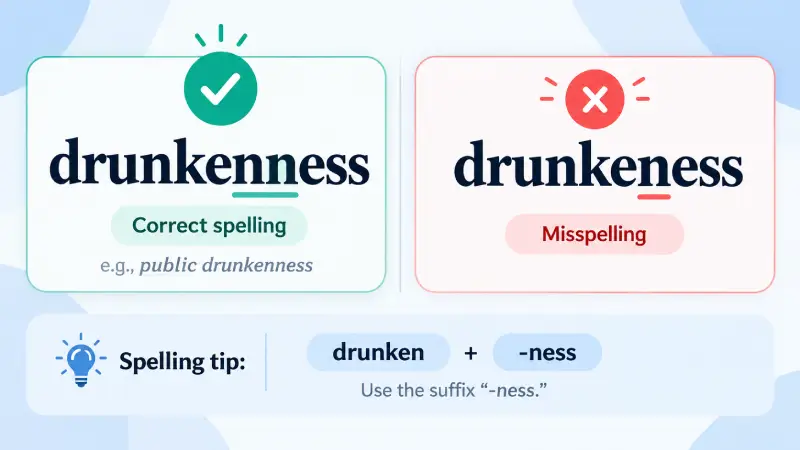
Drunkenness is the correct spelling. Drunkeness is a misspelling.
If you are unsure whether to write drunkenness or drunkeness, remember that the correct word contains “kn” + “enness” after the base word drunken: drunkenness.
The word drunkenness is a noun that describes the condition or state of being drunk. It can refer to noticeable intoxication caused by alcohol. In contrast, drunkeness is not the standard spelling in English.
Quick answer:
✅ Drunkenness = correct spelling
❌ Drunkeness = incorrect spelling
Is “drunkenness” or “drunkeness” correct?
Drunkenness is the correct spelling.
The incorrect form drunkeness leaves out an n before the suffix -ness. Therefore, when you need the noun describing the state of being drunk, use drunkenness.
| Spelling | Correct? | Meaning |
|---|---|---|
| drunkenness | ✅ Yes | The state or condition of being drunk |
| drunkeness | ❌ No | Common misspelling of drunkenness |
For example:
The law addresses public drunkenness.
His drunkenness affected his judgment.
The signs of drunkenness were obvious.
Although drunkeness may appear in informal writing or online searches, it is not the standard spelling.
What does “drunkenness” mean?
Drunkenness is a noun meaning the state of being drunk or intoxicated.
The word usually describes a condition in which a person has consumed enough alcohol to become noticeably impaired. Depending on the context, drunkenness can involve impaired judgment, poor coordination, unusual behavior, or difficulty speaking clearly.
For example:
The officer noticed signs of drunkenness.
Here, drunkenness refers to the person’s intoxicated condition.
The word can also describe drunken behavior more generally:
The story describes the consequences of repeated drunkenness.
In this sentence, drunkenness refers to the repeated state or behavior associated with being drunk.
Why is “drunkenness” spelled with two n’s?
The spelling becomes easier to understand when you look at the base word.
The adjective drunken already ends with n:
drunken
When you add the suffix -ness, the existing ending remains:
drunken + ness = drunkenness
That produces:
D R U N K E N N E S S
Notice the two n letters together:
drunkenness
The incorrect form drunkeness has only one n between the e and ess portion:
drunkeness ❌
Therefore, if you remember that the base word is drunken, you can avoid dropping the second n.
Drunkenness vs. drunkeness: spelling rule
The main spelling rule is simple:
drunken + ness = drunkenness
The suffix -ness is commonly used to turn adjectives into nouns that describe a state, quality, or condition.
For example:
- dark + ness = darkness
- kind + ness = kindness
- weak + ness = weakness
- ill + ness = illness
- drunken + ness = drunkenness
In drunkenness, the final n of drunken stays in place when -ness is added.
Consequently, the correct spelling contains nn in the middle:
drunkenness
How do you spell drunkenness correctly?
Spell it this way:
D-R-U-N-K-E-N-N-E-S-S
A useful way to break it apart is:
drunken + ness
The base word is:
drunken
The suffix is:
-ness
Together:
drunken + ness = drunkenness
This method is more reliable than trying to memorize every letter individually.
What is the difference between drunkenness and being drunk?
Although the words are related, they have different grammatical functions.
Drunkenness is a noun. It names the state or condition.
Drunk can function as an adjective and can also be used as a noun in certain contexts.
Compare:
His drunkenness caused problems at work.
He was drunk at the party.
The first sentence names the condition. The second describes the person’s state.
Similarly:
The law prohibits public drunkenness.
The man appeared drunk.
Therefore, use drunkenness when you need a noun describing the condition.
Examples of “drunkenness” in sentences
Here are several natural examples of drunkenness in American English:
The police officer suspected drunkenness after observing the driver’s behavior.
Public drunkenness can create safety concerns.
The company has rules concerning alcohol use and drunkenness in the workplace.
His repeated drunkenness caused serious problems for his family.
The report described the effects of alcohol and drunkenness.
The court considered evidence related to alleged drunkenness.
Excessive alcohol consumption can result in drunkenness.
The hotel has a policy against disruptive drunkenness.
These examples show how drunkenness normally works as a noun.
Drunkenness in everyday conversation
In casual conversation, people often use simpler expressions such as being drunk, intoxication, or being intoxicated.
For example:
He was drunk last night.
She was concerned about his drinking.
The police suspected intoxication.
However, drunkenness remains a standard English noun. It is especially common in formal, legal, medical, journalistic, and descriptive contexts.
For instance:
The law prohibits public drunkenness.
This sounds more formal than:
The law prohibits being drunk in public.
Both can communicate a similar idea, but their style differs.
Drunkenness in legal and public contexts
The word drunkenness frequently appears in discussions of public behavior, law enforcement, and alcohol-related offenses.
For example:
The officer arrested him for public drunkenness.
The city has regulations concerning public drunkenness.
The report discussed drunkenness and disorderly conduct.
However, the exact legal terminology can vary by jurisdiction. A particular law may use terms such as public intoxication rather than public drunkenness.
Therefore, when discussing a specific law, it is important to use the terminology found in the relevant statute or official source.
Drunkenness vs. intoxication
- Drunkenness and intoxication are closely related, but they are not always interchangeable.
- Drunkenness usually emphasizes the condition of being drunk, particularly because of alcohol.
Intoxication is broader and can refer to impairment caused by alcohol, drugs, or other substances.
Compare:
The signs of drunkenness were easy to recognize.
The doctor evaluated the patient’s level of intoxication.
In everyday American English, drunkenness often has a stronger connection to alcohol.
Meanwhile, intoxication can be more formal or technical.
Drunkenness vs. drunkness
Another spelling that sometimes causes confusion is drunkness.
The standard noun is drunkenness, not drunkness.
The adjective drunken provides the base for the noun:
drunken + ness = drunkenness
Therefore:
- drunkenness ✅
- drunkeness ❌
- drunkness ❌
When you need the noun, choose drunkenness.
Why do people spell “drunkenness” as “drunkeness”?
The misspelling drunkeness is understandable because the word has several consecutive letters that can be easy to overlook.
When people add -ness to drunken, they may mentally simplify the spelling:
drunken + ness
and accidentally write:
drunkeness
The missing n is the main problem.
Moreover, English spelling often becomes difficult when a base word already ends with a letter that also begins part of the added suffix. Looking at the word in parts helps prevent this mistake.
Remember:
DRUNKEN + NESS
not:
DRUNKENE + SS
Easy memory trick for drunkenness
Use this simple trick:
Remember “DRUNKEN + NESS”
The word drunkenness contains the complete word drunken.
DRUNKEN + NESS = DRUNKENNESS
Do not remove the final n from drunken.
You can also remember:
Drunken has an N at the end, and -ness keeps it.
So:
drunken → drunkenness
This makes the spelling easier to recall when writing quickly.
Common mistakes with drunkenness
Mistake 1: Writing “drunkeness”
Incorrect:
His drunkeness caused problems.
Correct:
His drunkenness caused problems.
The correct form has two consecutive n letters.
Mistake 2: Writing “drunkness”
Incorrect:
The report discussed drunkness.
Correct:
The report discussed drunkenness.
The standard noun uses drunken, not simply drunk, before -ness.
Mistake 3: Confusing “drunken” and “drunk”
These words are related, but they do not always work in exactly the same way.
He was drunk.
His drunkenness was obvious.
The first sentence uses drunk as a description. The second uses drunkenness as a noun.
Is “drunkenness” formal or informal?
Drunkenness is a standard word that can appear in both everyday and formal English. However, it often sounds more formal than simply saying being drunk.
For example:
His drunkenness became a serious problem.
This sounds more formal than:
His being drunk became a serious problem.
In everyday conversation, speakers may simply say:
He was drunk.
In legal, journalistic, or formal writing, drunkenness can be a natural choice.
Drunkenness vs. alcoholism
These terms should not be treated as exact synonyms.
Drunkenness describes a state of being drunk or intoxicated.
Alcoholism traditionally refers to problematic dependence on alcohol. Modern health terminology often uses alcohol use disorder (AUD) instead.
Therefore, someone can experience drunkenness without necessarily having an alcohol use disorder.
For example:
The incident involved drunkenness.
That statement describes a condition at a particular time. It does not, by itself, establish a long-term drinking disorder.
Is “drunkenness” a noun?
Yes. Drunkenness is a noun.
It names a condition or state.
For example:
Drunkenness can affect judgment.
Here, drunkenness is the subject of the sentence.
You can also use it after a preposition:
The officer reported signs of drunkenness.
Because it is a noun, it can function as a subject, object, or object of a preposition.
What are the related forms of drunkenness?
Several related words are useful:
| Word | Part of speech | Meaning |
|---|---|---|
| drink | verb/noun | To consume a liquid; a beverage |
| drunk | adjective/noun | Intoxicated; a person who is drunk |
| drunken | adjective | Characterized by or affected by intoxication |
| drunkenness | noun | The state or condition of being drunk |
| drunkenly | adverb | In a drunken manner |
For example:
He drank too much.
He was drunk.
The drunken driver was stopped.
His drunkenness was apparent.
The man behaved drunkenly.
These forms are related, but each serves a different grammatical purpose.
Quick-Reference Takeaway
- Drunkenness is the correct spelling.
- Drunkeness is a misspelling.
- Drunkenness is a noun.
- It means the state or condition of being drunk.
- The spelling comes from drunken + ness.
- Keep the final n in drunken when adding -ness.
- The correct word contains nn: drunkenness.
- Drunkenness and intoxication can overlap in meaning, but they are not always exact synonyms.
- Drunkenness is different from alcoholism or alcohol use disorder.
- For the standard English noun, always choose drunkenness.
FAQs
Is drunkenness the correct spelling?
Yes. Drunkenness is the correct standard spelling. Drunkeness is a misspelling.
How do you spell drunkenness?
Spell it D-R-U-N-K-E-N-N-E-S-S. You can remember it as drunken + ness.
What does drunkenness mean?
Drunkenness means the state or condition of being drunk or intoxicated, usually because of alcohol.
Is drunkeness a word?
Drunkeness is not the standard spelling of the noun. If you mean the condition of being drunk, use drunkenness.
Is it drunkenness or drunkness?
The standard form is drunkenness. The spelling drunkness is not the standard noun form.
What is the difference between drunkenness and intoxication?
Drunkenness specifically emphasizes the state of being drunk, usually from alcohol. Intoxication is a broader term that can describe impairment caused by alcohol or other substances.
Is drunkenness a noun?
Yes. Drunkenness is a noun because it names a state or condition.
How can I remember the spelling of drunkenness?
Break it into two parts: drunken + ness. Keep the final n in drunken, giving you drunkenness.
Conclusion
Drunkenness is the correct spelling, while drunkeness is a misspelling. The easiest way to remember the correct form is to start with drunken and add -ness:
drunken + ness = drunkenness
The word drunkenness is a noun that describes the state or condition of being drunk. Although drunkenness, intoxication, and related terms can overlap, they have different meanings and uses.
Whenever you need the standard English noun, choose drunkenness with the double n:
Drunkenness ✅
Drunkeness ❌

Olivia Smith is a US English writer and language enthusiast who specializes in spelling, word choice, and commonly confused words. She creates clear, practical guides that help readers understand the correct spelling, meaning, and usage of English words.
At GrammarPool.com, Olivia focuses on spelling-choice topics, common spelling mistakes, and easy-to-understand explanations for everyday English users. Her writing is designed to make confusing word choices simple, accurate, and easy to remember.
Expertise: US English, spelling, word choice, commonly confused words, grammar, and language usage.