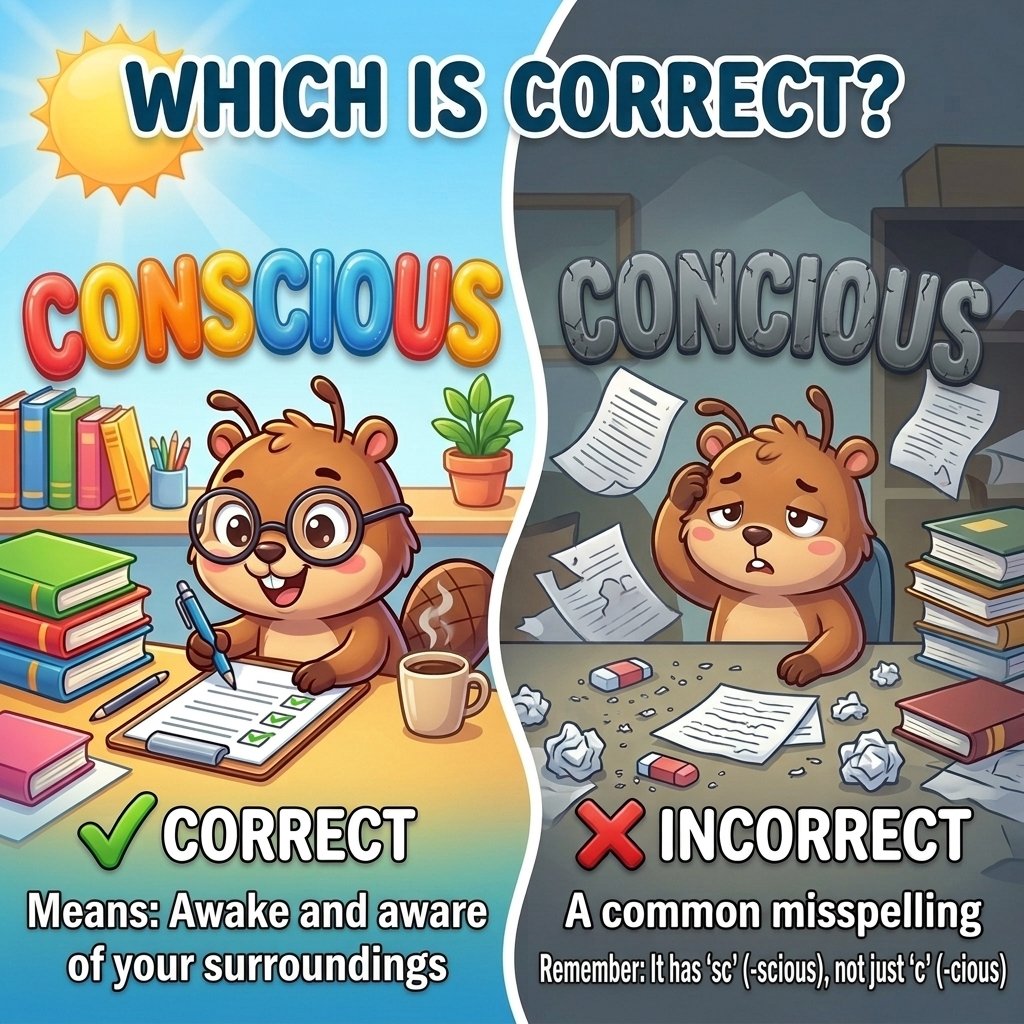
Conscious vs. concious is a common English spelling confusion. The correct spelling is conscious, while concious is a misspelling. If you want to describe someone who is awake, aware of their surroundings, or able to recognize their thoughts and feelings, use conscious.
Although concious may look like a reasonable spelling, it leaves out the letter s after the first ou sound. This small mistake can affect the accuracy of your writing, especially in school assignments, professional emails, and online content. In this guide, you will learn the difference between conscious and concious, explore clear examples, and discover easy ways to remember the correct spelling.
Quick Answer: Conscious vs. Concious
Conscious is the correct spelling. It means awake, aware, or able to notice something. Concious is incorrect and does not have a standard meaning in English.
- Correct: She remained conscious throughout the medical examination.
- Incorrect: She remained concious throughout the medical examination.
Remember to include the letter s after con when spelling conscious.
What Does Conscious Mean?
The word conscious is an adjective that describes someone who is awake, aware, or mentally able to recognize what is happening around them. It can also describe deliberate thoughts, decisions, or actions.
For example, a person who is conscious can usually respond to their surroundings. Similarly, someone who makes a conscious decision chooses to act intentionally rather than by accident.
Examples of Conscious in Sentences
- The patient was conscious and able to answer the doctor’s questions.
- I am conscious of the time, so I will keep my presentation brief.
- She made a conscious effort to improve her writing.
- He became conscious of the noise coming from the next room.
- The company is becoming more conscious of its environmental impact.
- After the accident, the driver remained conscious until help arrived.
In each sentence, conscious describes awareness, alertness, or intentional action.
What Does Concious Mean?
Concious is a misspelling of conscious. It is not accepted as the standard spelling in modern English, so you should avoid using it in formal or informal writing.
People often misspell conscious because the word contains an unusual combination of letters. They may remember the sound of the word but forget the s that appears after con.
Examples of the Incorrect Spelling
- Incorrect: He was concious of his mistake.
- Correct: He was conscious of his mistake.
- Incorrect: The patient was still concious.
- Correct: The patient was still conscious.
- Incorrect: She made a concious choice.
- Correct: She made a conscious choice.
If you see concious in your writing, replace it with conscious.
Conscious vs. Concious: Key Differences
The main difference between conscious and concious is spelling. Only conscious is correct.
| Feature | Conscious | Concious |
|---|---|---|
| Spelling status | Correct | Incorrect |
| Part of speech | Adjective | Misspelling |
| Meaning | Awake, aware, or intentional | No standard meaning |
| Suitable for formal writing | Yes | No |
| Example | He was conscious of the risk. | He was concious of the risk. |
The easiest way to avoid confusion is to remember that conscious contains the letter s after con.
Why Do People Misspell Conscious?
There are several reasons why writers confuse conscious with concious.
1. The Spelling Is Unusual
The combination of letters in conscious does not always feel intuitive to English learners. As a result, writers may leave out a letter when typing the word.
2. Pronunciation Can Be Misleading
In everyday American English, conscious is commonly pronounced approximately as KON-shuhs. The spelling does not match the pronunciation in a straightforward, letter-by-letter way, which can make it harder to remember.
3. People Type Too Quickly
When writing quickly, you might remember the general appearance of the word but accidentally omit the s. This is especially common when drafting messages, articles, or schoolwork without proofreading.
4. Spell-Check May Not Catch Every Mistake
Most modern spell-checking tools can identify many misspellings, but you should still proofread your work. Tools may overlook errors in certain contexts, and relying on them alone is not a reliable editing strategy.
How to Remember the Correct Spelling of Conscious
Use these simple spelling tips to remember conscious.
Remember the Letter S
The most useful trick is to focus on the missing letter in the incorrect version.
Con + scious = conscious
Remember that the correct spelling contains s immediately after con. The spelling concious skips that letter.
Connect Conscious With Awareness
Think of conscious as a word related to awareness. When you are conscious, you are aware of yourself or your surroundings.
For example, you might say, “I am conscious of my responsibilities.” Connecting the word with a familiar meaning can make it easier to recall.
Practice With Short Sentences
Write a few sentences using the correct spelling:
- I am conscious of my actions.
- The patient is conscious.
- She made a conscious decision.
Repeating the correct spelling in context can help reinforce it.
Proofread the Word Carefully
When you finish writing, check whether you have included the s after con. This quick review can prevent a common spelling error.
Conscious vs. Conscience vs. Consciousness
The word conscious is also easy to confuse with conscience and consciousness. Although these words are related, they have different meanings.
| Word | Meaning | Example |
|---|---|---|
| Conscious | Awake or aware | He was conscious after the fall. |
| Conscience | An inner sense of right and wrong | Her conscience told her to admit the truth. |
| Consciousness | The state of being aware | The medication affected his consciousness. |
Conscious
Use conscious when describing awareness, alertness, or intentional behavior.
Example: She was conscious of the audience watching her.
Conscience
Use conscience when discussing someone’s moral judgment or sense of right and wrong.
Example: His conscience would not let him lie.
Consciousness
Use consciousness when referring to the state or condition of being aware.
Example: The injured person briefly lost consciousness.
Learning these distinctions will help you choose the right word for your sentence.
Common Sentences Using Conscious Correctly
Here are additional examples showing how to use conscious naturally in American English.
- I was conscious of my pronunciation during the interview.
- The swimmer remained conscious while waiting for assistance.
- He made a conscious decision to save money.
- She is conscious of how her words affect other people.
- The athlete was fully conscious after the game.
- We should be conscious of our environmental responsibilities.
- He became conscious that everyone was listening.
- The teacher encouraged students to make conscious choices.
- I was barely conscious when the paramedics arrived.
- They made a conscious effort to reduce waste.
Notice that the meaning changes slightly with context, but the spelling always remains conscious.
Is Conscious or Concious Correct in American English?
Conscious is correct in American English. The spelling does not change between American and British English. In both varieties, concious is a misspelling.
For example, American writers should use phrases such as conscious effort, conscious decision, and fully conscious. The same spellings apply in British English.
If you are writing an essay, business email, blog post, or academic paper, always use conscious.
FAQs
1. Is conscious or concious correct?
Conscious is correct. Concious is a misspelling and should not appear in standard English writing.
2. What does conscious mean?
Conscious means awake, aware of your surroundings, or aware of your thoughts and actions. It can also describe an intentional choice or effort.
3. Why do people spell conscious as concious?
People often leave out the letter s because the word has an unusual spelling pattern and its pronunciation can make the letter sequence difficult to remember.
4. How do you spell conscious correctly?
Spell it c-o-n-s-c-i-o-u-s. Remember the s immediately after con to avoid writing concious.
5. Is conscious the same as conscience?
No. Conscious describes awareness or alertness, while conscience refers to a person’s inner sense of right and wrong.
6. Is conscious spelled differently in American and British English?
No. Both American and British English use conscious. The spelling concious is incorrect in both varieties.
Conclusion
When comparing conscious vs. concious, remember that conscious is the only correct spelling. It describes someone who is awake, aware, or acting intentionally. The spelling concious is incorrect because it leaves out the letter s after con.
To avoid this mistake, practice writing the word in sentences, connect it with the idea of awareness, and proofread your work before publishing or submitting it. Once you remember the correct letter sequence, you can use conscious confidently in everyday and professional writing.