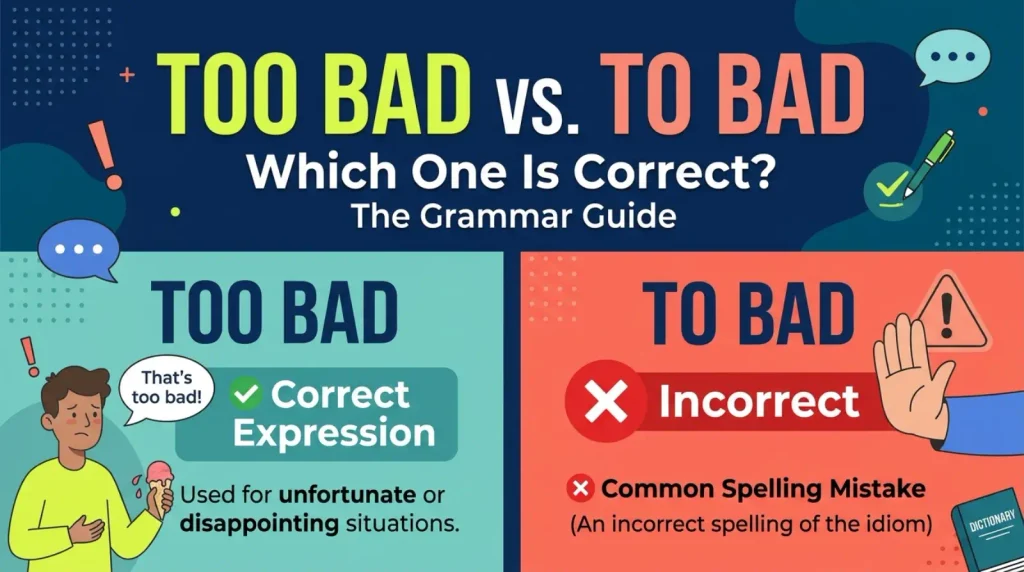
Too bad is the correct expression when you mean unfortunate, disappointing, or regrettable. To bad is generally incorrect when used with this meaning because to and bad do not form a standard expression. However, the words to and bad can appear next to each other in a sentence when they serve separate grammatical functions.
The confusion between too bad vs. to bad happens because the words too and to sound alike in American English. Their meanings and grammatical functions, however, are different. Once you understand how each word works, you can choose the correct expression in everyday conversations, text messages, school assignments, and professional writing.
Quick Answer: Too Bad or To Bad?
- Too bad: Correct when expressing disappointment, sympathy, or regret. Example: “It’s too bad that the game was canceled.”
- To bad: Incorrect when you intend to express disappointment. Example: “It’s to bad that the game was canceled” should be “It’s too bad that the game was canceled.”
The easiest way to remember the difference is that too can mean also or more than is desirable, while to commonly introduces an infinitive verb or indicates direction.
For example:
- “It’s too bad you missed the concert.” This expresses disappointment.
- “I want to avoid a bad decision.” Here, to introduces the verb avoid, and bad describes decision.
The words can appear in the same sentence without forming the incorrect expression to bad.
What Does Too Bad Mean?
Too bad is a common English expression used to describe an unfortunate situation, express disappointment, or acknowledge that something did not happen as hoped.
It can also communicate sympathy, although the tone depends on the context and the speaker’s intention.
1. Too Bad Means Unfortunate
When you describe something as too bad, you mean that it is unfortunate, disappointing, or regrettable.
Examples:
- It’s too bad that your favorite restaurant closed before you could visit.
- The school canceled the field trip because of the storm. That’s too bad.
- It’s too bad we couldn’t attend the wedding, but we hope everyone had a wonderful time.
- It’s too bad that the company postponed the product launch after months of preparation.
- The team practiced for weeks, so it was too bad that the final game was canceled.
In each example, too bad comments on an undesirable outcome. It does not describe the physical condition or moral character of a person.
2. Too Bad Can Express Sympathy
People often use too bad to respond when someone shares disappointing news.
For example:
- “I lost my wallet on the way home.” “Oh, that’s too bad. I hope you find it.”
- “My flight was delayed by six hours.” “That’s too bad. Did the airline offer another flight?”
- “I didn’t get the job I applied for.” “That’s too bad, but another opportunity may come along.”
In these situations, the phrase acknowledges another person’s disappointment.
However, tone matters. A warm, sympathetic voice can make too bad sound caring, while a dismissive tone can make it sound indifferent.
3. Too Bad Can Sound Dismissive or Sarcastic
Although too bad can express sympathy, it can also suggest that the speaker does not care about someone else’s problem.
Consider this exchange:
“Can we reschedule the meeting? I have an emergency.”
“Too bad. The meeting is still happening.”
Here, the expression sounds dismissive because the speaker refuses to accommodate the other person’s situation.
Similarly, someone might say, “Too bad you can’t come!” with genuine disappointment or use the same words sarcastically.
Therefore, the meaning of too bad depends partly on context, delivery, and the relationship between the speakers.
4. Too Bad Can Express Resignation
Sometimes, too bad acknowledges an unfortunate fact that cannot easily be changed.
Examples:
- It’s too bad that the tickets sold out, but we can try again next year.
- The deadline has passed, so it’s too bad we didn’t submit the application earlier.
- It’s too bad the weather changed, but we can move the picnic indoors.
The phrase does not always require strong emotion. It can simply recognize a disappointing circumstance.
What Does To Bad Mean?
To bad is not a standard English expression when you want to say that something is unfortunate. In that context, you should write too bad.
The confusion arises because to is an extremely common English word, and it sounds like too. However, to performs different grammatical functions from too.
1. To Introduces an Infinitive Verb
One of the most common uses of to is to introduce the base form of a verb.
Examples:
- I need to finish my homework before dinner.
- She hopes to become a teacher.
- We decided to leave before the traffic became heavy.
- He wants to improve his writing skills.
- They plan to discuss the proposal during tomorrow’s meeting.
Notice that to is followed by a verb in each example.
You cannot replace it with too without changing the sentence’s meaning or making the construction ungrammatical.
2. To Can Indicate Direction or Destination
The word to also indicates movement toward a destination, recipient, or endpoint.
Examples:
- We drove to the airport early in the morning.
- Please send the documents to the manager.
- She walked to the library after class.
- The package was delivered to our office yesterday.
- He transferred the money to his savings account.
In these sentences, to connects an action with its destination or recipient.
3. To and Bad Can Appear Separately
The words to and bad may appear next to each other in a grammatically correct sentence if they have separate functions.
For example:
- I don’t want to make a bad impression during the interview.
- She decided to avoid bad habits that affected her sleep.
- We need to prevent bad decisions from harming the project.
- He tried to correct a bad assumption before the presentation.
In these examples, to introduces a verb, while bad describes a noun such as impression, habits, decisions, or assumption.
This distinction is important: the problem is not that the letters to and bad can never occur together. The problem is using to bad as a substitute for the expression too bad.
Too Bad vs. To Bad: Side-by-Side Comparison
| Feature | Too Bad | To Bad |
|---|---|---|
| Standard expression | Yes | No, not with the meaning of unfortunate |
| Meaning | Unfortunate, disappointing, or regrettable | No established meaning as a fixed expression |
| Main function | Expresses disappointment or comments on an unfortunate situation | To introduces an infinitive or indicates direction when used grammatically |
| Typical context | Conversations, texts, emails, and informal writing | Separate grammatical constructions containing to and bad |
| Example | It’s too bad we missed the bus. | I don’t want to make a bad decision. |
| Common mistake | Confusing too with to | Writing to bad when too bad is intended |
The key difference is that too bad works as a recognizable expression, whereas to bad does not have that standard meaning.
Why Do People Confuse Too Bad and To Bad?
Several features of English make this mistake common.
1. Too and To Sound Alike
In standard American English, too and to are usually pronounced the same way in ordinary speech. This makes it easy to choose the wrong spelling when writing quickly.
For example:
Incorrect: “It’s to bad that you missed the interview.”
Correct: “It’s too bad that you missed the interview.”
The speaker may know exactly what the sentence means but select the wrong word because pronunciation alone does not reveal the spelling.
2. Fast Typing Can Cause Errors
People often write text messages, social media comments, and emails without carefully reviewing every word.
For example:
Incorrect: “Too bad you can’t make it” might accidentally become “To bad you can’t make it.”
The correction is straightforward: use too bad when expressing disappointment.
3. Autocorrect Does Not Always Catch the Mistake
Both to and too are legitimate English words. As a result, spell-checking tools may not flag the incorrect expression.
For example:
Incorrect: “It’s to bad that the store is closed.”
Correct: “It’s too bad that the store is closed.”
Because the first sentence contains correctly spelled individual words, a basic spell-checker may overlook the contextual error. Reading the sentence for meaning is more reliable than depending entirely on automatic correction.
4. Writers May Remember the Sound but Forget the Rule
Some writers learn expressions by hearing them rather than seeing them in print. If they have not learned the distinction between to, too, and two, they may use the wrong spelling.
A useful solution is to memorize the expression as a complete unit: too bad means unfortunate.
How to Remember Too Bad vs. To Bad
You can distinguish these words quickly with two practical techniques.
Trick 1: Replace Too With Also
The word too can mean also in sentences such as “I’m coming too.”
This meaning does not work as a direct substitute in every expression, but it helps you remember that too is a separate word from the infinitive marker to.
For the phrase too bad, memorize the complete expression rather than trying to apply the also meaning literally.
Example:
“It’s too bad that the concert was canceled.”
The phrase communicates disappointment, so too bad is the correct spelling.
Trick 2: Ask What the Sentence Means
Before choosing between to bad and too bad, identify the intended meaning.
- If you mean unfortunate, use too bad.
- If you are introducing an action, use to before the verb.
- If you are describing a noun with bad, keep the sentence structure intact.
Compare these examples:
- “It’s too bad that we arrived late.” Correct: expresses disappointment.
- “I want to avoid a bad outcome.” Correct: to introduces avoid, and bad describes outcome.
- “She tried to fix a bad connection.” Correct: to introduces fix, while bad describes connection.
This test works because it focuses on the function of each word instead of its sound.
Too Bad vs. To Bad in Real-Life Situations
Seeing the distinction in context makes the rule easier to apply.
Scenario 1: Text Messages
Incorrect text:
“It’s to bad you can’t come to the party tonight.”
Correct text:
“It’s too bad you can’t come to the party tonight.”
The sender is expressing disappointment that a friend cannot attend. The phrase too bad communicates that meaning naturally.
A different message might say:
“I need to make a bad situation better.”
That sentence is also grammatically correct because to introduces make, and bad describes situation.
Scenario 2: Workplace Email
Consider this message from a colleague:
“It’s too bad the client postponed the meeting. I’ll contact them tomorrow to arrange another time.”
The phrase acknowledges an inconvenient change while keeping the email professional and constructive.
By contrast, this sentence is incorrect if it expresses disappointment:
“It’s to bad that the client postponed the meeting.”
The correct version uses too bad.
For more formal business communication, you might choose a more precise alternative, such as “It’s unfortunate that the client postponed the meeting.” This wording sounds more neutral and may be preferable when writing to senior colleagues or external clients.
Scenario 3: School Writing
Suppose a student is writing about a canceled school event.
Incorrect: “It was to bad that the students missed the science fair.”
Correct: “It was too bad that the students missed the science fair.”
The second sentence uses the standard expression to communicate disappointment.
If the assignment requires formal academic language, the student could write, “It was unfortunate that the students missed the science fair.” Both sentences communicate a similar idea, but the second is more formal.
Related Confusions: Too, To, and Two
The too bad vs. to bad confusion is part of a broader group of English word-choice errors. Understanding the related words makes your writing more accurate.
Too vs. To
Too commonly means also or more than is desirable. To often introduces an infinitive verb or expresses direction.
Examples:
- “I want to go too.” Here, too means also.
- “We need to leave now.” Here, to introduces the verb leave.
- “The soup is too hot.” Here, too means excessively.
Remember that too bad is the conventional expression for an unfortunate situation.
Too vs. Two
Two is the number 2. It has a different meaning from both to and too, even though the three words sound alike in standard American English.
Examples:
- I bought two notebooks for school.
- It’s too cold to swim today.
- We need to arrive before noon.
A useful check is to ask whether the sentence refers to the number 2, expresses an idea such as also or excessively, or uses to for direction or an infinitive.
Bad vs. Badly
Bad and badly are related, but they do not always serve the same grammatical function.
Bad is commonly an adjective that describes a noun: “The weather was bad.”
Badly is commonly an adverb that describes an action: “He played badly during the first half.”
However, bad can also appear in informal expressions such as “I feel bad about what happened.” In this sentence, bad describes the speaker’s emotional state rather than the manner of an action.
This related distinction does not change the spelling of too bad. The standard expression still uses too.
Too Bad vs. Too Much
Too bad expresses disappointment or describes an unfortunate situation. Too much indicates an excessive amount or degree.
Examples:
- It’s too bad that the store closed early.
- You added too much salt to the soup.
- The team lost the match, which was too bad.
- We spent too much money on unnecessary supplies.
Although both expressions contain too, they communicate different ideas. Use the phrase that matches your intended meaning.
Are There Any Exceptions to the Too Bad vs. To Bad Rule?
There is no standard exception that makes to bad an acceptable substitute for too bad when expressing disappointment.
However, the individual words to and bad can appear together in a sentence when the grammar supports them. For example, “I want to avoid a bad outcome” is correct because to introduces the verb avoid and bad modifies outcome.
There is also an important difference between a spelling mistake and an informal expression. Too bad is acceptable in casual conversation, text messages, and many forms of everyday writing. In formal contexts, alternatives such as unfortunate, regrettable, or disappointing may fit better.
The correct choice therefore depends on meaning, grammar, and tone, not simply on whether the sentence sounds natural when spoken.
Frequently Asked Questions
1. Is It Too Bad or To Bad?
Too bad is correct when you mean unfortunate, disappointing, or regrettable. To bad is incorrect when used with that meaning.
2. Why Is Too Bad Correct?
Too bad is an established English expression that communicates disappointment or describes an unfortunate situation. The word too is part of the expression and cannot be replaced by to without changing the intended meaning.
3. Is Too Bad One Word or Two Words?
Too bad is written as two separate words. Do not combine it into toobad or write it as to bad when expressing disappointment.
4. Can I Use Too Bad in Formal Writing?
Yes, but it may sound conversational. In formal reports, academic writing, or professional emails, phrases such as it is unfortunate or this is regrettable may communicate the same idea in a more formal tone.
5. Is “It’s Too Bad” Grammatically Correct?
Yes. “It’s too bad that we missed the train” is grammatically correct and natural English. The expression communicates disappointment about missing the train.
Quick Reference: Too Bad vs. To Bad
- Too bad: Correct expression meaning unfortunate or disappointing.
- To bad: Incorrect when used to express disappointment.
- To: Commonly introduces an infinitive verb or indicates direction.
- Too: Can mean also, excessively, or form part of the expression too bad.
- Memory tip: If you mean unfortunate, write too bad.
The bottom line is simple: too bad vs. to bad is primarily a word-choice and spelling distinction. When you want to express disappointment, use too bad. Save to for its grammatical functions, such as introducing verbs and indicating direction.