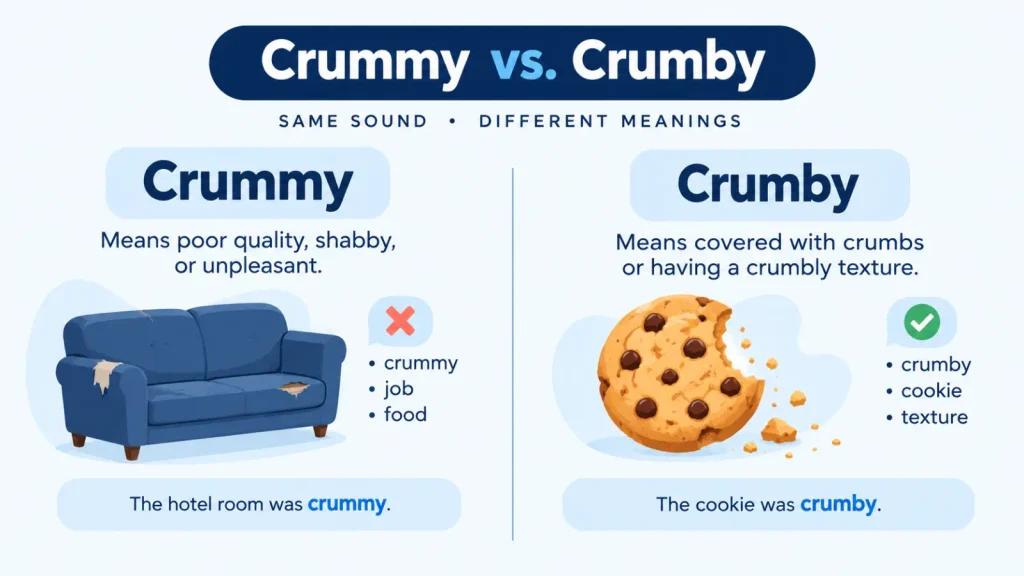
Crummy and crumby are both recognized English words, but they usually have different meanings and levels of familiarity. Crummy is the more common choice when describing something bad, poor in quality, unpleasant, or disappointing. For example, “We had a crummy day because it rained throughout our trip.”
Crumby, on the other hand, is generally associated with crumbs, meaning small pieces of bread, cake, cookies, or other baked foods. It can describe something that produces crumbs or is covered with them. However, crumby is much less common than crummy, and writers sometimes use it informally as a spelling variant.
The key difference in crummy vs. crumby is meaning and context. If you want to describe a terrible experience, poor service, or something of low quality, crummy is usually the appropriate word. If you are specifically talking about crumbs, crumby may be suitable.
Quick Answer: Crummy or Crumby?
- Crummy: The usual spelling for something bad, unpleasant, inferior, or disappointing.
- Crumby: A less common word associated with crumbs or something crumb-covered.
- Most common everyday usage: Crummy.
- Part of speech: Both words can function as adjectives.
- Example of crummy: The hotel room was crummy and uncomfortable.
- Example of crumby: The table became crumby after we ate cookies.
If you are unsure which spelling to choose, use crummy when expressing dissatisfaction or describing poor quality. Use crumby when the context specifically involves crumbs, while keeping in mind that crumb-covered or crumbly may communicate the intended meaning more clearly.
What Does Crummy Mean?
Crummy is an informal adjective that means bad, poor in quality, unpleasant, shabby, or inferior. People often use it in everyday conversation to express dissatisfaction with something.
The Cambridge Dictionary defines crummy as something of very bad quality. The word is informal, so it generally fits casual conversation better than formal academic or professional writing.
English meaning – Cambridge Dictionary
+1
Crummy Means Bad or Poor in Quality
Use crummy when something does not meet expectations or has poor quality.
Examples:
- We stayed in a crummy hotel during our vacation.
- The restaurant served crummy food.
- He bought a crummy phone that stopped working after a week.
- The movie received negative reviews because of its crummy script.
- She had to work with crummy equipment.
In these sentences, crummy expresses a negative opinion. It does not mean that the hotel, phone, food, or equipment contains crumbs.
Crummy Means Unpleasant or Disappointing
The word can also describe an unpleasant experience, a disappointing situation, or a person’s negative feelings.
Examples:
- I had a crummy day at work.
- The team played a crummy game and lost the championship.
- He felt crummy after hearing the disappointing news.
- We had crummy weather during our camping trip.
- She felt crummy about forgetting her friend’s birthday.
Here, crummy communicates dissatisfaction, disappointment, or feeling unwell. The exact meaning depends on the sentence.
Crummy Means Shabby or Run-Down
Crummy can describe a place or object that looks neglected, worn out, cheap, or poorly maintained.
Examples:
- They rented a crummy apartment with broken windows.
- The old building looked crummy from the outside.
- We found a crummy motel beside the highway.
- His car was old, noisy, and crummy.
- The office had crummy furniture and poor lighting.
This usage is informal and often carries a critical or dismissive tone.
What Does Crumby Mean?
Crumby is a legitimate English word. Its primary meaning relates to crumbs, the small pieces that break off bread, biscuits, cookies, cakes, or similar foods.
According to Dictionary.com, crumby can mean full of crumbs or soft. It is also recorded as an informal alternative to crummy in some varieties of English.
Dictionary.com
+1
Crumby Means Full of Crumbs
Use crumby when you want to describe something containing or covered with crumbs.
Examples:
- The kitchen counter became crumby after breakfast.
- My shirt was crumby after eating a cookie.
- The table looked crumby after the children finished their snacks.
- I wiped the crumby surface with a damp cloth.
- The car seat was crumby because someone had eaten crackers there.
In these examples, crumby refers to actual food particles rather than poor quality.
However, in polished writing, you may find covered with crumbs, full of crumbs, or crumb-covered clearer than crumby.
Crumby Can Describe a Crumb-Like Texture
Some dictionaries also associate crumby with softness or a texture resembling the inside of bread. The exact interpretation depends on context and regional usage.
Collins English Dictionary
+1
Examples:
- The baker described the bread as having a soft, crumby texture.
- The pastry left a crumby layer on the plate.
- The old cake had a crumby surface.
If you mean that a food breaks apart easily into small pieces, crumbly is usually the clearer and more familiar choice.
For example, “The cookie was crumbly” communicates that the cookie broke apart easily.
Crumby Can Also Mean Crummy
The distinction between these words is not absolute. Some dictionaries recognize crumby as an informal alternative spelling of crummy, including when it means bad or inferior. Collins records both the crumb-related meaning and the alternative spelling usage.
Collins English Dictionary
+1
For example, a writer might use crumby to mean poor or unpleasant. Nevertheless, if you are writing for a general American English audience and mean lousy or bad, crummy is the more familiar and clearer choice.
Crummy vs. Crumby: Key Differences
Although crummy and crumby are pronounced the same in ordinary English, their primary uses are different.
| Feature | Crummy | Crumby |
|---|---|---|
| Main meaning | Bad, poor, unpleasant, or inferior | Full of or covered with crumbs |
| Part of speech | Adjective | Adjective |
| Typical context | Experiences, places, products, quality, feelings | Food, surfaces, clothing, crumb-covered objects |
| Tone | Informal, often negative | Descriptive, usually literal |
| American English preference | Common for the meaning “bad” | Commonly associated with crumbs |
| Alternative meaning | Can describe a crumb-like condition in older usage | Can be an informal variant of crummy |
| Example | We had a crummy experience. | The table was crumby. |
The most useful distinction is:
- Crummy = lousy or poor quality.
- Crumby = containing or covered with crumbs.
- Crumbly = easily breaking into crumbs.
Remember that crumby can sometimes carry the same meaning as crummy, so context matters more than a rigid rule that the words can never overlap.
Why Do Crummy and Crumby Sound the Same?
Crummy and crumby are generally pronounced the same way: /ˈkrʌmi/, approximately KRUM-ee.
The difference is in their spelling and usual meaning, not their pronunciation. The letter b in crumby is silent, just as it is in the noun crumb.
Consider these words:
- Crumb: A small piece of bread, cake, or another food.
- Crumby: Containing or covered with crumbs.
- Crummy: Bad, unpleasant, shabby, or poor in quality.
- Crumbly: Easily breaking into crumbs or small pieces.
Because crummy and crumby sound alike, it can be difficult to determine which word someone means when hearing it spoken. The surrounding sentence usually makes the intended meaning clear.
For example:
- “This hotel is crummy.” The speaker thinks the hotel is poor or unpleasant.
- “This table is crumby.” The speaker means that crumbs are scattered on the table.
The spelling difference helps communicate the intended meaning when writing.
Crummy vs. Crumby vs. Crumbly
A third word, crumbly, is also worth understanding because it is frequently confused with the other two.
Crumbly means that something breaks apart easily into small pieces or crumbs. It often describes foods such as biscuits, cookies, pastries, and certain types of bread.
Unlike crummy, which usually expresses a negative judgment, crumbly describes a physical texture. A crumbly cake can be delicious, and a crumbly biscuit can have a desirable texture.
| Word | Definition | Example |
|---|---|---|
| Crummy | Bad, inferior, or unpleasant | The service at the restaurant was crummy. |
| Crumby | Full of or covered with crumbs | The kitchen counter was crumby. |
| Crumbly | Easily breaking into crumbs | The biscuit was crumbly and delicate. |
When Should You Use Crumbly?
Use crumbly when you want to describe the way a substance breaks apart.
Examples:
- The cheese had a dry, crumbly texture.
- These cookies are delicious but very crumbly.
- The old plaster became crumbly with age.
- The cake was soft and crumbly.
- The dry soil felt crumbly between my fingers.
Notice that crumbly does not automatically mean something is bad. It simply describes a physical characteristic.
Is Crumby the Same as Crumbly?
Not exactly. Crumby generally means full of or covered with crumbs, while crumbly means likely to break into crumbs.
For example, a clean plate can become crumby after someone eats a biscuit. The biscuit itself may be crumbly if it breaks apart easily.
This distinction helps you select the most precise word.
Crummy vs. Crumby in American English
For readers in the United States, the most practical approach is to distinguish the common American meanings while recognizing that dictionaries record some overlap.
Crummy is an established informal American English adjective meaning bad, poor in quality, shabby, or unpleasant. Cambridge gives examples such as crummy weather, a crummy job, and a crummy movie.
definition in the Cambridge English Dictionary
+1
Crumby is also used in American English, especially when describing something full of crumbs. Some dictionaries additionally list it as an informal alternative to crummy.
Dictionary.com
+1
Examples for American Readers
Use crummy when expressing dissatisfaction:
- I had a crummy day at work.
- The hotel room was crummy and uncomfortable.
- We received crummy customer service.
- That was a crummy excuse.
- The movie was entertaining, but the ending was crummy.
Use crumby when referring to crumbs:
- The kitchen floor was crumby after the party.
- My keyboard became crumby after I ate a muffin.
- The children left a crumby mess on the couch.
- The counter was still crumby after lunch.
In formal American English, you can often replace crumby with a clearer expression such as covered with crumbs. Similarly, replace crummy with poor-quality, unsatisfactory, or unpleasant when a more professional tone is appropriate.
Crummy vs. Crumby in British English
British English recognizes crummy as an informal adjective meaning inferior, unpleasant, or of little value. British dictionaries also record crumby as a spelling variant with overlapping meanings.
Collins English Dictionary
+1
The distinction between the two spellings is therefore not universal across all English varieties.
In practical terms, British writers can encounter both spellings in contexts involving poor quality and crumbs. However, crummy remains a familiar choice for the negative, informal meaning.
Examples:
- We stayed in a crummy hotel near the station.
- The service at the restaurant was crummy.
- The table was crumby after the children ate biscuits.
- The pastry had a soft, crumby texture.
For an article aimed at American readers, explaining the common distinction is helpful, but it would be inaccurate to claim that crumby can never mean crummy.
Is Crummy a Formal or Informal Word?
Crummy is an informal adjective. It is common in conversation and casual writing, particularly when someone wants to criticize something in a direct, conversational way. Cambridge labels the word informal in its English and American dictionary entries.
English meaning – Cambridge Dictionary
+1
When Crummy Is Appropriate
You can use crummy in:
- Casual conversations with friends.
- Informal messages and text chats.
- Personal stories and reviews.
- Dialogue in fiction.
- Informal blog posts.
- Everyday discussions about poor experiences.
For example:
“My flight was delayed, the food was cold, and the hotel was crummy.”
The sentence sounds conversational and expresses dissatisfaction.
When to Choose a More Formal Alternative
In business correspondence, academic writing, and formal reports, a more precise adjective may communicate your point more effectively.
| Informal wording | More formal alternative |
|---|---|
| Crummy service | Poor-quality service |
| A crummy result | An unsatisfactory result |
| A crummy hotel | An inadequate or poorly maintained hotel |
| A crummy experience | An unpleasant experience |
| A crummy product | A defective or inferior product |
| A crummy excuse | An unconvincing excuse |
The best alternative depends on what you want to criticize. For example, defective implies a problem with how something works, whereas unpleasant describes an experience or feeling.
Synonyms and Related Words for Crummy
Several words have meanings similar to crummy, but each has a slightly different emphasis.
- Lousy: Very bad or unsatisfactory; an informal synonym.
- Terrible: Extremely bad or unpleasant.
- Awful: Very bad, unpleasant, or distressing.
- Shabby: Worn, neglected, or in poor condition.
- Inferior: Lower in quality than something else.
- Substandard: Below an expected or required standard.
- Miserable: Very unpleasant or deeply unhappy, depending on context.
- Cheap: Low in price, or sometimes poorly made.
- Unpleasant: Not enjoyable or agreeable.
- Inadequate: Not good enough for a particular purpose.
- Second-rate: Inferior to the best available quality.
- Unsatisfactory: Failing to meet expectations or requirements.
Which Synonym Should You Choose?
Use lousy when you want an informal alternative to crummy.
Example: “We had a lousy experience at the restaurant.”
Use shabby when describing a neglected or worn-out place.
Example: “The apartment looked shabby after years without maintenance.”
Use substandard when describing something that fails to meet a particular standard.
Example: “The inspection identified substandard construction materials.”
Use unpleasant when discussing a negative experience without using slang.
Example: “We had an unpleasant conversation with the manager.”
These distinctions help you communicate more accurately instead of relying on crummy in every situation.
Words Related to Crumby
When describing crumbs, texture, or food, several related words may be more appropriate than crumby.
- Crumb: A small fragment of bread, cake, or another substance.
- Crumbs: Small fragments, often left after eating.
- Crumb-covered: Covered with small pieces or crumbs.
- Crumbly: Easily breaking into crumbs.
- Crumbed: Covered with breadcrumbs or a crumb coating, particularly in food preparation.
- Breadcrumbs: Small pieces of dried or fresh bread used in cooking.
- Crumb-like: Resembling a small crumb or fragment.
Examples:
- The table was covered with crumbs.
- The biscuit was crumbly.
- The fish was crumbed before frying.
- The surface had a crumb-like texture.
- The baker added breadcrumbs to the mixture.
These terms make it easier to describe the exact physical condition of an object or food.
Common Mistakes to Avoid
Mistake 1: Using Crummy to Mean Covered With Crumbs
Sentence: “The table was crummy after breakfast.”
This sentence may be understood, but it is not the clearest way to describe a table covered with food particles.
Better: “The table was crumby after breakfast.”
Even clearer: “The table was covered with crumbs after breakfast.”
Mistake 2: Using Crumby When You Mean Bad Quality
Sentence: “The customer received a crumby product.”
If you mean that the product was poor quality, crummy is the more familiar spelling for American readers.
Better: “The customer received a crummy product.”
In formal writing, consider “The customer received a poor-quality product.”
Mistake 3: Confusing Crumby With Crumbly
Sentence: “The cookie was crumby because it broke apart easily.”
If you mean that the cookie broke into small pieces, crumbly is more precise.
Better: “The cookie was crumbly.”
Mistake 4: Assuming Crumby Is Always Incorrect
Crumby is a legitimate word. It is not simply a misspelling of crummy. Dictionaries recognize its crumb-related meaning and, in some cases, its use as an informal alternative to crummy.
Dictionary.com
+1
Mistake 5: Assuming Crummy Always Refers to Food
Although the words are related historically, modern crummy commonly means bad, shabby, or unpleasant.
For example, “I feel crummy today” usually means that the speaker feels unwell or generally miserable, not that the speaker is covered with crumbs.
Mistake 6: Using Informal Language in a Formal Report
Sentence: “The company provided crummy service.”
This is understandable, but it may sound too casual in a professional complaint or formal report.
Better: “The company provided poor-quality service.”
The best choice depends on your audience, purpose, and tone.
Crummy vs. Crumby: Practical Sentence Comparisons
The following examples show how the two spellings work in everyday situations.
| Sentence | Correct word | Explanation |
|---|---|---|
| We stayed in a crummy hotel. | Crummy | The hotel was poor or unpleasant. |
| The kitchen counter was crumby. | Crumby | Crumbs were scattered on the counter. |
| I had a crummy day at work. | Crummy | The day was unpleasant. |
| My shirt became crumby after lunch. | Crumby | Small food particles were on the shirt. |
| The company offered crummy service. | Crummy | The service was poor. |
| The table was covered with crumbs. | Crumbs | This wording is clearer and more direct. |
| The biscuit was crumbly. | Crumbly | The biscuit broke apart easily. |
| I feel crummy today. | Crummy | The speaker feels unwell or miserable. |
These examples illustrate the most useful distinction for everyday writing. When you mean bad or unpleasant, choose crummy. When you mean covered with crumbs, crumby can work, although a more descriptive phrase may be clearer.
Frequently Asked Questions (FAQs)
Is Crummy or Crumby Correct?
Both crummy and crumby are recognized English words. Crummy is the more familiar spelling when describing something bad or poor in quality. Crumby usually refers to something containing or covered with crumbs, although some dictionaries also recognize it as an informal variant of crummy.
What Does Crummy Mean?
Crummy is an informal adjective meaning bad, inferior, shabby, or unpleasant. For example, “We stayed in a crummy hotel” means that the hotel was poor or disappointing.
What Does Crumby Mean?
Crumby usually means full of or covered with crumbs. For example, “The table was crumby after lunch” means that small food particles were scattered on the table.
Is Crumby a Misspelling of Crummy?
No. Crumby is a legitimate English word. It has its own crumb-related meaning and is also listed in some dictionaries as an informal spelling variant of crummy.
Are Crummy and Crumby Pronounced the Same Way?
Yes. In ordinary English, both words are pronounced approximately KRUM-ee. The b in crumby is silent, so context usually helps readers determine which meaning is intended.
What Is the Difference Between Crummy and Crumbly?
Crummy usually means bad, unpleasant, or inferior. Crumbly describes something that breaks apart easily into crumbs or small pieces. For example, a hotel can be crummy, while a biscuit can be crumbly.
Can Crumby Mean Bad or Poor Quality?
Yes. Some dictionaries recognize crumby as an informal alternative to crummy. However, crummy is generally the clearer choice for American readers when you mean something is bad, inferior, or unpleasant.
Is Crummy Formal or Informal?
Crummy is informal. It works well in casual conversations, personal stories, and informal writing. In professional or academic contexts, alternatives such as poor-quality, unsatisfactory, inferior, or unpleasant may be more appropriate.
What Is Another Word for Crummy?
Common alternatives include lousy, awful, terrible, shabby, inferior, and substandard. Choose the synonym that best describes the problem you mean.
Should I Use Crumby or Crumb-Covered?
Both can communicate that something has crumbs on it, but crumb-covered is often clearer in formal or descriptive writing. For example, “The counter was covered with crumbs” communicates the meaning directly.
Final Thoughts
The difference between crummy vs. crumby becomes easier to understand when you focus on meaning and context. Crummy is the familiar informal word for something bad, unpleasant, shabby, or poor in quality. Crumby usually describes something full of or covered with crumbs, although it can also serve as an alternative spelling of crummy in some usage.
Remember the related word crumbly, which describes something that breaks apart easily. For clear American English writing, choose crummy when you mean “lousy,” crumby when you mean “covered with crumbs,” and crumbly when describing texture.

Olivia Smith is a US English writer and language enthusiast who specializes in spelling, word choice, and commonly confused words. She creates clear, practical guides that help readers understand the correct spelling, meaning, and usage of English words.
At GrammarPool.com, Olivia focuses on spelling-choice topics, common spelling mistakes, and easy-to-understand explanations for everyday English users. Her writing is designed to make confusing word choices simple, accurate, and easy to remember.
Expertise: US English, spelling, word choice, commonly confused words, grammar, and language usage.