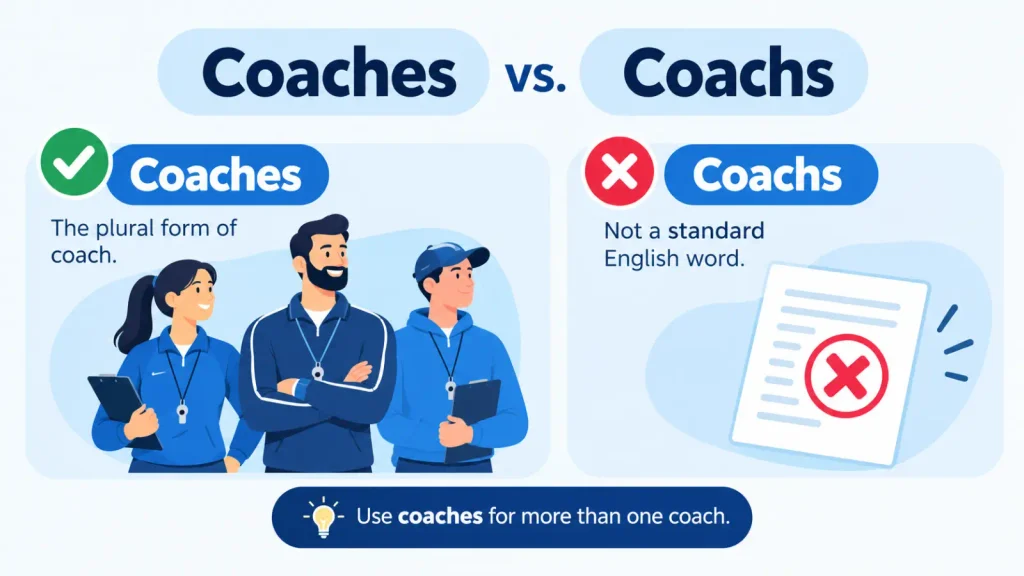
Coaches is the correct spelling, while coachs is incorrect in standard English. If you want to describe more than one sports trainer, teacher, mentor, or instructor, use coaches. The same spelling also applies when coaches functions as a verb, as in “She coaches the school basketball team.”
The difference between coaches vs. coachs comes down to a basic English spelling rule: most nouns ending in -ch form their plurals by adding -es, not simply -s. Therefore, coach becomes coaches, just as church becomes churches, match becomes matches, and watch becomes watches.
For example, “The coaches helped the players prepare for the final match” is correct. Writing “The coachs helped the players” is incorrect in standard English.
In this guide, you will learn the correct spelling, the grammar rule behind it, the difference between coach, coaches, coach’s, and coaches’, and how to use these words naturally in American English.
Quick Answer: Coaches or Coachs?
- Correct spelling: Coaches
- Incorrect spelling: Coachs
- Singular noun: Coach
- Plural noun: Coaches
- Singular possessive: Coach’s
- Plural possessive: Coaches’
- Verb form: Coaches
- Main spelling rule: Add -es to form the plural of coach.
- Example: The coaches prepared their teams for the competition.
Use coaches whenever you mean more than one coach or describe the action performed by a singular third-person subject.
The important distinction is that coaches can be either a plural noun or a verb, depending on the sentence. However, coachs is not the standard spelling for either use.
What Does Coach Mean?
The word coach has several meanings in English. Most commonly, it refers to a person who trains, teaches, guides, or helps another person improve a skill or achieve a goal.
A coach may work in sports, education, business, personal development, fitness, or other professional fields. The precise meaning depends on the context.
Coach as a Sports Trainer
In sports, a coach trains athletes or a team. A coach may teach techniques, develop strategies, improve fitness, organize practice sessions, and help players prepare for competitions.
Examples:
- The coach taught the players how to defend against the opposing team.
- Our basketball coach organized an extra practice session.
- The football coach explained the team’s strategy before the match.
- Her tennis coach helped her improve her serve.
- The swimming coach encouraged every athlete to work toward their personal best.
When more than one trainer performs these duties, use the plural noun coaches.
For example, “The basketball coaches discussed their training plans before the tournament.”
Coach as a Mentor or Instructor
A coach can also help people develop skills outside sports. A life coach, career coach, business coach, or communication coach may guide clients toward specific personal or professional goals.
Examples:
- My career coach helped me prepare for a job interview.
- The business coach recommended a new marketing strategy.
- Her life coach encouraged her to establish realistic goals.
- The communication coach helped the employees improve their presentations.
When several people provide this kind of guidance, coaches is the correct plural form.
For example, “The company hired three business coaches to support its management team.”
Coach as a Type of Vehicle
In some varieties of English, particularly British English, a coach can refer to a large bus used for long-distance travel. In American English, people more commonly use terms such as bus, motorcoach, or charter bus, depending on the vehicle.
Examples:
- The coach carried passengers between two cities.
- Several coaches arrived at the station before sunrise.
- The tour company arranged two coaches for the school trip.
Again, the plural spelling remains coaches.
Why Is Coaches Correct and Coachs Incorrect?
The spelling coaches follows a standard English pluralization rule. When a noun ends in -ch, it generally takes -es to form its plural.
The singular word coach ends with the letters c, h, and a final consonant sound represented by ch. Adding only -s would produce coachs, which does not follow the standard spelling pattern for this word.
Instead, add -es:
Coach + es = Coaches
This rule appears in many familiar English nouns.
| Singular | Correct plural | Incorrect plural |
|---|---|---|
| Coach | Coaches | Coachs |
| Church | Churches | Churchs |
| Match | Matches | Matchs |
| Watch | Watches | Watchs |
| Beach | Beaches | Beachs |
| Branch | Branches | Branchs |
| Torch | Torches | Torchs |
| Lunch | Lunches | Lunchs |
| Peach | Peaches | Peachs |
| Bench | Benches | Benchs |
The pattern makes the correct spelling easier to remember. Rather than memorizing coaches as an isolated word, learn the broader rule that many nouns ending in -ch take -es in the plural.
Why Do We Add -Es Instead of -S?
English spelling and pronunciation work together when forming plurals. Adding -es to words such as coach makes the plural easier to pronounce.
The word coach ends in the sound /tʃ/. Its plural, coaches, adds an extra syllable, making it sound approximately like KOH-chiz. This pattern is common with nouns ending in sounds such as /s/, /z/, /ʃ/, /tʃ/, and /dʒ/.
Compare these examples:
- Coach: one coach.
- Coaches: two or more coaches.
- Match: one match.
- Matches: two or more matches.
- Dish: one dish.
- Dishes: two or more dishes.
- Box: one box.
- Boxes: two or more boxes.
The extra -es helps create a pronounceable plural form.
Is the Rule Always the Same for Every Word Ending in -Ch?
The spelling of English plurals depends on established word patterns, and not every noun follows one universal rule. However, for ordinary nouns such as coach, church, match, and branch, adding -es is the standard pattern.
Some words borrowed from other languages or used in specialized contexts can have unusual plural forms. These exceptions do not change the standard spelling of coach.
For everyday writing, the rule is straightforward: write coaches, not coachs.
Coaches vs. Coachs: Key Differences
The distinction between coaches and coachs is not a difference in meaning. It is a difference between the accepted spelling and a nonstandard spelling.
| Feature | Coaches | Coachs |
|---|---|---|
| Standard spelling | Yes | No |
| Accepted plural of coach | Yes | No |
| Correct in formal writing | Yes | No |
| Used for multiple trainers | Yes | No |
| Used as a third-person verb | Yes | No |
| Recommended in school assignments | Yes | No |
| Recommended in professional writing | Yes | No |
Coaches is the form you should use in standard American English and standard British English.
For example:
- Correct: The coaches met after practice.
- Incorrect: The coachs met after practice.
- Correct: She coaches the youth soccer team.
- Incorrect: She coachs the youth soccer team.
Notice that the last two sentences demonstrate a second important point: coaches is also the correct third-person singular form of the verb coach.
Coach vs. Coaches: Understanding Singular and Plural Nouns
A singular noun identifies one person, place, object, or thing. A plural noun refers to more than one.
Coach is singular, while coaches is plural.
Use coach when referring to one person or one vehicle. Use coaches when referring to two or more.
Examples of Coach as a Singular Noun
- The coach arrived at the training ground early.
- Our coach explained the rules before the game.
- The coach selected five players for the final lineup.
- My career coach helped me revise my résumé.
- The coach waited outside the station.
Each sentence refers to one coach.
Examples of Coaches as a Plural Noun
- The coaches arrived at the training ground early.
- Our coaches explained the rules before the game.
- The coaches selected five players for the final lineup.
- My career coaches helped me revise my résumé.
- The coaches waited outside the station.
Each sentence refers to more than one coach.
How to Choose Between Coach and Coaches
Before choosing the word, identify how many people or things you mean.
If you mean one, use coach. If you mean two or more, use coaches.
Consider these examples:
- One football coach is speaking to the team.
- Two football coaches are speaking to the team.
- One travel coach is waiting at the station.
- Three travel coaches are waiting at the station.
This distinction matters because singular and plural nouns also affect other parts of a sentence, including verbs and pronouns.
For example, “The coach is ready” is correct, while “The coaches are ready” is correct when referring to multiple coaches.
Coaches vs. Coach’s vs. Coaches’: What Is the Difference?
One of the most common writing problems involving coach is confusing its plural form with its possessive forms.
Although coaches, coach’s, and coaches’ look similar, they serve different grammatical purposes.
Coaches: The Plural Form
Coaches refers to more than one coach. It does not require an apostrophe when it is simply a plural noun.
Examples:
- The coaches attended the meeting.
- Several coaches worked together to improve the team’s performance.
- The coaches discussed their plans for next season.
- The school hired four new coaches.
In each sentence, the word identifies multiple coaches rather than indicating ownership.
Coach’s: The Singular Possessive Form
Coach’s indicates that something belongs to, is associated with, or is connected to one coach.
To form the singular possessive, add an apostrophe and s to coach.
Coach + ’s = Coach’s
Examples:
- The coach’s office is near the gym.
- The coach’s instructions were clear.
- We followed the coach’s advice.
- The coach’s whistle fell onto the field.
- The coach’s decision surprised the players.
Each sentence refers to one coach and something associated with that coach.
The apostrophe is important. Without it, coaches would normally indicate multiple coaches or serve as a verb, not the singular possessive.
Coaches’: The Plural Possessive Form
Coaches’ indicates that something belongs to or is associated with multiple coaches.
Because coaches already ends in s, the usual plural possessive form adds an apostrophe after the final s.
Coaches + ’ = Coaches’
Examples:
- The coaches’ meeting begins at noon.
- The coaches’ offices are on the second floor.
- We reviewed the coaches’ recommendations.
- The coaches’ decisions affected the entire team.
- The coaches’ training schedules were updated.
These examples refer to something connected with more than one coach.
Comparison Table: Coaches, Coach’s, and Coaches’
| Form | Grammatical purpose | Example |
|---|---|---|
| Coach | Singular noun | The coach arrived. |
| Coaches | Plural noun | The coaches arrived. |
| Coach’s | Singular possessive | The coach’s bag is here. |
| Coaches’ | Plural possessive | The coaches’ bags are here. |
| Coaches | Third-person singular verb | She coaches the team. |
| Coachs | Nonstandard spelling | Avoid this form. |
A Simple Way to Remember the Difference
Ask yourself two questions.
First, are you referring to more than one coach? If so, use coaches.
Second, are you showing ownership or a relationship? If so, decide whether the owner is one coach or multiple coaches.
- One coach owns something: the coach’s notebook.
- Several coaches own something: the coaches’ notebooks.
- Several coaches attend something: the coaches attend the meeting.
- One person trains a team: she coaches the team.
This method helps you distinguish the plural, possessive, and verb forms without confusing their spellings.
Coaches as a Verb: How to Use It Correctly
The word coaches is not limited to plural nouns. It is also a present-tense verb form.
The base verb is coach, which means to train, teach, guide, or mentor someone. When the subject is he, she, it, or another singular third-person noun, the verb generally takes -es.
For example:
- I coach a youth team.
- You coach a youth team.
- We coach a youth team.
- They coach a youth team.
- She coaches a youth team.
- He coaches a youth team.
- The instructor coaches new employees.
The verb follows the same spelling pattern as the plural noun, but the grammatical function is different.
Why Is She Coachs Incorrect?
In standard English, coachs is incorrect because the verb coach follows the same spelling pattern as the noun when forming the third-person singular present tense.
For verbs ending in -ch, adding -es is standard.
Examples:
- Teach → Teaches
- Watch → Watches
- Reach → Reaches
- Coach → Coaches
Therefore, write “She coaches the players,” not “She coachs the players.”
More Examples of Coaches as a Verb
- The instructor coaches students through difficult exercises.
- My brother coaches a local basketball team.
- Sarah coaches managers on leadership skills.
- The trainer coaches athletes before major competitions.
- Our mentor coaches new team members during their first month.
- The consultant coaches business owners on planning and growth.
- He coaches children to develop confidence and teamwork.
- She coaches singers on stage presence and performance.
In all these examples, coaches describes an action performed by one person.
Coaches vs. Coaching vs. Coached
These forms come from the same base verb, but they express different grammatical functions.
| Form | Usage | Example |
|---|---|---|
| Coach | Base form | I coach the team. |
| Coaches | Third-person singular present | She coaches the team. |
| Coached | Past tense or past participle | He coached the team last year. |
| Coaching | Present participle or gerund | She is coaching the team. |
Understanding these forms makes it easier to use coaches correctly in different sentences.
How to Pronounce Coach and Coaches
Correct spelling becomes easier to remember when you understand pronunciation.
The word coach is generally pronounced as one syllable, approximately KOHCH. The plural form coaches is pronounced approximately KOH-chiz, with two syllables.
The additional syllable in coaches is a useful clue that the plural spelling contains -es.
| Word | Approximate pronunciation | Syllables |
|---|---|---|
| Coach | KOHCH | 1 |
| Coaches | KOH-chiz | 2 |
| Coach’s | KOH-chiz | 2 |
| Coaches’ | KOH-chiz | 2 |
The possessive forms coach’s and coaches’ generally sound the same as coaches. Their meanings differ because of grammar and context, not pronunciation.
For example, compare these sentences:
- The coaches arrived early.
- The coach’s office opened early.
- The coaches’ offices opened early.
The pronunciation of the highlighted forms is generally the same, but the spelling indicates whether the word is plural or possessive.
When writing, use the surrounding sentence to determine which form you need.
Common Mistakes When Using Coaches
Writers sometimes make errors when forming plurals, using possessives, or matching subjects with verbs. Learning these common mistakes will help you write coaches correctly.
Mistake 1: Writing Coachs Instead of Coaches
Incorrect: The coachs discussed the new training schedule.
Correct: The coaches discussed the new training schedule.
The noun coach takes -es in the plural. Adding only -s produces a nonstandard spelling.
Mistake 2: Using an Apostrophe to Form a Plural
Incorrect: Three coach’s attended the meeting.
Correct: Three coaches attended the meeting.
Apostrophes do not normally form English plurals. Use coaches when referring to multiple coaches without indicating possession.
Mistake 3: Confusing Coaches’ With Coach’s
Incorrect: The coach’s discussed their plans together.
Correct: The coaches discussed their plans together.
The first sentence incorrectly uses the singular possessive form where a plural noun is needed. The second sentence correctly identifies multiple coaches as the people discussing their plans.
Mistake 4: Using Coaches With a Singular Subject Incorrectly
Incorrect: The coaches is preparing the players.
Correct: The coach is preparing the players.
When you refer to one coach, use the singular noun coach with the singular verb is.
If you mean multiple coaches, write:
“The coaches are preparing the players.”
Mistake 5: Forgetting the -Es Ending in a Verb
Incorrect: She coachs the school team.
Correct: She coaches the school team.
The verb coach takes -es in the third-person singular present tense. This rule applies to sentences with subjects such as he, she, it, and singular nouns.
Mistake 6: Confusing Plural Possession With Singular Possession
Incorrect: The coaches’s meeting starts at nine.
Correct: The coaches’ meeting starts at nine.
The plural noun coaches already ends in s. To form its standard possessive, place the apostrophe after the final s.
For one coach, however, write coach’s meeting.
Coaches in Sports and Everyday Conversation
The word coaches appears frequently in sports, schools, professional development, and ordinary conversation.
Because the meaning of coach changes with context, it helps to examine examples from different situations.
Coaches in Football and Soccer
In football and soccer, coaches train players, organize tactics, and prepare teams for matches.
Examples:
- The coaches reviewed the team’s performance after the game.
- Both coaches changed their lineups before halftime.
- The assistant coaches helped the players warm up.
- The team’s coaches emphasized communication and teamwork.
- Several youth soccer coaches attended the regional training event.
Use coaches whenever you refer to more than one person responsible for training or guiding players.
Coaches in Basketball
Basketball teams may have a head coach, assistant coaches, and specialized trainers.
Examples:
- The basketball coaches organized a shooting practice.
- Two assistant coaches worked with the younger players.
- The coaches reviewed defensive strategies before the final.
- The head coach thanked the other coaches for their support.
These sentences illustrate the plural noun in a natural sports context.
Coaches in Schools and Education
In educational settings, a coach may help students, teachers, or staff develop specific skills.
Examples:
- The instructional coaches helped teachers improve classroom activities.
- Several academic coaches supported students preparing for examinations.
- The school hired two new athletic coaches.
- The coaches worked with students to strengthen their study habits.
Here, coaches can refer to athletic trainers or people who provide educational guidance.
Coaches in Business and Professional Development
Business coaches may help managers, employees, and entrepreneurs improve their performance.
Examples:
- The company invited experienced business coaches to lead the workshop.
- Career coaches helped participants prepare for interviews.
- The leadership coaches worked with department managers.
- Several executive coaches presented strategies for effective communication.
The plural spelling remains coaches, regardless of the professional field.
Coaches in Personal Development
People may also work with life coaches, fitness coaches, or other mentors.
Examples:
- Fitness coaches helped participants build consistent exercise routines.
- Life coaches encouraged clients to establish practical goals.
- The wellness center employed several personal coaches.
- The coaches provided feedback throughout the program.
These examples show that the word is not limited to sports.
Coaches in American English vs. British English
The spelling coaches is standard in both American English and British English.
Unlike some words that have different American and British spellings, such as color and colour, the plural of coach does not change between these varieties.
| Meaning | American English | British English |
|---|---|---|
| One sports trainer | Coach | Coach |
| Multiple sports trainers | Coaches | Coaches |
| Possession by one coach | Coach’s | Coach’s |
| Possession by multiple coaches | Coaches’ | Coaches’ |
| A person trains a team | Coaches | Coaches |
The main differences may appear in vocabulary and context rather than spelling. For example, a long-distance passenger vehicle may commonly be called a motorcoach or charter bus in American English, while coach is frequently used for this type of vehicle in British English.
Nevertheless, the plural of coach remains coaches in both varieties.
For a website targeting readers in the United States, use coaches consistently in titles, headings, examples, and body text.
Words Similar to Coach That Also Take -Es
Learning related spelling patterns can help you avoid errors with coaches and other nouns.
Many words ending in -ch, -sh, -s, -x, or -z take -es to form their regular plurals.
Nouns Ending in -Ch
| Singular | Plural |
|---|---|
| Coach | Coaches |
| Church | Churches |
| Match | Matches |
| Watch | Watches |
| Branch | Branches |
| Bench | Benches |
| Peach | Peaches |
| Sandwich | Sandwiches |
| Speech | Speeches |
| Approach | Approaches |
These examples reinforce the pattern used in coach → coaches.
Nouns Ending in -Sh
| Singular | Plural |
|---|---|
| Dish | Dishes |
| Brush | Brushes |
| Wish | Wishes |
| Flash | Flashes |
| Brush | Brushes |
These words also use -es, although their endings differ from -ch.
Nouns Ending in -S or -X
| Singular | Plural |
|---|---|
| Bus | Buses |
| Class | Classes |
| Box | Boxes |
| Fox | Foxes |
| Tax | Taxes |
The general lesson is that plural spelling depends on the ending of the word. For coach, the standard form is coaches.
A Simple Method to Remember Coaches
If you frequently confuse coaches and coachs, use these practical memory techniques.
Remember the Formula
The simplest method is:
Coach + es = Coaches
Remember that the word ends in -ch, so you add -es to form the plural.
Compare It With Church
Think of the familiar word church.
You would write:
- One church
- Two churches
You would not normally write churchs. The same spelling pattern applies to coach.
- One coach
- Two coaches
Connecting the two words makes the rule easier to remember.
Read the Word Aloud
Say coach and then coaches aloud. Notice that the plural contains an additional syllable.
This pronunciation pattern reinforces the spelling, although you should still rely on the written rule when proofreading.
Practice With Short Sentences
Try completing these sentences with the correct form:
- The school hired three new ______.
- She ______ the basketball team every weekend.
- The ______ met to discuss the schedule.
- Our ______ are preparing for the competition.
- He ______ young athletes after school.
The correct answers are coaches, coaches, coaches, coaches, and coaches.
The grammatical roles differ: sentences 1, 3, and 4 use the plural noun, while sentences 2 and 5 use the verb.
Check Your Writing Before Publishing
If you write articles, school assignments, sports reports, or website content, search for coachs during proofreading. Replace it with coaches when you mean the plural noun or the third-person singular verb.
However, do not automatically replace every similar-looking word. Check whether the sentence needs coach, coaches, coach’s, or coaches’.
This final check helps you correct spelling without introducing grammatical mistakes.
Frequently Asked Questions (FAQs)
Is Coaches or Coachs Correct?
Coaches is the correct spelling in standard English. It is the plural form of coach and the correct third-person singular form of the verb. Coachs is a nonstandard spelling and should be avoided in formal writing.
Why Is Coaches Spelled With -Es?
The word coach ends in -ch, an ending that commonly takes -es when forming regular plurals. Therefore, coach + es = coaches. The same pattern appears in words such as churches, matches, and watches.
What Is the Plural of Coach?
The plural of coach is coaches. For example, “The three coaches discussed their training plans.” The spelling remains the same in American and British English.
Is Coaches a Verb or a Noun?
Coaches can function as either a noun or a verb. As a noun, it refers to multiple trainers or instructors. As a verb, it describes training or guiding someone, as in “She coaches the school team.”
What Is the Difference Between Coach’s and Coaches’?
Coach’s is the singular possessive form, indicating something associated with one coach. Coaches’ is the plural possessive form, indicating something associated with multiple coaches. For example, “the coach’s office” refers to one coach, while “the coaches’ offices” refers to several coaches.
Is Coachs Ever Correct in English?
Coachs is not the standard plural spelling of coach, nor is it the standard third-person singular form of the verb. In ordinary English writing, use coaches instead.
How Do You Use Coaches in a Sentence?
You can use coaches as a plural noun or a verb. For example, “The coaches arrived early” uses the plural noun, while “She coaches the team” uses the verb.
What Is the Difference Between Coach and Coaches?
Coach refers to one trainer, instructor, or mentor, while coaches refers to more than one. For example, “The coach gave instructions” describes one person, whereas “The coaches gave instructions” describes multiple people.
Do American and British English Spell Coaches Differently?
No. Both American and British English use coaches as the plural of coach. The spelling does not change between these varieties of English.
How Can I Remember Coaches vs. Coachs?
Remember the formula coach + es = coaches. Because coach ends in -ch, you add -es to form the standard plural. Comparing it with church → churches can help you remember the pattern.
Final Thoughts
When comparing coaches vs. coachs, coaches is the correct spelling in standard English. Use it when referring to multiple trainers, instructors, mentors, or passenger vehicles, or when describing someone who trains or guides others.
The most important rule is simple: coach + es = coaches. Remember to distinguish coaches from coach’s and coaches’, because apostrophes change the grammatical meaning. Whether you are writing a school assignment, a sports report, a professional email, or an SEO article, choosing coaches will help you maintain accurate spelling and clear communication.