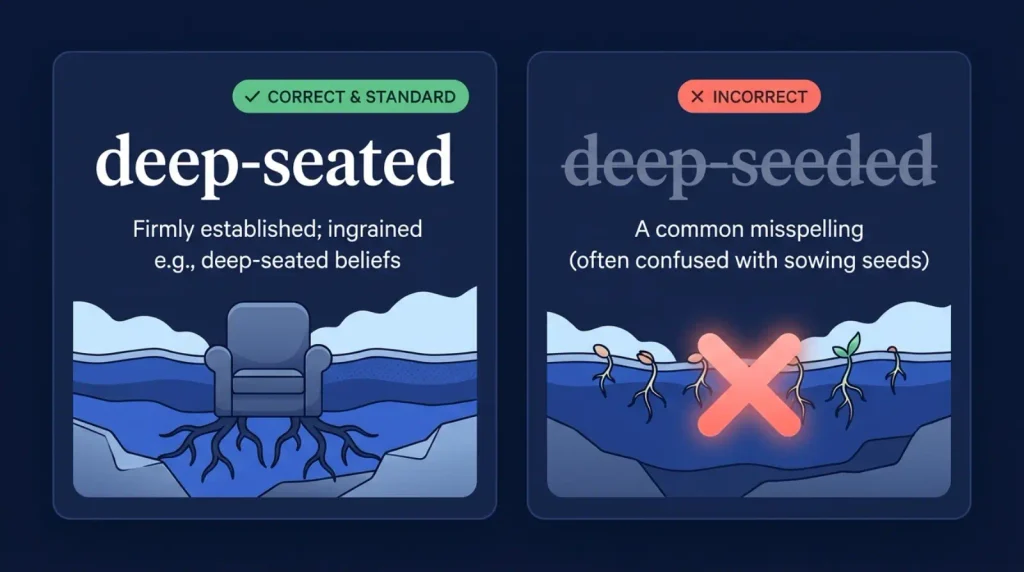
If you are wondering whether deep-seated vs. deep-seeded is correct, the standard expression is deep-seated. It describes a feeling, belief, habit, problem, or attitude that is firmly established and difficult to change. Although deep-seeded may look logical because seeds grow deep into the ground, it is generally considered a misspelling of the established expression.
Understanding this distinction helps you write more accurately in American English, whether you are discussing deep-seated fears, workplace conflicts, personal habits, cultural beliefs, or long-standing social problems.
Deep-Seated vs. Deep-Seeded: The Main Difference
Deep-seated is the standard expression for something firmly established or deeply rooted. Deep-seeded is a common spelling error that results from confusing the word seated with seeded.
The confusion makes sense because both words are real English words. However, they perform different functions and do not mean the same thing in this expression.
Consider these examples:
- Correct: She has a deep-seated fear of public speaking.
- Incorrect in standard usage: She has a deep-seeded fear of public speaking.
- Correct: The company has a deep-seated problem with communication.
- Incorrect in standard usage: The company has a deep-seeded problem with communication.
In both correct sentences, deep-seated indicates that something has existed for a long time or become firmly established. The word does not necessarily mean that the issue is permanent, but it suggests that changing it may require considerable effort.
What Does Deep-Seated Mean?
Deep-seated is an adjective that describes something firmly established, deeply ingrained, or difficult to change because it has developed over time.
The expression commonly describes abstract things, including emotions, opinions, beliefs, prejudices, habits, fears, conflicts, and social problems.
For example, a person may have a deep-seated fear of rejection even when other people offer reassurance. Similarly, a company may have deep-seated communication problems that cannot be resolved through one meeting or a single policy change.
The important idea is that the feeling, belief, or problem has become firmly established rather than existing only temporarily.
Examples of Deep-Seated in Everyday English
- His deep-seated fear of failure prevented him from applying for the promotion.
- She has a deep-seated belief that honesty matters more than popularity.
- My brother developed a deep-seated distrust of strangers after a difficult experience.
- The argument revealed a deep-seated disagreement about how the family should manage its finances.
- Despite their friendly conversations, a deep-seated resentment remained between the two colleagues.
- The coach recognized a deep-seated habit that was affecting the player’s performance.
Each example describes something more established than a passing feeling or temporary disagreement.
Deep-Seated in Professional and Academic Writing
The expression is also useful in business reports, research discussions, education, journalism, and formal essays.
Examples include:
- The audit revealed deep-seated weaknesses in the organization’s internal controls.
- Researchers examined the deep-seated assumptions that influenced the participants’ decisions.
- The school introduced a mentoring program to address deep-seated barriers to student achievement.
- The report identified deep-seated inequalities that had developed over several decades.
- Management acknowledged that the department’s deep-seated communication problems required structural changes.
In professional writing, deep-seated often communicates that a problem cannot be solved effectively by addressing only its visible symptoms.
For example, improving a company’s meeting schedule may help employees communicate, but it may not resolve a deep-seated lack of trust between departments.
What Does Deep-Seeded Mean?
Deep-seeded combines deep with seeded, the past-tense or past-participle form of the verb seed. The verb seed can mean to plant seeds, add seeds to something, or establish seeds in a particular place.
Although deep-seeded can be interpreted literally in a context involving planting or seed placement, it is not the standard spelling of the idiomatic expression meaning firmly established or difficult to change.
For that meaning, use deep-seated.
Why Deep-Seeded Looks Correct to Many Writers
The mistake is understandable because the image of a seed growing deep into the soil seems to match the figurative meaning of something deeply rooted.
For instance, someone might write:
“Years of disagreement created a deep-seeded distrust between the two families.”
The intended meaning is clear, but the standard edited version is:
“Years of disagreement created a deep-seated distrust between the two families.”
The correction does not change the intended meaning. It replaces the mistaken spelling with the conventional expression.
When Seeded Is Actually Correct
The word seeded is perfectly correct when it refers to planting, adding seeds, or assigning rankings in a competition.
Examples:
- The farmer seeded the field before the rainy season.
- The gardener planted grass in a newly seeded lawn.
- The tournament’s top-seeded player advanced to the final.
- The researcher seeded the culture with a small number of cells.
These examples demonstrate why it is important to distinguish between a genuine use of seeded and the conventional idiom deep-seated.
A field can be seeded, and a tennis player can be seeded in a tournament. However, a long-standing fear is ordinarily deep-seated, not deep-seeded.
Deep-Seated vs. Deep-Seeded: Side-by-Side Comparison
| Feature | Deep-Seated | Deep-Seeded |
|---|---|---|
| Standard idiomatic expression | Yes | No |
| Meaning | Firmly established or difficult to change | Literal combination involving seeds; not the standard idiom |
| Typical use | Fears, beliefs, habits, resentment, problems | Literal planting contexts, when the wording genuinely fits |
| Part of speech | Compound adjective | Adjective or participial construction, depending on context |
| Example | A deep-seated fear | A deeply seeded area, if literal meaning is intended |
| Recommended for formal writing | Yes | Avoid for the intended figurative meaning |
The central distinction is not that seeded is always wrong. Rather, deep-seated is the established expression for deeply rooted feelings, beliefs, and problems.
Why Is Deep-Seated the Correct Expression?
The word seated is associated with something placed, settled, or firmly established. In the expression deep-seated, the image is of something situated deeply and securely rather than something that can be moved or changed easily.
Over time, the expression acquired its familiar figurative meaning. Today, writers use it for conditions that have become firmly established in a person’s mind, an organization, or society.
The word seeded, by contrast, suggests the planting or distribution of seeds. Although seeds can serve as a metaphor for the beginning of an idea or problem, that imagery does not make deep-seeded the standard idiom.
This is a useful reminder that English expressions do not always follow the most intuitive spelling or metaphor. Established usage determines which form readers expect in a particular context.
Common Mistakes With Deep-Seated and Deep-Seeded
Writers often make this mistake because the two expressions look similar and suggest related images. Recognizing the common error patterns makes proofreading easier.
1. Choosing Seeded Because of the Seed Metaphor
Incorrect: The community has a deep-seeded mistrust of local officials.
Correct: The community has a deep-seated mistrust of local officials.
The writer may imagine mistrust as a seed planted long ago. Nevertheless, the conventional expression uses seated.
2. Using Deep-Seeded in Workplace Reports
Incorrect: The investigation uncovered deep-seeded problems within the department.
Correct: The investigation uncovered deep-seated problems within the department.
Business and technical documents should use the established expression when discussing persistent organizational issues.
3. Repeating the Error in Academic Essays
Incorrect: The novel explores the protagonist’s deep-seeded insecurities.
Correct: The novel explores the protagonist’s deep-seated insecurities.
In literary analysis, psychology discussions, and academic writing, deep-seated communicates that an emotion or belief is firmly established.
4. Assuming Both Forms Are Equal Variants
Incorrect assumption: Deep-seated and deep-seeded are interchangeable in every context.
Correct understanding: They are not standard interchangeable variants. Use deep-seated for the established figurative meaning, and use seeded when discussing actual seeds or another appropriate literal use.
5. Trusting Spell-Check Without Reviewing the Sentence
A spelling checker may recognize both seated and seeded as valid words. Consequently, it might not flag the incorrect expression.
For example:
“Her deep-seeded anxiety affected her interviews.”
The individual words are spelled correctly, but the expression is not the standard form. Proofreading should therefore include a check of word combinations, not merely individual spelling.
How to Remember Deep-Seated vs. Deep-Seeded
Two simple memory tricks can help you choose the correct form.
Memory Trick 1: Think of Something Firmly Settled
Remember that deep-seated describes something that has become firmly established.
Imagine a belief or fear that has settled deeply in someone’s mind. Because the idea is firmly established, changing it may take time.
Examples:
- A deep-seated fear
- A deep-seated belief
- A deep-seated conflict
- A deep-seated habit
When describing an established feeling, belief, or problem, think of something that has settled deeply rather than a seed that has been planted.
Memory Trick 2: Replace It With Deep-Rooted
Try replacing the expression with deep-rooted.
If the sentence still makes sense, deep-seated is probably the expression you need.
For example:
- Deep-seated prejudice → deep-rooted prejudice
- Deep-seated resentment → deep-rooted resentment
- Deep-seated problems → deep-rooted problems
Both expressions can communicate that something is firmly established.
However, this test is a practical memory aid rather than an absolute grammatical rule. Always consider the sentence’s intended meaning.
Deep-Seated in Real-World Contexts
Seeing the expression in realistic passages helps demonstrate how naturally it fits into everyday communication.
Example 1: A Text Conversation
Maya: Why does Daniel avoid speaking during team meetings?
Alex: I think he has a deep-seated fear of being criticized.
Maya: That makes sense. Maybe we should give him more opportunities to share his ideas privately first.
Here, deep-seated describes a fear that may have developed over time and influences Daniel’s behavior.
Example 2: A Professional Email
Subject: Department Communication Issues
Hi Jordan,
The latest review suggests that our communication problems are more serious than we initially thought. We appear to have a deep-seated lack of trust between the sales and operations teams.
I recommend that we discuss the underlying causes before introducing another reporting procedure.
Best,
Morgan
In this example, the adjective emphasizes that the problem is established and may require more than a superficial solution.
Example 3: An Article About Social Change
The new policy improved access to public services, but it did not eliminate the deep-seated inequalities affecting disadvantaged communities. Long-term progress will require continued investment, better accountability, and a closer examination of the conditions that sustain those inequalities.
The expression helps distinguish persistent social conditions from problems that can be resolved through one immediate intervention.
Deep-Seated vs. Deep-Rooted
Deep-seated and deep-rooted are closely related expressions. Both describe feelings, beliefs, attitudes, habits, or problems that are firmly established and difficult to change.
For example:
- The organization has a deep-seated distrust of outside consultants.
- The organization has a deep-rooted distrust of outside consultants.
Both sentences are natural and convey similar meanings.
However, deep-rooted directly evokes the image of roots extending into the ground, while deep-seated emphasizes something firmly established. In many contexts, the two expressions are interchangeable, although the most natural choice can depend on the sentence.
Neither expression should be confused with deep-seeded when the intended meaning is a persistent belief, emotion, or problem.
Deep-Seated vs. Long-Standing
Long-standing describes something that has existed for a considerable period. Deep-seated emphasizes that something is firmly established or difficult to change.
Compare these sentences:
- The organization has a long-standing partnership with the university.
- The organization has a deep-seated distrust of the university’s leadership.
The first sentence emphasizes duration. The second emphasizes an established attitude.
A problem can be both long-standing and deep-seated, but the expressions highlight different aspects of the situation.
For example, a long-standing disagreement may have continued for years without becoming deeply entrenched. A deep-seated prejudice, on the other hand, describes an established attitude that may be difficult to change even if its history is relatively short.
Deep-Seated vs. Deep-Rooted vs. Entrenched
The word entrenched is another useful alternative when discussing established attitudes, practices, or systems.
- Deep-seated: A deep-seated fear prevented her from speaking publicly.
- Deep-rooted: Deep-rooted traditions influenced the family’s decisions.
- Entrenched: Entrenched procedures made the organization resistant to change.
All three expressions can describe something firmly established. However, entrenched often emphasizes resistance to change, particularly in institutions, politics, and organizational systems.
Choosing among these expressions can make writing more precise. Nevertheless, none provides a reason to substitute deep-seeded for the standard idiom deep-seated.
Are There Any Exceptions?
There is no widely accepted exception that makes deep-seeded the standard spelling of the figurative expression meaning firmly established.
The word seeded remains correct in its ordinary uses. For instance, a lawn can be seeded, a field can be seeded with grass, and an athlete can be seeded in a tournament.
A writer could also construct a literal description involving seeds placed deeply in soil. In that unusual context, the intended meaning would concern seeds rather than a deeply established feeling or belief. Depending on the sentence, a clearer phrase such as seeds planted deep in the soil might be preferable.
For ordinary American English, however, the decision is straightforward: use deep-seated fear, deep-seated belief, deep-seated resentment, and deep-seated problem.
Frequently Asked Questions
Is Deep-Seated or Deep-Seeded Correct?
Deep-seated is the standard expression when describing a firmly established feeling, belief, habit, or problem. Deep-seeded is generally considered a misspelling in this context.
Is Deep-Seeded Ever Correct?
The word seeded is correct when it refers to planting seeds or another literal use of the verb seed. However, deep-seeded is not the standard expression for something deeply rooted or difficult to change.
Why Do People Write Deep-Seeded?
People often confuse seated with seeded because seeds grow in the ground, making the second spelling seem logical. Nevertheless, the established English expression is deep-seated.
Should Deep-Seated Have a Hyphen?
Yes. Deep-seated is conventionally hyphenated when used as the adjective meaning firmly established, as in a deep-seated fear. Keep the hyphen in standard edited American English.
What Is Another Word for Deep-Seated?
Useful alternatives include deep-rooted, ingrained, entrenched, and firmly established. The best choice depends on whether you want to emphasize duration, persistence, resistance to change, or the strength of a belief or habit.
Quick Reference: Deep-Seated vs. Deep-Seeded
- Deep-seated: Correct standard expression meaning firmly established or difficult to change.
- Deep-seeded: Generally incorrect for that figurative meaning.
- Seeded: Correct when referring to planting seeds or another appropriate literal meaning.
- Deep-rooted: A useful synonym for deep-seated in many contexts.
- Memory trick: If you mean a persistent fear, belief, habit, or problem, use deep-seated.
Conclusion
When choosing between deep-seated vs. deep-seeded, use deep-seated to describe something firmly established, deeply ingrained, or difficult to change. It is the standard expression in American English and works naturally with words such as fear, belief, resentment, prejudice, habit, and problem.
Although deep-seeded may appear logical because seeds grow into the ground, that interpretation does not make it the conventional spelling of the idiom. Remember the related expression deep-rooted, check the intended meaning, and use the hyphenated form deep-seated in your articles, emails, reports, and academic writing.

Olivia Smith is a US English writer and language enthusiast who specializes in spelling, word choice, and commonly confused words. She creates clear, practical guides that help readers understand the correct spelling, meaning, and usage of English words.
At GrammarPool.com, Olivia focuses on spelling-choice topics, common spelling mistakes, and easy-to-understand explanations for everyday English users. Her writing is designed to make confusing word choices simple, accurate, and easy to remember.
Expertise: US English, spelling, word choice, commonly confused words, grammar, and language usage.