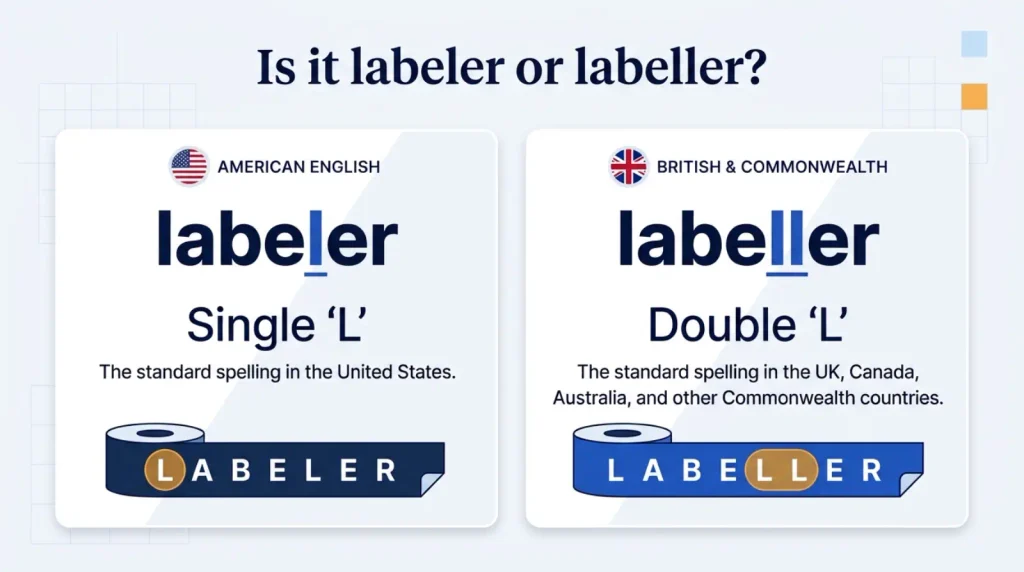
Labeler and labeller are both correct spellings of the same word. The difference is regional: labeler is the standard American English spelling, while labeller is commonly used in British English and other varieties that follow British spelling conventions. Both words refer to a person, machine, or device that labels something.
If you are writing for a US audience, choose labeler. If you are following British English conventions, labeller is generally the preferred spelling. The two forms do not have different meanings, and neither is inherently incorrect.
Quick Answer: Labeler or Labeller?
- Labeler: Preferred American English spelling. Use it in US articles, business documents, product descriptions, and everyday writing.
- Labeller: Common British English variant. Use it when following a British spelling style or a publication’s established conventions.
- Meaning: Both refer to someone or something that applies, creates, or attaches labels.
- Plural forms: Labelers and labellers.
- Related verb: Label. The spelling difference follows the convention for forming the agent noun from this verb.
Example: The warehouse hired a labeler to mark every shipping box.
In British English, the same sentence may use labeller instead. The meaning remains unchanged.
What Does Labeler Mean?
A labeler is a person, machine, or device that labels objects, products, packages, documents, or other items. It is a noun formed from the verb label, which means to attach a label to something or to identify something with a descriptive name or category.
The word appears in several settings, including manufacturing, shipping, retail, laboratories, data annotation, and office administration.
For example:
- The labeler printed the product names and expiration dates.
- Our warehouse needs another labeler during the holiday season.
- The automated labeler applies stickers to hundreds of bottles per minute.
- A careful labeler checks every package before it leaves the facility.
- The data labeler categorized thousands of images for a machine-learning project.
In each sentence, labeler identifies the person or equipment performing the labeling task.
Labeler as a Person
When the word describes a person, it generally refers to someone who applies labels or assigns descriptive categories.
For instance, a warehouse labeler may attach shipping labels to boxes, while a laboratory labeler may identify samples with names, dates, and tracking numbers.
The word can also describe a person who categorizes information. In data science, a labeler might identify objects in photographs, classify text, or assign categories to training data.
The precise job depends on the context, but the central idea remains the same: the person performs a labeling task.
Labeler as a Machine
A labeler can also be a machine designed to print, apply, or attach labels.
Manufacturers use automatic and semiautomatic labelers to place product information on bottles, containers, cartons, and other packaging. These machines help businesses maintain consistent placement and process large quantities of products.
For example:
The factory installed an automatic labeler to speed up the packaging line.
Here, labeler refers to equipment rather than a human worker. The spelling remains the same.
What Does Labeller Mean?
Labeller has the same meaning as labeler. It refers to a person, machine, or device that labels something, but it is more commonly associated with British English spelling conventions.
The extra l reflects the British spelling pattern used in certain words derived from verbs ending in a single l.
Examples include:
- The warehouse hired a labeller to prepare the outgoing parcels.
- The factory purchased a new automatic labeller for its packaging line.
- Each labeller must check that the product information is accurate.
- The labeller attached identification stickers to the sample containers.
- Our supplier provides replacement parts for industrial labellers.
These sentences are grammatically correct. American readers will generally understand the word, although they may expect the spelling labeler in US publications.
Labeller in British English
British English commonly doubles the final l when forming certain words from verbs, including label.
The pattern appears in words such as:
- Label → labelling
- Label → labelled
- Label → labeller
This convention is not an absolute rule for every English word ending in l. Spelling depends on the word and the conventions followed by the variety of English.
In British-oriented writing, labeller fits naturally alongside labelled and labelling.
Is Labeller a Different Job Title?
No. Labeller does not identify a separate profession from labeler.
A job advertisement requesting a labeller and one requesting a labeler may describe essentially the same work. The actual responsibilities depend on the employer, not on which spelling appears in the job title.
If you are preparing a résumé, searching for employment, or writing a job description, consider using the spelling common in the country where the employer operates.
Why Do Labeler and Labeller Have Different Spellings?
The difference comes from regional English spelling conventions, particularly how English handles a final l when adding certain suffixes.
The base verb is label. When English forms related words, spelling conventions may either retain the single l or double it.
American English generally uses:
- Labeling
- Labeled
- Labeler
British English commonly uses:
- Labelling
- Labelled
- Labeller
The difference is not a change in pronunciation or meaning. It is a difference in spelling preference.
The Role of the Suffix -er
The suffix -er often forms a noun describing a person or thing that performs an action. For example, teach becomes teacher, and print becomes printer.
Likewise, label becomes labeler or labeller, depending on the spelling convention.
The suffix itself does not change the basic meaning of the verb. It identifies the person or equipment associated with the action.
However, the spelling of the resulting word follows regional conventions. That is why the American form has one l after the vowel in the relevant spelling pattern, while the British form commonly doubles it.
Labeler vs. Labeller: Side-by-Side Comparison
| Feature | Labeler | Labeller |
|---|---|---|
| Correct spelling | Yes | Yes |
| Main regional preference | American English | British English |
| Part of speech | Noun | Noun |
| Meaning | A person or machine that labels | A person or machine that labels |
| Plural | Labelers | Labellers |
| Related verb | Label | Label |
| Common US forms | Labeled, labeling | Less typical in US prose |
| Common UK forms | Less typical in UK prose | Labelled, labelling |
| Pronunciation | Generally the same | Generally the same |
| Formal writing | Appropriate in US English | Appropriate in British English |
The most important point is that the words have the same meaning. The choice depends on the spelling system you are following.
When Should You Use Labeler?
Choose labeler when writing for an American audience or following American English spelling conventions.
1. American Business Writing
US businesses commonly use American spelling in product documentation, internal policies, job descriptions, and operational manuals.
Example:
The shipping department assigned a labeler to each packing station.
The single-l spelling is appropriate for an American business document.
2. Product Descriptions
If you are describing equipment sold primarily in the United States, labeler is a natural choice.
Example:
This automatic bottle labeler applies adhesive labels to cylindrical containers.
The spelling matches the American convention and is suitable for a US product page.
3. School and Academic Writing
Students writing in American English should generally use labeler when discussing a person or machine that applies labels.
Example:
The researcher used a digital labeler to classify images for the experiment.
The important consideration is consistency with the required style guide.
4. Websites Targeting US Readers
For an American-focused website, use labeler in headings, descriptions, examples, and explanatory text.
For example, a US article might use the heading How to Choose an Automatic Labeler.
If the rest of the article uses American spellings such as color, organize, and labeled, using labeler maintains a consistent style.
5. Job Listings in the United States
An American employer would generally use labeler in a job title or vacancy description.
Example:
We are hiring a warehouse labeler for our afternoon shift.
Although employers may use different terminology, labeler follows standard American spelling.
When Should You Use Labeller?
Choose labeller when writing in British English or when an organization’s established style requires the doubled-l spelling.
1. British Business Documents
British companies may use labeller in operating procedures, packaging instructions, and job descriptions.
Example:
The labeller must verify the batch number before sealing each carton.
The spelling is consistent with British conventions.
2. British Product Documentation
A British manufacturer might describe a piece of equipment as an automatic labeller.
Example:
The automatic labeller can process several packaging formats.
If the rest of the documentation uses labelled and labelling, this spelling maintains consistency.
3. British Academic Writing
In a British academic paper, labeller may appear when discussing data classification, experimental procedures, or research equipment.
Example:
Each labeller reviewed the assigned images before submitting the final dataset.
The spelling is appropriate when it matches the publication’s style.
4. British Job Advertisements
A job advertisement for a packaging worker in the United Kingdom may use labeller.
Example:
The successful applicant will work as a production labeller on the evening shift.
The spelling is a regional preference, not a different job qualification.
5. Publications Following British English
Some international publications follow British spelling even when their readers live in multiple countries. In those cases, labeller may be preferable to labeler.
Always follow the publication’s style guide if it specifies one.
Common Mistakes With Labeler and Labeller
Although both spellings are valid, writers can still make mistakes when choosing between them.
Mistake 1: Assuming Labeller Is Always Wrong
Incorrect claim: Labeller is not a real English word.
Correction: Labeller is a valid spelling, commonly used in British English.
The extra l does not make the word incorrect. It reflects a different regional convention.
Mistake 2: Assuming Labeler Is Always Wrong
Incorrect claim: You must write labeller because label ends in l.
Correction: Labeler is the standard American spelling.
American English generally uses labeler, labeled, and labeling. The doubled-l forms are common in British English.
Mistake 3: Mixing Regional Spellings Without a Reason
Inconsistent example:
The labeller printed the labels before the labeling process began.
This sentence combines the British-preferred labeller with the American-preferred labeling.
A more consistent American version is:
The labeler printed the labels before the labeling process began.
A more consistent British version is:
The labeller printed the labels before the labelling process began.
Mixing conventions is not always grammatically wrong, but it can make professional writing look inconsistent.
Mistake 4: Confusing the Noun With the Verb
Incorrect: Please labeller these packages before shipping.
Correct: Please label these packages before shipping.
Label is the verb. Labeler and labeller are nouns. The noun identifies the person or machine performing the action, while the verb names the action itself.
Mistake 5: Treating the Spelling Difference as a Meaning Difference
Incorrect assumption: A labeler applies labels, but a labeller classifies data.
Correction: Both forms can describe either activity when the context supports that meaning.
The spelling alone does not distinguish between a human worker, an industrial machine, and a person who classifies information.
Mistake 6: Following Autocorrect Without Checking Regional Settings
A spelling checker configured for British English may prefer labeller, while an American English checker may prefer labeler.
If your software flags one form, check its language settings before assuming the word is misspelled. The correction may reflect regional preferences rather than a universal rule.
How to Remember Labeler vs. Labeller
Two simple methods can help you choose the correct form quickly.
Memory Trick 1: Match the Spelling to Your Audience
Remember:
- US = labeler
- UK = labeller
This is the quickest practical test for most writers.
If you are writing for an American company, choose labeler. If you are following British spelling conventions, choose labeller.
Memory Trick 2: Keep Related Words Consistent
Look at the other forms in your sentence or article.
If you normally write labeled and labeling, use labeler.
If you normally write labelled and labelling, use labeller.
This technique is especially useful when editing long articles, product catalogs, technical documents, and website content.
Labeler vs. Labeller in Real-World Contexts
The following examples show how the choice works in everyday writing.
Scenario 1: A US Warehouse
Manager: Who will prepare the outgoing packages this afternoon?
Supervisor: Maria will work as the labeler and check each shipping address.
In this American workplace, labeler fits the regional spelling convention. It identifies Maria’s role in the shipping process.
Scenario 2: A British Manufacturing Company
Subject: Packaging Line Update
The new automatic labeller has been installed and tested. Please check that each product label displays the correct batch number before starting production.
In this British-style business message, labeller and the surrounding terminology fit the doubled-l convention.
Scenario 3: A Data Annotation Project
The project manager assigned five labelers to classify images of vehicles, buildings, and street signs. Each labeler must follow the same annotation instructions so the final dataset remains consistent.
This example uses American spelling. A British publication could use labellers without changing the meaning of the passage.
Related Spelling Confusions
The labeler-versus-labeller question belongs to a broader group of spelling differences involving regional conventions and doubled consonants.
Labeling vs. Labelling
Labeling is the standard American spelling, while labelling is common in British English.
Both refer to the act or process of applying labels or assigning categories.
Examples:
- US: The labeling process takes less than a minute.
- UK: The labelling process takes less than a minute.
The difference is regional rather than semantic.
Labeled vs. Labelled
Labeled is the usual American spelling, and labelled is common in British English.
Examples:
- US: The labeled containers are ready for inspection.
- UK: The labelled containers are ready for inspection.
Both forms describe containers that have received labels.
Traveler vs. Traveller
Traveler is the standard American spelling, while traveller is commonly preferred in British English.
For example, an American travel website might write frequent traveler, while a British publication might use frequent traveller.
This pair demonstrates a similar regional spelling pattern, although individual words can follow their own conventions.
Modeling vs. Modelling
Modeling is standard in American English, while modelling is common in British English.
The word can refer to creating a representation, developing a mathematical model, or working as a fashion model.
For example:
- US: The team is modeling the expected sales growth.
- UK: The team is modelling the expected sales growth.
As with labeler and labeller, the spelling difference does not automatically change the meaning.
Are There Any Exceptions to the Labeler vs. Labeller Rule?
There is no major meaning-based exception to this pair: both words refer to someone or something that labels.
However, there are a few practical considerations.
First, organizational style can override the usual regional preference. A multinational company may prescribe one spelling for all its publications. Follow that instruction even if it differs from the common convention in your location.
Second, official job titles and product names may use a specific spelling. If a company identifies a product as a Labeller 3000, preserve that official name rather than changing it to Labeler 3000.
Third, technical contexts may use more specific terms. A machine that applies labels automatically may be called an automatic labeling machine, label applicator, or labeling system. These expressions can be more precise than labeler or labeller, depending on the equipment.
Finally, regional spelling preferences are conventions, not guarantees about every individual writer. You may encounter labeler in British material or labeller in American material. That does not necessarily mean the writer has misunderstood the word.
Frequently Asked Questions
Is Labeler or Labeller Correct in American English?
Labeler is the standard American English spelling. Use it in US business writing, academic work, product descriptions, and general publications unless a specific style guide requires otherwise.
Is Labeller a Misspelling?
No. Labeller is a valid spelling commonly used in British English. It has the same meaning as labeler.
Do Labeler and Labeller Mean the Same Thing?
Yes. Both can refer to a person, machine, or device that labels something. The difference is primarily regional spelling preference, not meaning.
What Is the Plural of Labeler?
The plural of labeler is labelers. The plural of labeller is labellers. Choose the form that matches the spelling convention you are using.
Should I Use Labeler or Labeller for SEO Content?
Choose the spelling that matches your target audience and the article’s purpose. For content aimed at readers in the United States, labeler is generally the better primary form. If the article targets British readers, labeller is usually more appropriate.
Conclusion: Labeler vs. Labeller
The difference between labeler and labeller comes down to regional spelling conventions. Both are correct, both are nouns, and both describe a person, machine, or device that labels something.
Use labeler for standard American English and labeller for British English conventions. Keep related words consistent by pairing labeler with labeled and labeling, or labeller with labelled and labelling.
For most US-focused writing, the choice is straightforward: labeler is the preferred spelling.

Olivia Smith is a US English writer and language enthusiast who specializes in spelling, word choice, and commonly confused words. She creates clear, practical guides that help readers understand the correct spelling, meaning, and usage of English words.
At GrammarPool.com, Olivia focuses on spelling-choice topics, common spelling mistakes, and easy-to-understand explanations for everyday English users. Her writing is designed to make confusing word choices simple, accurate, and easy to remember.
Expertise: US English, spelling, word choice, commonly confused words, grammar, and language usage.