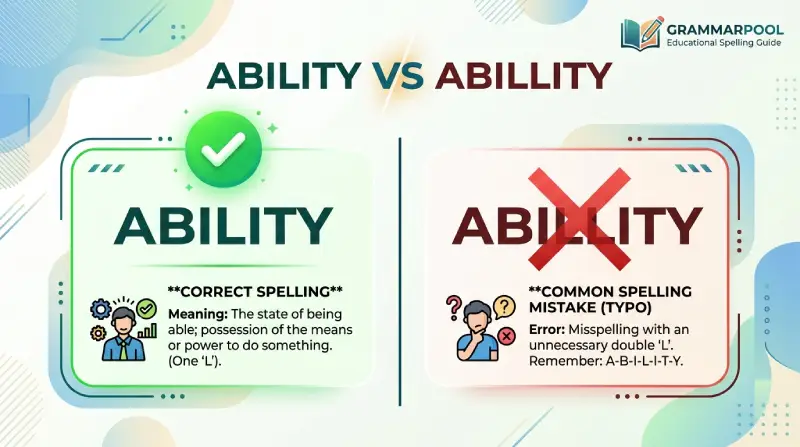
Ability is the correct spelling. Abillity is a common misspelling and is not the standard English form.
If you are wondering whether to write ability or abillity, always choose ability. The word is a noun that refers to the power, skill, or capacity to do something successfully.
Quick Answer: Ability or Abillity?
The correct spelling is ability.
- Ability ✅ Correct
- Abillity ❌ Incorrect
The key spelling difference is the number of l’s. Ability has one l, while the incorrect form abillity has two.
Correct: She has the ability to solve difficult problems.
Incorrect: She has the abillity to solve difficult problems.
What Does Ability Mean?
Ability means the power, skill, or capacity to do something.
It can describe a person’s natural talent, a learned skill, or the capacity to perform a particular task.
For example:
He has the ability to communicate clearly.
Her ability to learn quickly impressed the teacher.
The job requires the ability to work under pressure.
The word can refer to physical, mental, practical, social, or professional skills.
Why Is Abillity Incorrect?
Abillity is incorrect because the standard spelling of the word contains only one l.
The correct spelling is:
A-B-I-L-I-T-Y
The incorrect form adds an extra l:
A-B-I-L-L-I-T-Y
English has many words that use double consonants, so it can be tempting to write abillity. However, ability does not double the l.
Remember:
Ability has one L.
How Do You Spell Ability?
The correct spelling is:
A-B-I-L-I-T-Y
That gives you:
ability
A simple way to remember it is to focus on the middle:
abi + lity
There is only one l before ity.
Ability ✅
Abillity ❌
What Is the Meaning of Ability?
Ability refers to someone’s power, skill, or capacity to perform an action or achieve something.
For example:
The athlete demonstrated his ability to perform under pressure.
She has the ability to understand complex ideas.
Good communication is an important ability in many careers.
The meaning can change slightly depending on context, but the central idea is having the capacity or skill to do something.
Ability in Everyday English
Ability is a very common noun in everyday and professional English.
You can use it when talking about education, work, sports, communication, problem-solving, creativity, and many other areas.
For example:
Everyone has the ability to improve with practice.
Her ability to stay calm helped the team.
The employee showed an excellent ability to solve problems.
His writing ability improved significantly.
Because the word is so common, using the correct spelling is important in both formal and informal writing.
Ability vs. Skill
- Ability and skill are closely related, but they are not always identical.
- Ability refers to the capacity or power to do something. Skill usually refers to a learned or developed ability gained through practice or experience.
For example:
She has the ability to learn languages quickly.
She has excellent writing skills.
Someone may have an ability that is partly natural, while a skill is often developed through training and practice.
Ability vs. Capability
Ability and capability can have similar meanings, but capability often emphasizes the capacity or potential to perform something.
For example:
He has the ability to solve the problem.
The machine has the capability to process large amounts of data.
Both words can refer to what someone or something can do. However, ability is generally more common when discussing a person’s skills or talents.
Ability vs. Capacity
- Ability can also be compared with capacity.
- Ability often refers to the skill or power to perform an action, while capacity can refer to the amount or extent that someone or something can handle.
For example:
She has the ability to lead a team.
The room has a capacity of 200 people.
In some contexts, the two words overlap, but their typical uses are different.
Common Phrases With Ability
Ability to
The phrase ability to is one of the most common structures.
He has the ability to solve complex problems.
She developed the ability to work independently.
Ability to learn
This phrase describes someone’s capacity to learn.
Children have a remarkable ability to learn new languages.
Ability to communicate
This refers to someone’s communication skills.
The position requires a strong ability to communicate.
Problem-solving ability
This describes the capacity to identify and solve problems.
The employer was impressed by her problem-solving ability.
Physical ability
This refers to someone’s capacity to perform physical actions.
The test measures basic physical ability.
Ability vs. Abillity Examples
The following examples show the correct spelling.
Correct
She has the ability to work independently.
His ability to solve problems is impressive.
The course improves students’ ability to write clearly.
Everyone has the ability to learn new skills.
The job requires strong communication ability.
Incorrect
She has the abillity to work independently.
His abillity to solve problems is impressive.
The course improves students’ abillity to write clearly.
Everyone has the abillity to learn new skills.
The job requires strong communication abillity.
In every incorrect example, abillity should be replaced with ability.
Is Ability a Correct Word?
Yes. Ability is a standard English noun.
It refers to the power, skill, or capacity to do something.
For example:
Her ability to explain difficult ideas makes her an effective teacher.
By contrast, abillity is a misspelling.
How Do You Pronounce Ability?
In American English, ability is commonly pronounced approximately:
uh-BIL-uh-tee
The pronunciation can vary slightly depending on the speaker and sentence, but the spelling remains:
A-B-I-L-I-T-Y
Pronunciation may make it tempting to add an extra l, but the written form contains only one.
How to Remember the Spelling Ability
The easiest trick is:
Ability has ONE L.
Write the word like this:
A-B-I-L-I-T-Y
Do not write:
A-B-I-L-L-I-T-Y
Another useful reminder is:
Ability = able + ity
Although the word does not form through a simple spelling change from able, this association can help you remember the single l.
Ability or Abillity in American English
For standard American English, use ability.
Abillity is not an alternative spelling. It is simply a misspelling of ability.
Use ability in school assignments, professional documents, emails, articles, resumes, reports, and everyday writing.
The standard spelling is also used in other major varieties of English.
Why Do People Spell Ability as Abillity?
The mistake usually happens because writers expect the l to be doubled.
English has many words in which consonants are doubled when suffixes are added, so abillity may look familiar. However, the noun ability uses only one l.
The correct pattern is:
A-B-I-L-I-T-Y
Remembering the single l is the easiest way to avoid the common misspelling.
Ability vs. Abillity: Quick Comparison
| Word | Correct? | Meaning |
|---|---|---|
| Ability | ✅ Yes | The power, skill, or capacity to do something |
| Abillity | ❌ No | Common misspelling of ability |
The key spelling rule is simple:
Ability = one L.
FAQs
Is ability or abillity correct?
Ability is correct. Abillity is a misspelling and should not be used in standard English.
How do you spell ability correctly?
The correct spelling is A-B-I-L-I-T-Y: ability. It contains only one l.
What does ability mean?
Ability means the power, skill, or capacity to do something.
Is abillity a word?
No. Abillity is not the standard spelling of the English word. The correct form is ability.
What is the plural of ability?
The plural of ability is abilities.
For example:
The job requires several different abilities.
What is the difference between ability and skill?
Ability refers to the power or capacity to do something, while skill often refers to a learned or practiced ability.
Conclusion
Ability is the correct spelling, while abillity is incorrect. Ability means the power, skill, or capacity to do something.
The easiest way to remember the spelling is:
Ability = one L
Whenever you are unsure whether to write ability or abillity, choose ability.