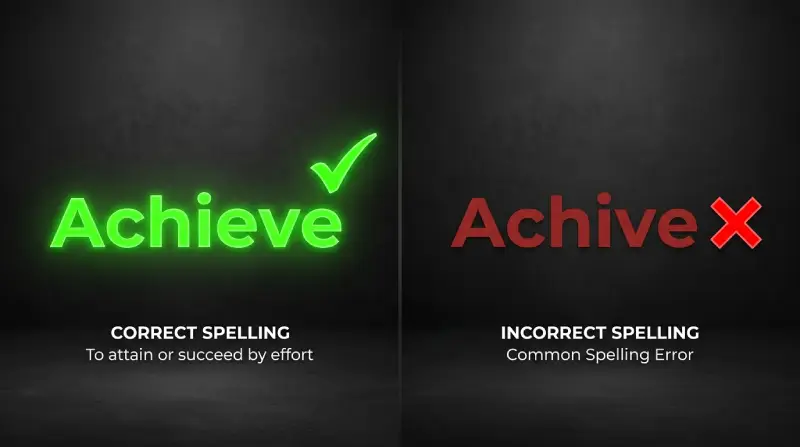
Achieve and achive look similar, but only one is correct in standard English. If you are unsure which spelling to use in an email, school assignment, or professional document, the answer is simple: write achieve.
The word achieve describes reaching a goal or successfully completing something through effort. The spelling achive leaves out a letter and is a common spelling mistake, not an accepted American or British English variant.
Quick Answer
Achieve is correct; achive is incorrect.
Use achieve when talking about reaching a goal, completing a task, or gaining success through effort. Always include the letter e between the letters v and the ending position in the complete spelling.
- Correct: She worked hard to achieve her goals.
- Incorrect: She worked hard to achive her goals.
Remember the complete spelling: a-c-h-i-e-v-e.
Why People Confuse Them
The difference between achieve and achive is just one letter. When typing quickly, writers may leave out the second e and accidentally produce achive.
Pronunciation can also contribute to the confusion. In American English, achieve is pronounced approximately “uh-CHEEV.” The final e is silent, so hearing the word does not tell you exactly how to spell it.
However, the correct spelling always includes the complete -ieve letter pattern. Reading your writing carefully can help you catch the missing letter before you submit or publish it.
Key Differences At A Glance
| Context | Best Choice | Why |
|---|---|---|
| Standard American English | achieve | This is the correct spelling. |
| British English | achieve | The standard spelling is the same. |
| School assignments | achieve | It follows standard English spelling. |
| Work emails and reports | achieve | It is appropriate for professional writing. |
| Writing achive as a verb | Avoid it | It is a misspelling, not a standard verb. |
The key difference is spelling accuracy, not meaning, pronunciation, or regional preference.
- Achieve: Correct spelling; a verb meaning to reach a goal or accomplish something.
- Achive: Incorrect spelling; it should be corrected to achieve.
Are They the Same Word?
No. They are not two accepted spellings of the same word. Achieve is the recognized English verb, while achive is a misspelling of it.
The correct verb can describe personal, academic, or professional progress. For example, a student can achieve a high grade, an employee can achieve a sales target, and a team can achieve its goal.
The incorrect spelling does not have a separate standard meaning. If you see achive in a sentence, the intended word is usually achieve.
US vs UK Preference
There is no US-versus-UK spelling difference here. Both American and British English use achieve.
Unlike certain words that have accepted regional spelling variants, this pair does not represent a choice between two standard forms. The spelling achive is incorrect in both varieties.
For American readers, use achieve in everyday messages, college applications, business reports, résumés, and other formal or informal writing.
Which Spelling Should You Use?
Choose achieve every time you mean to accomplish something or reach a desired result.
For example:
- She hopes to achieve her career goals this year.
- Our team needs to achieve its target by Friday.
- With regular practice, you can achieve better results.
- They finally achieved their dream of owning a home.
In each sentence, achieve describes a successful result. The spelling does not change based on whether the goal is personal, academic, or professional.
When One Spelling Looks Wrong
The spelling achive may look plausible because it resembles the correct word. However, leaving out the e makes it incorrect.
Compare these examples:
- Correct: He wants to achieve financial independence.
- Incorrect: He wants to achive financial independence.
- Correct: We achieved our goal last month.
- Incorrect: We achived our goal last month.
Notice that the past-tense form also requires the correct base spelling: achieved, not achived. Learning the full word pattern helps prevent mistakes in related forms.
Common Mistakes (and Quick Fixes)
Here are practical ways to avoid spelling errors involving achieve.
1. Leaving out the e
Incorrect: I want to achive success.
Correct: I want to achieve success.
Fix: Check that the word contains the complete sequence i-e-v-e.
2. Misspelling the past tense
Incorrect: She achived her goal.
Correct: She achieved her goal.
Fix: Start with the correct base word achieve, then change its ending to form achieved.
3. Misspelling the -ing form
Incorrect: He is achiving great results.
Correct: He is achieving great results.
Fix: Remove the final e before adding -ing, giving you achieving.
4. Assuming pronunciation determines spelling
The final e in achieve is silent, but that does not make it optional.
Fix: Memorize the full spelling rather than relying only on how the word sounds.
Everyday Examples
These examples show how to use achieve naturally in American English.
- Maya studied every evening to achieve a higher grade.
- The company hopes to achieve its sales target this quarter.
- I want to achieve a better balance between work and family.
- Our neighborhood group worked together to achieve its goal.
- He achieved a personal record in the 5K race.
- With patience and practice, you can achieve steady progress.
- The students achieved excellent results on their final projects.
- She is working hard to achieve her dream of becoming a nurse.
Each sentence uses the correct spelling. None requires achive, because that form is not accepted in standard English.
Dictionary-Style Word Details
Verb
Achieve: A standard verb meaning to succeed in reaching a goal, completing a task, or obtaining a desired result through effort.
Examples include achieve success, achieve a goal, and achieve better results.
Achive: An incorrect spelling of achieve. It is not a standard English verb.
The correct forms of the verb are:
- Present: achieve
- Third-person singular: achieves
- Past tense: achieved
- Present participle: achieving
Noun
Achieve: This word functions as a verb, not a noun. Its related noun is achievement, which refers to something accomplished successfully.
Achive: It has no recognized noun form in standard English.
For example, “Winning the award was a major achievement” uses the correct noun form.
Synonyms
Synonyms for achieve depend on the sentence. Useful alternatives include:
- Accomplish: To complete something successfully.
- Attain: To reach a goal or desired level.
- Reach: To arrive at a target or objective.
- Fulfill: To meet a requirement, promise, or ambition.
These alternatives are not always interchangeable. Choose the word that best fits your intended meaning.
Achive: It has no standard meaning and therefore no established synonyms of its own.
Example Sentences
- Achieve: She hopes to achieve her goal before the end of the year.
- Achieve: The team achieved its objective ahead of schedule.
- Achieve: Regular practice is helping him achieve better results.
- Achive: This is an incorrect spelling and should be changed to achieve.
Word History
Achieve has a long history in English. Dictionary.com traces it to Middle English acheven, from Old French achever, meaning to finish or bring something to a conclusion.
The spelling achive is a misspelling of the established word, not a separate historical or regional form that readers should use.
Phrases Containing
The following common phrases use the correct spelling achieve:
- Achieve a goal
- Achieve success
- Achieve an objective
- Achieve better results
- Achieve your dreams
- Achieve financial independence
- Achieve a balance
- Achieve a desired outcome
Do not replace achieve with achive in any of these phrases.
Conclusion
When comparing achieve vs. achive, the correct choice is always achieve in standard American and British English. The second spelling is a misspelling caused by leaving out the letter e.
Remember the complete spelling, a-c-h-i-e-v-e, and use it whenever you describe reaching a goal or completing something successfully. With that simple check, you can avoid this common error in everyday and professional writing.