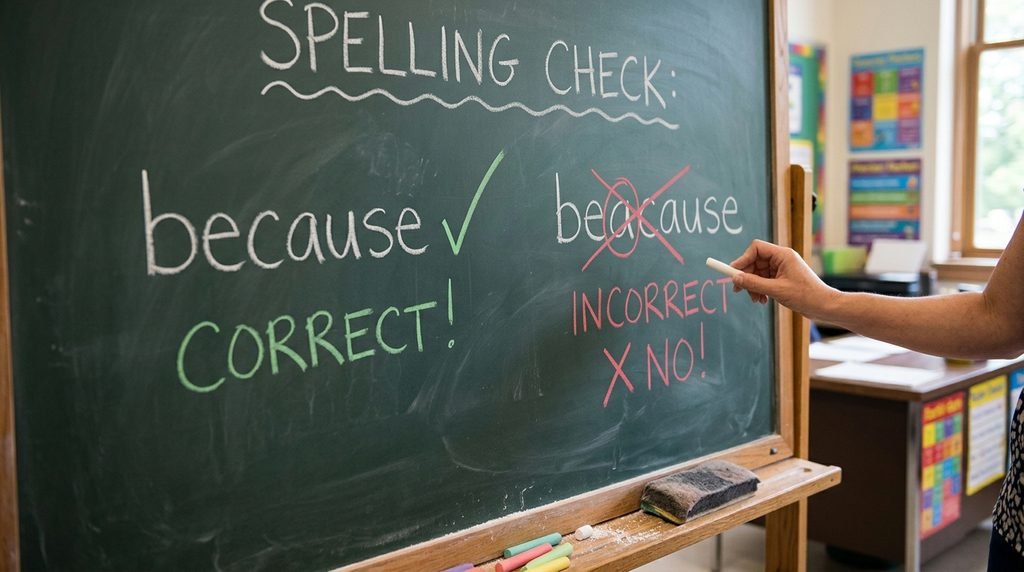
Because vs. beacause is a common English spelling confusion. Both forms look similar, but only one is correct in standard English. Since because appears frequently in everyday conversations, school assignments, emails, and professional writing, learning its spelling is important.
The correct spelling is because. The spelling beacause is incorrect because it rearranges the letters in the middle of the word.
This guide explains the difference between because and beacause, defines the word’s meaning, provides useful examples, and shares simple tips to help you remember the correct spelling.
Quick Answer
Because is the correct spelling. Beacause is a misspelling and should not be used in standard English writing.
- Correct: I stayed home because it was raining.
- Incorrect: I stayed home beacause it was raining.
Memory tip: Remember the spelling pattern be-cause. After “be,” write cause, not “acause.”
What Does Because Mean?
Because is a conjunction that introduces a reason or explanation. It connects an action, event, or situation to the reason it happened.
For example, in the sentence “She smiled because she was happy,” the word because explains why she smiled.
Because Introduces a Reason
Use because to explain why something happens or why someone makes a decision.
Examples:
- I brought an umbrella because the forecast predicted rain.
- He went to bed early because he was tired.
- We canceled the picnic because the weather was खराब.
- She studied hard because she wanted to pass the exam.
- They took a taxi because the bus was late.
In each example, the clause beginning with because gives a reason for the main action or situation.
Because Answers the Question “Why?”
When someone asks why something happened, a response often begins with because.
Examples:
- Why are you happy? Because I passed my test.
- Why did you leave early? Because I had another appointment.
- Why is the road closed? Because workers are repairing it.
These short answers are natural in conversation. In more formal writing, you can usually combine the reason with a complete main clause.
Because Can Explain Decisions and Opinions
The word also helps explain a choice, belief, or preference.
Examples:
- I chose this laptop because it was affordable.
- She trusts him because he always tells the truth.
- We prefer this route because it is shorter.
- He likes the book because the story is interesting.
Using because makes the relationship between an idea and its reason clear.
Why Do People Confuse Because and Beacause?
People may confuse these spellings because the word contains a familiar combination of vowels, and they sometimes place the letters a and u in the wrong order.
The incorrect form beacause places an a immediately after “be,” while the correct word follows the pattern be-cause.
Breaking the word into two parts makes it easier to remember:
be + cause = because
Although the pronunciation helps identify the word, it may not always make the letter sequence obvious. Practicing the correct spelling is more reliable than guessing from sound alone.
The Letter Order That Matters
| Spelling | Status | Explanation |
|---|---|---|
| Because | Correct | Uses the sequence be-cause |
| Beacause | Incorrect | Places the letters in the wrong order |
Spelling rule: Write because with b-e-c-a-u-s-e. Keep the letters in this order every time.
Because vs. Beacause: Key Differences
| Feature | Because | Beacause |
|---|---|---|
| Correct spelling | Yes | No |
| Part of speech | Conjunction | No standard usage |
| Meaning | Introduces a reason | No accepted standard meaning |
| Common use | Explaining why something happens | Usually a spelling error |
| Example | I left because I was tired. | I left beacause I was tired. |
The difference is spelling, not meaning. Because is the standard English word, while beacause is a misspelling.
How to Use Because in a Sentence
Use because when you want to explain a reason. It can connect a main clause to a dependent clause that tells readers why something happened.
Examples About Everyday Situations
- I stayed inside because it was too cold.
- She missed the bus because she woke up late.
- We ordered pizza because nobody wanted to cook.
- He wore a jacket because the evening was chilly.
- They arrived early because they wanted good seats.
Examples About School and Work
- I completed the assignment because the deadline was approaching.
- She received a promotion because she worked hard.
- The teacher repeated the instructions because some students were confused.
- We postponed the meeting because several people were unavailable.
- He practiced every day because he wanted to improve his writing.
Examples About Feelings and Preferences
- I was relieved because the problem was solved.
- She likes the park because it is quiet.
- He felt nervous because he had never spoken in public before.
- We chose the restaurant because it had good reviews.
- They were excited because their relatives were visiting.
These examples show how because can explain actions, choices, feelings, and events.
What Is the Difference Between Because and Since?
Because and since can both introduce a reason. However, since can also refer to time, so because may be clearer when you want to explain why something happened.
Compare these examples:
- Because: I stayed home because I was sick.
- Since: Since I was sick, I stayed home.
Both sentences give a reason. However, “I have lived here since 2020” uses since to refer to time, not to explain a cause.
When clarity matters, especially in formal writing, use because to make the reason explicit.
Can You Start a Sentence With Because?
Yes. Starting a sentence with because is grammatically correct when the sentence contains a complete main clause as well as the reason clause.
Correct examples:
- Because it was raining, we stayed indoors.
- Because she studied carefully, she passed the exam.
- Because the store was closed, we returned home.
Each sentence begins with a reason and then states the main result.
However, avoid leaving a dependent clause by itself in formal writing.
Incomplete: Because I was tired.
Complete: Because I was tired, I went to bed early.
A short answer such as “Because I wanted to” can be perfectly natural in conversation. The issue is whether the sentence fits its context, not whether because appears at the beginning.
Common Spelling Mistakes to Avoid
Even frequently used words can be misspelled when their letters appear in an unexpected order. Use these tips to avoid writing beacause.
1. Remember the Correct Letter Sequence
The correct spelling is b-e-c-a-u-s-e. Focus on the order of the letters after “be.”
2. Break the Word Into Parts
Think of the word as be + cause. Recognizing the familiar word cause can help you remember the spelling.
3. Practice With a Complete Sentence
Write a few sentences that use the word correctly.
- I stayed home because I was sick.
- She smiled because she was happy.
- We left early because it was getting late.
Reading and writing the word in context can reinforce the correct letter order.
4. Proofread Before Publishing
A spellchecker can often identify beacause, but proofreading remains useful. Check spelling carefully in essays, emails, website articles, and other important writing.
Alternatives to Because
Depending on the sentence, you can sometimes replace because with another expression that introduces a reason.
- Since: Since it was raining, we stayed home.
- As: As the store was closed, we returned later.
- Given that: Given that the road was blocked, we took another route.
- Due to the fact that: Due to the fact that the road was blocked, we took another route.
The last expression is wordy. In most cases, because or because of makes the meaning clearer and more concise.
Remember that these alternatives do not work in every context. Choose the expression that best fits the sentence and intended meaning.
FAQs
Is Because or Beacause Correct?
Because is correct. Beacause is a misspelling caused by placing the letters in the wrong order.
How Do You Spell Because Correctly?
The correct spelling is b-e-c-a-u-s-e. A useful memory trick is to divide it into be + cause.
What Does Because Mean?
Because introduces a reason or explanation. For example, “I stayed home because I was tired” explains why the person stayed home.
Why Do People Misspell Because as Beacause?
People may mix up the order of the vowels in the middle of the word. Remembering the pattern be-cause helps prevent this mistake.
Can You Start a Sentence With Because?
Yes. For example, “Because it was late, we went home.” Make sure the sentence expresses a complete thought in formal writing.
What Is Another Word for Because?
Depending on the context, alternatives include since, as, and given that. However, because is often the clearest choice for explaining a reason.
Conclusion
The correct spelling is because, while beacause is incorrect. Use because to introduce a reason, explain an action, or show why something happened.
To remember the spelling, divide the word into be + cause and keep the letters in the correct order. With this simple trick, you can avoid a common spelling mistake in everyday conversations, schoolwork, and professional writing.