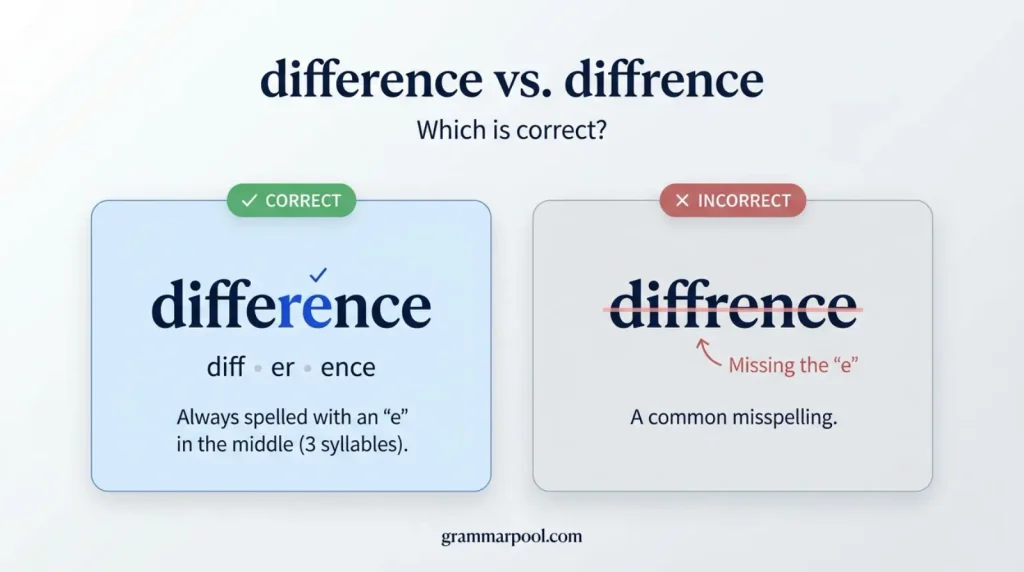
Difference vs diffrence is a common spelling question for English learners and writers. The correct spelling is difference, while diffrence is incorrect. If you want to describe how two or more things are unlike each other, you should always use difference.
This spelling mistake often happens because people pronounce words quickly or forget a vowel when writing. However, learning the correct spelling of difference can help you write more accurately in school assignments, professional emails, articles, and everyday conversations.
In this guide, you will learn the meaning of difference, understand why diffrence is incorrect, explore example sentences, and discover simple ways to remember the correct spelling.
Quick Answer: Difference vs Diffrence
Difference is the correct English spelling. It is a noun that describes the way people, objects, ideas, or situations are not the same.
Diffrence is a misspelling and should not be used in standard English writing.
| Word | Spelling Status | Meaning |
|---|---|---|
| Difference | Correct | The way things are unlike each other |
| Diffrence | Incorrect | A misspelling of difference |
Example: There is a big difference between these two products.
What Does Difference Mean?
The word difference refers to a way in which two or more things are not the same. It can describe differences in appearance, behavior, opinions, prices, abilities, or results.
For example, two students may have different opinions about a book. Similarly, two phones may have differences in price, battery life, and camera quality.
The word can also describe the effect of an action. When someone says, “Your support made a difference,” they mean that the support had a meaningful effect.
Examples of Difference in Sentences
- There is a clear difference between the two answers.
- I noticed a difference in her writing style.
- The price difference between these products is small.
- Education can make a positive difference in people’s lives.
- We discussed the difference between American and British English.
These examples show how difference works in everyday and professional communication.
Why Is Diffrence Incorrect?
The spelling diffrence is incorrect because it leaves out the letter e that appears after the first f in the standard spelling.
The correct spelling is d-i-f-f-e-r-e-n-c-e. Pay attention to the sequence diff-e-rence when writing the word.
Because English contains many words with similar sounds and letter patterns, it is easy to omit a letter by mistake. However, diffrence is not an accepted standard spelling of the noun.
Common Spelling Mistakes
Here are some examples of the incorrect and correct forms:
- Incorrect: There is a big diffrence between them.
- Correct: There is a big difference between them.
- Incorrect: I can see the diffrence in quality.
- Correct: I can see the difference in quality.
- Incorrect: What is the diffrence between these words?
- Correct: What is the difference between these words?
Always use difference in schoolwork, business writing, website content, and other formal or informal communication.
Difference vs Diffrence: Key Differences
The main difference between these two spellings is that only difference is correct in standard English.
| Feature | Difference | Diffrence |
|---|---|---|
| Spelling | Correct | Incorrect |
| Part of speech | Noun | Misspelling |
| Meaning | A way things are unlike each other | No standard meaning |
| Standard English usage | Accepted | Not accepted |
| Example | The difference is obvious. | Incorrect spelling |
Therefore, if you are writing an essay, creating an article, or sending a message, choose difference.
How to Remember the Correct Spelling of Difference
You can remember the correct spelling by breaking the word into smaller parts and practicing it regularly.
1. Remember the Missing E
The most common mistake in diffrence is leaving out an e. Remember that the correct word contains two f letters followed by e: diff-e-rence.
2. Break the Word Into Parts
Try remembering the word as:
dif + fer + ence
This simple technique can make the spelling easier to recall. When writing the word, check that you have included every letter.
3. Practice With a Sentence
Write this sentence a few times: “There is a difference between right and wrong.”
Using the word in context can help reinforce its correct spelling.
4. Check Your Writing
If you are uncertain, use a reliable dictionary or spell-checking tool. These tools can identify diffrence as an error and suggest the correct form.
Difference vs Different: What Is the Difference?
Although difference and different are related, they serve different grammatical purposes.
Difference is a noun that identifies how things are unlike each other. Different is an adjective that describes things that are not the same.
Examples:
- Difference: I noticed a difference between the two designs.
- Different: The two designs look different.
Both words are correct, but you should choose the one that fits the sentence.
What Is the Plural of Difference?
The plural form of difference is differences. You use it when referring to more than one distinction or contrast.
Examples:
- There are several differences between the two plans.
- We discussed the cultural differences between the countries.
- The teacher explained the differences between the answers.
Remember that the plural is differences, not diffrences.
How to Use Difference in Everyday English
The word difference appears in many situations, from casual conversations to academic and professional writing.
Here are some common expressions:
- Make a difference: Have an effect or create a change.
- Tell the difference: Recognize how two things are unlike each other.
- A big difference: A significant distinction.
- The main difference: The most important distinction.
- Without a difference: Without a meaningful distinction, depending on the context.
For example, “Can you tell the difference between these two pictures?” asks whether someone can identify how the pictures differ.
Learning these expressions can help you use the word naturally and confidently.
Frequently Asked Questions
Is difference or diffrence correct?
Difference is correct. Diffrence is a misspelling because it omits a letter from the standard English word.
How do you spell difference correctly?
The correct spelling is d-i-f-f-e-r-e-n-c-e. Remember to include the e after the double f.
What does difference mean?
Difference means a way in which two or more things are not the same. It can refer to appearance, opinions, quality, quantity, or results.
What is the plural of difference?
The plural form is differences. For example, “We noticed several differences between the two models.”
Why do people misspell difference as diffrence?
People may omit the letter e when typing quickly or recalling the word from memory. Breaking the spelling into smaller parts can help prevent this mistake.
How do you use difference in a sentence?
You can write, “There is a significant difference between the two methods.” In this sentence, difference describes how the methods are unlike each other.
Conclusion
When comparing difference vs diffrence, the correct spelling is always difference. The word is a noun that describes how people, objects, ideas, or situations are unlike each other. In contrast, diffrence is an incorrect spelling and should be avoided.
To remember the correct form, focus on the complete spelling: d-i-f-f-e-r-e-n-c-e. Practice writing the word in sentences and check your work before publishing or submitting it.
By learning this simple spelling rule, you can improve your English writing and avoid a common mistake in everyday communication.

Olivia Smith is a US English writer and language enthusiast who specializes in spelling, word choice, and commonly confused words. She creates clear, practical guides that help readers understand the correct spelling, meaning, and usage of English words.
At GrammarPool.com, Olivia focuses on spelling-choice topics, common spelling mistakes, and easy-to-understand explanations for everyday English users. Her writing is designed to make confusing word choices simple, accurate, and easy to remember.
Expertise: US English, spelling, word choice, commonly confused words, grammar, and language usage.