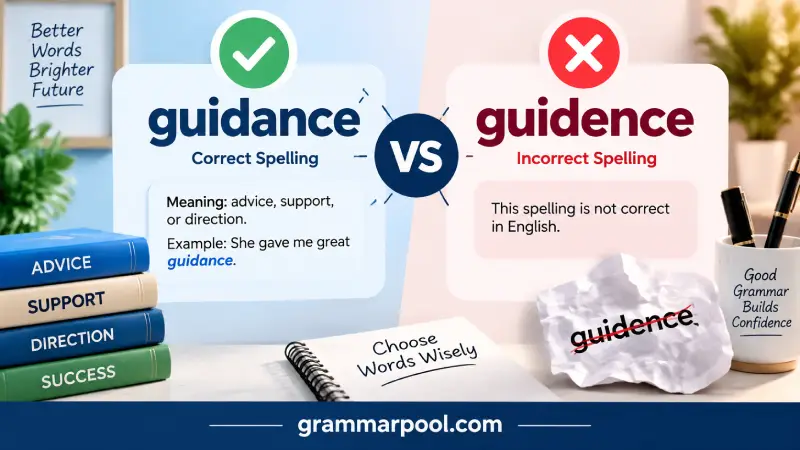
Guidance is the correct spelling, while guidence is a common misspelling. If you are unsure whether to write guidance or guidence, use guidance in standard American English.
The word guidance refers to advice, direction, help, or recommendations that help someone make a decision or complete a task. Although guidence may look reasonable because of words such as evidence and confidence, it is not the standard spelling.
Quick Answer: Is It Guidance or Guidence?
Guidance is correct.
Guidence is incorrect and should not be used in standard English.
| Spelling | Correct? | Meaning |
|---|---|---|
| guidance | ✅ Yes | Advice, direction, or help |
| guidence | ❌ No | Common misspelling of guidance |
For example:
The teacher gave me helpful guidance before the exam.
Not:
The teacher gave me helpful guidence before the exam.
Why Is Guidance the Correct Spelling?
The correct word is guidance, which comes from the verb guide.
When -ance is added to guide, the resulting noun is guidance. The spelling keeps the a before the final nce:
guide → guidance
This spelling can be confusing because English has many nouns ending in -ence, such as difference, confidence, and reference. However, guidance follows a different spelling pattern.
Therefore, remember:
guide + ance = guidance
The spelling guidence is a misspelling because it incorrectly changes the a to e.
What Does Guidance Mean?
Guidance means advice, assistance, direction, or recommendations provided to help someone make a decision or handle a situation.
For example:
I need some guidance on choosing a college.
Here, guidance means helpful advice about the decision.
The word can also describe instructions or professional help:
The counselor provided guidance to the students.
In this sentence, the counselor helps the students understand their options and make appropriate decisions.
Guidance in Everyday English
Guidance is common in everyday American English, especially when someone receives advice or direction.
For example:
My parents gave me valuable guidance when I started my first job.
She asked her older brother for guidance.
We need some guidance before making a final decision.
His advice provided useful guidance during a difficult situation.
Although advice and guidance can have similar meanings, they are not always interchangeable. Guidance often suggests ongoing help or direction, while advice can refer to a particular recommendation.
Guidance in School and Education
Students often receive guidance from teachers, counselors, mentors, and school administrators.
For example:
The counselor offered guidance about college applications.
Students can seek guidance from their teachers.
The teacher gave the class guidance on how to complete the project.
In education, guidance can include academic advice, career information, study recommendations, or general support.
Is “Guidance” Correct in Academic Writing?
Yes. Guidance is completely acceptable in formal and academic writing when it accurately describes advice or direction.
For example:
The researchers followed the guidance provided by the institution.
Students should seek professional guidance when conducting complex research.
However, choose a more specific word when appropriate. For instance, instructions, recommendations, advice, or directions may communicate the exact meaning more clearly.
Guidance in the Workplace
Guidance is also widely used in professional and business communication.
For example:
Employees can contact their manager for guidance.
The company issued new guidance about workplace procedures.
I appreciate your guidance throughout this project.
The team needs additional guidance before moving forward.
In workplace writing, guidance often refers to advice, instructions, policies, or recommendations from a manager, organization, or professional authority.
Guidance vs. Advice: Are They the Same?
Guidance and advice are closely related, but they can have slightly different uses.
Advice usually refers to a recommendation about what someone should do.
My doctor gave me advice about improving my diet.
Guidance often suggests broader direction or support.
My mentor provided guidance throughout my career.
In other words, advice can be a specific recommendation, whereas guidance can describe a broader process of helping someone understand what to do.
Guidance vs. Direction
Guidance and direction can also overlap.
Direction can mean instructions about what action to take:
The manager gave us clear directions for the project.
Guidance can sound broader and may involve advice or support:
The manager provided guidance throughout the project.
Therefore, the best choice depends on the context.
Common Mistake: Guidence
Guidence is not the standard spelling of the English word.
People often write guidence because the pronunciation can make the spelling less obvious. English also contains many familiar words ending in -ence, so it is easy to mistakenly apply that pattern here.
For example, these words contain -ence:
- confidence
- difference
- evidence
- reference
- preference
However, guidance uses -ance, not -ence.
How to Remember the Correct Spelling
A simple way to remember guidance is to connect it with guide:
GUIDE → GUIDANCE
The important part to remember is the a:
guidance ✅
guidence ❌
You can also remember the phrase:
A guide gives guidance.
This connection makes the correct spelling easier to recall.
Guidance: Pronunciation and Word Form
Guidance is generally pronounced approximately like:
GUY-dन्स / ˈɡaɪdəns
The first syllable sounds like guide.
That connection can help you remember the spelling:
guide → guidance
The word guidance is a noun.
Related words include:
- guide , va person, thing, or action that provides direction
- guided , directed or assisted
- guiding , providing direction or help
- guidance , advice or direction
For example:
The mentor guided the student and provided valuable guidance.
Examples of Guidance in Sentences
Here are several natural examples using guidance:
- I asked my teacher for guidance.
- She provided helpful guidance during the project.
- The counselor offered guidance about career options.
- We need professional guidance before making a decision.
- His guidance helped the team solve the problem.
- Parents often provide guidance to their children.
- The organization published guidance for new employees.
- Thank you for your guidance and support.
Each sentence uses guidance as a noun referring to help, advice, or direction.
Is Guidence Ever Correct?
No. Guidence is not the standard spelling of the word meaning advice or direction.
If you mean advice, help, or direction, write guidance.
For example:
Thank you for your guidance.
Avoid:
Thank you for your guidence.
The incorrect spelling may appear in informal writing, online posts, or user-generated content, but that does not make it an accepted standard spelling.
Guidance vs. Guidence in American English
For US English writing, the correct spelling is guidance.
This applies to:
- school assignments
- professional emails
- business documents
- websites
- applications
- reports
- academic writing
- everyday communication
For example:
Please contact your supervisor if you need additional guidance.
This sentence is natural and correct in American English.
FAQs
Is guidance or guidence correct?
Guidance is correct. Guidence is a misspelling and should be avoided in standard English.
How do you spell guidance correctly?
The correct spelling is guidance: G-U-I-D-A-N-C-E.
A useful memory trick is guide → guidance.
What does guidance mean?
Guidance means advice, direction, help, or recommendations that help someone make a decision or handle a situation.
Why do people spell guidance as guidence?
People may write guidence because English has many words ending in -ence, such as evidence and confidence. However, the correct spelling is guidance, with -ance.
Is guidance a noun?
Yes. Guidance is a noun.
For example:
The student received guidance from her teacher.
What is the difference between guidance and advice?
Advice often refers to a particular recommendation, while guidance can describe broader direction, help, or ongoing support.
What is the plural of guidance?
Guidance is generally an uncountable noun, so we normally do not say guidances in standard English. Depending on the context, use phrases such as pieces of guidance, types of guidance, or simply guidance.
Conclusion
Guidance is the correct spelling, while guidence is a common misspelling. The word guidance means advice, direction, help, or support that helps someone make a decision or complete a task.
The easiest way to remember the spelling is to connect it with guide:
guide → guidance ✅
Whenever you mean advice or direction, use guidance, not guidence.

Olivia Smith is a US English writer and language enthusiast who specializes in spelling, word choice, and commonly confused words. She creates clear, practical guides that help readers understand the correct spelling, meaning, and usage of English words.
At GrammarPool.com, Olivia focuses on spelling-choice topics, common spelling mistakes, and easy-to-understand explanations for everyday English users. Her writing is designed to make confusing word choices simple, accurate, and easy to remember.
Expertise: US English, spelling, word choice, commonly confused words, grammar, and language usage.