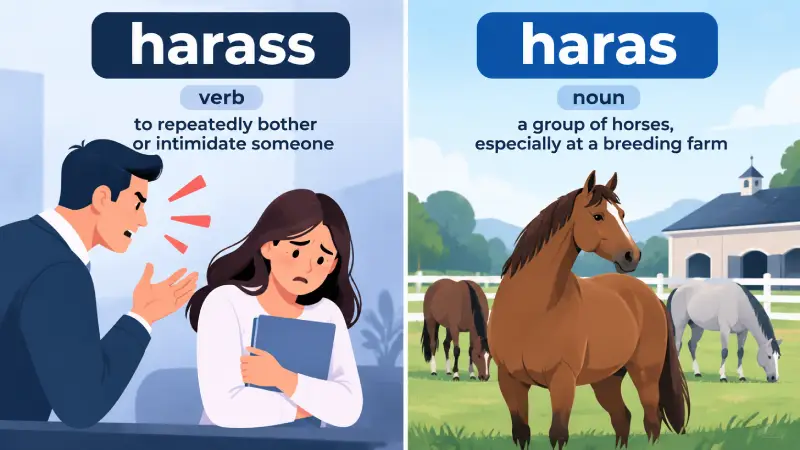
Harass is the correct spelling. Haras is a common misspelling and is not the standard English form of the word.
If you are unsure whether to write harass or haras, use harass. The word means to repeatedly bother, intimidate, annoy, or trouble someone, especially through unwanted behavior.
Quick Answer: Harass or Haras?
The correct spelling is harass.
- Harass ✅ Correct
- Haras ❌ Incorrect
The word harass contains two s’s at the end. The spelling haras leaves out the second s, making it incorrect in standard English.
Correct: The company has rules against employees who harass others.
Incorrect: The company has rules against employees who haras others.
What Does Harass Mean?
Harass is a verb that means to repeatedly bother, disturb, intimidate, or pressure someone.
The behavior can take different forms. Depending on the context, harassment may involve unwanted messages, repeated insults, threats, unwanted attention, or other persistent behavior.
For example:
The student reported that another student continued to harass him.
Nobody should harass someone online.
Repeated unwanted calls can harass and upset a person.
The word usually describes behavior that continues or happens repeatedly rather than a single minor annoyance.
Why Is Haras Incorrect?
Haras is incorrect because it does not contain the complete spelling of the standard English verb harass.
The final part of the word is:
-ass
Therefore:
har + ass = harass
When the second s is removed, the result is haras, which is not the standard spelling of the English verb.
A useful way to remember the difference is:
Harass has two S’s at the end.
How Do You Spell Harass?
The correct spelling is:
H-A-R-A-S-S
That gives you:
harass
A simple spelling reminder is to focus on the ending:
har + ass = harass
The word has double s at the end.
Harass ✅
Haras ❌
Harass as a Verb
Harass functions as a verb. It describes repeated or persistent behavior that bothers, pressures, intimidates, or troubles another person.
For example:
Do not harass other users online.
The employee claimed that a coworker continued to harass her.
Repeated messages may harass someone even when they seem harmless individually.
The verb can appear in different forms depending on the sentence.
Common Forms of Harass
| Form | Example |
|---|---|
| Base form | harass |
| Third-person singular | harasses |
| Past tense | harassed |
| Present participle | harassing |
Examples:
Some people harass others online.
He repeatedly harasses his neighbor.
The customer said the company harassed him with calls.
She was accused of harassing another employee.
Notice that the spelling changes when endings are added. The base form remains harass.
Harass vs. Harassment
Harass is the verb, while harassment is the noun.
Use harass when describing the action:
They continued to harass him.
Use harassment when referring to the behavior itself:
The company has a policy against workplace harassment.
These words are related, but they have different grammatical roles.
Examples
She reported that someone was harassing her.
The school investigated the alleged harassment.
Online harassment can have serious consequences.
Harass in Everyday English
The word harass commonly appears in conversations about workplaces, schools, online communication, relationships, and public behavior.
Here are some natural examples:
Don’t harass people because of their opinions.
The messages became increasingly aggressive and started to harass her.
Employees should report repeated behavior that makes them feel threatened or pressured.
Nobody has the right to harass another person.
The website allows users to report accounts that harass others.
The exact meaning can depend on the context, but the central idea involves unwanted and troubling behavior.
Common Phrases With Harass
Learning common phrases can make the word easier to recognize and use.
Harass someone
This means to repeatedly bother, pressure, intimidate, or trouble someone.
It is never acceptable to harass someone at work.
Harass employees
This phrase often appears in workplace contexts.
Employers should have clear procedures for reporting people who harass employees.
Harass someone online
This refers to repeated unwanted or abusive behavior through digital platforms.
Users can report accounts that harass people online.
Harass a person
This is another general construction.
The messages appeared to harass the person repeatedly.
Harass vs. Haras Examples
The following examples show how to use the correct spelling.
Correct
You should never harass another person.
The company investigated claims that an employee had harassed a coworker.
Some users harass others on social media.
He was accused of harassing his neighbor.
The school has rules against students who harass others.
Incorrect
You should never haras another person.
The company investigated claims that an employee had harased a coworker.
Some users haras others on social media.
He was accused of harasing his neighbor.
The standard spelling uses ss in harass.
Is Harass a Correct Word?
Yes. Harass is a correct English word and is widely used as a verb.
It can describe repeated unwanted behavior toward another person.
For example:
The manager warned the employee not to harass coworkers.
The related noun is harassment.
The company takes reports of harassment seriously.
By contrast, haras is not the standard spelling of this English word.
How Do You Pronounce Harass?
In American English, harass is commonly pronounced with the stress on the second syllable:
huh-RASS
The exact pronunciation can vary somewhat among English speakers and regions. However, pronunciation does not change the spelling.
If the word sounds like it ends with an s sound, remember that its written form ends in ss:
harass
How to Remember the Spelling Harass
The easiest trick is to remember:
Harass has two S’s.
You can also break the spelling into:
HAR + ASS = HARASS
The final part -ass contains two letters s.
Think:
Two S’s = harass.
This simple visual reminder can help you avoid writing haras.
Harass or Haras in American English
For standard American English, use harass.
The spelling haras is not an accepted alternative spelling of the English verb. Therefore, when writing an email, school assignment, article, report, workplace document, or website content, choose harass.
The same standard spelling is used across major varieties of English.
Why Do People Spell Harass as Haras?
The most common reason is that the final s can be easy to overlook.
Because harass is pronounced as one word, writers may spell it based on how they hear it. Some people may also assume that one s is enough at the end.
However, the standard spelling contains two s’s:
harass
Remembering the double s is the simplest way to avoid the mistake.
Harass vs. Haras: Quick Comparison
| Word | Correct? | Meaning |
|---|---|---|
| Harass | ✅ Yes | To repeatedly bother, pressure, intimidate, or trouble someone |
| Haras | ❌ No | Common misspelling of harass |
The difference is only one letter, but that letter matters. Harass is the correct spelling.
FAQs
Is harass or haras correct?
Harass is correct. Haras is a misspelling and should not be used in standard English.
How do you spell harass correctly?
The correct spelling is H-A-R-A-S-S: harass. Remember that the word ends with double s.
What does harass mean?
Harass means to repeatedly bother, pressure, intimidate, annoy, or trouble someone through unwanted behavior.
Is haras a word?
Haras is not the standard spelling of the English verb harass. In standard English writing, use harass.
What is the noun form of harass?
The noun form is harassment. For example, “The company investigated the harassment complaint.”
What are the forms of harass?
The main forms are harass, harasses, harassed, and harassing.
Conclusion
Harass is the correct spelling, while haras is incorrect. The word harass is a verb meaning to repeatedly bother, pressure, intimidate, or trouble someone.
The easiest way to remember the spelling is to focus on the ending:
Harass = double S
Whenever you are unsure whether to write harass or haras, choose harass.