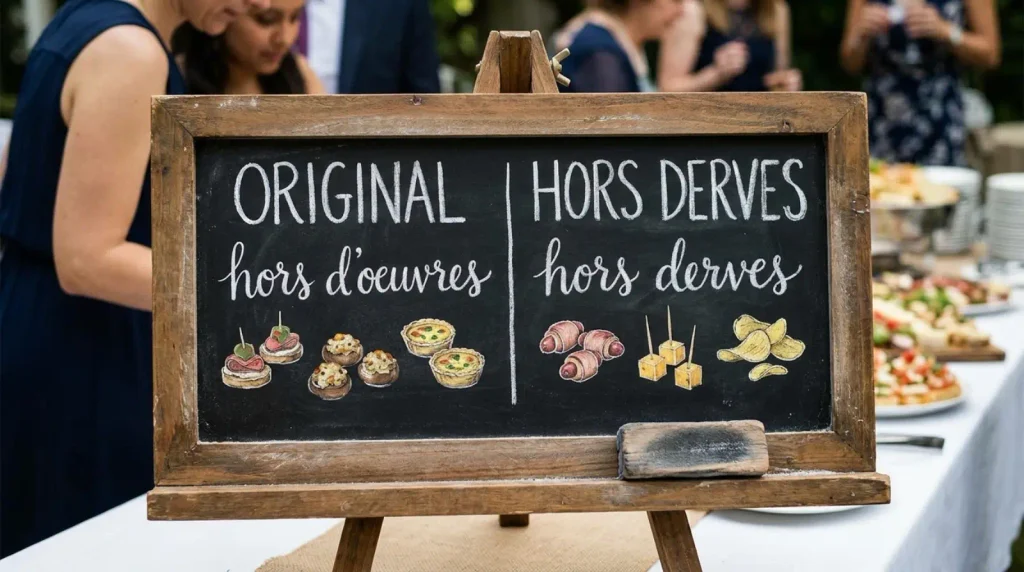
Hors d’oeuvres is the correct spelling, while hors derves is a misspelling of the French term. The phrase refers to small dishes or bite-sized foods served before a main meal, such as stuffed mushrooms, cheese bites, shrimp cocktails, and small pastries.
For example: “The restaurant served delicious hors d’oeuvres before dinner.”
The main difference is that hors d’oeuvres preserves the original French spelling, including the apostrophe and the letters in oeuvres. Hors derves leaves out important letters and is not a standard spelling.
Hors d’Oeuvres vs. Hors Derves: Quick Answer
| Spelling | Correct or Incorrect? | Meaning |
|---|---|---|
| Hors d’oeuvres | Correct | Small dishes served before a meal |
| Hors derves | Incorrect | A misspelling of hors d’oeuvres |
If you are writing a menu, invitation, restaurant review, food blog, or event description, use hors d’oeuvres.
What Does Hors d’Oeuvres Mean?
Hors d’oeuvres is a French expression used in English for small portions of food served before a main meal. These foods are often designed to be eaten in a few bites and may be served at parties, weddings, receptions, restaurants, and other social gatherings.
The expression comes from French, where it literally means “outside the work.” In culinary usage, it refers to food served outside the main courses of a meal.
Common examples of hors d’oeuvres include:
- Stuffed mushrooms: Small mushroom caps filled with cheese, herbs, or breadcrumbs.
- Shrimp cocktail: Chilled shrimp served with a dipping sauce.
- Cheese and crackers: Small portions of cheese paired with crackers.
- Mini quiches: Bite-sized savory pastries filled with eggs, cheese, and vegetables.
- Bruschetta: Small pieces of toasted bread topped with ingredients such as tomatoes and herbs.
- Deviled eggs: Hard-boiled eggs filled with a seasoned yolk mixture.
- Spring rolls: Small rolls filled with vegetables or other ingredients.
- Canapés: Small pieces of bread or crackers topped with savory ingredients.
These foods are popular because guests can enjoy them while socializing before a meal.
Why Is Hors d’Oeuvres the Correct Spelling?
The correct spelling is hors d’oeuvres because English has borrowed the expression from French while retaining its traditional spelling.
The word can look confusing because it contains letters and a combination of vowels that are unfamiliar to many English speakers.
Here is the standard spelling:
H-O-R-S D-’-O-E-U-V-R-E-S
The incorrect version, hors derves, omits letters from the French word oeuvres.
An Easy Way to Remember Hors d’Oeuvres
Remember that the correct expression includes two parts:
- Hors: The French word meaning “outside.”
- D’oeuvres: The second part of the French expression, referring to works or dishes in this culinary context.
You do not need to memorize the French pronunciation to spell the term correctly. Instead, save the full expression, hors d’oeuvres, as a spelling reference when writing menus or invitations.
Hors d’Oeuvres in Sentences
Seeing the expression in context can help you remember its spelling and meaning.
- The caterer prepared several varieties of hors d’oeuvres for the wedding reception.
- Guests enjoyed delicious hors d’oeuvres while waiting for dinner.
- The restaurant offers complimentary hors d’oeuvres before the evening meal.
- We served vegetarian hors d’oeuvres at the office party.
- The chef created elegant hors d’oeuvres using fresh seafood and herbs.
- Please arrive early to enjoy cocktails and hors d’oeuvres.
- The menu included both hot and cold hors d’oeuvres.
In each example, the term refers to small dishes served before or outside the main meal.
What Is the Difference Between Hors d’Oeuvres and Appetizers?
Hors d’oeuvres and appetizers are closely related terms. Both refer to food served before a main course, but their use can vary depending on the setting and style of service.
| Feature | Hors d’oeuvres | Appetizers |
|---|---|---|
| General meaning | Small foods served before a meal | Foods served to stimulate the appetite before the main course |
| Typical setting | Receptions, parties, cocktail events, and formal gatherings | Restaurants, family meals, and casual or formal dining |
| Serving style | Often served on trays or displayed for guests | Often ordered from a menu and served at the table |
| Examples | Canapés, cheese bites, mini pastries | Soup, salad, mozzarella sticks |
The distinction is not absolute. In everyday English, hors d’oeuvres and appetizers sometimes describe the same foods.
Hors d’Oeuvres vs. Canapés
A canapé is a particular type of hors d’oeuvre. It usually consists of a small base, such as bread, toast, or a cracker, topped with ingredients such as cheese, meat, fish, or vegetables.
For example, smoked salmon on a small piece of toast can be a canapé and an hors d’oeuvre.
However, not all hors d’oeuvres are canapés. Stuffed mushrooms, shrimp cocktail, and deviled eggs can also be hors d’oeuvres without being canapés.
Is Hors d’Oeuvres Singular or Plural?
Hors d’oeuvres is the standard plural form in English. The singular form is hors d’oeuvre, referring to one small dish.
Examples:
- Singular: The chef prepared one hors d’oeuvre for each guest.
- Plural: The chef prepared several hors d’oeuvres for the reception.
Notice that the plural form adds an s at the end of oeuvre. In everyday menus and event invitations, the plural form is particularly common.
How Do You Pronounce Hors d’Oeuvres?
The French expression hors d’oeuvres is commonly pronounced approximately as or-DURVZ in English.
The spelling does not closely match its English pronunciation, which is one reason people sometimes misspell it as hors derves or use other informal phonetic versions.
For formal writing, however, always use hors d’oeuvres, regardless of how you pronounce it.
Common Misspellings of Hors d’Oeuvres
Because the phrase has an unusual spelling, several errors can occur when people write it from memory.
| Incorrect or Nonstandard Form | Standard Form |
|---|---|
| Hors derves | Hors d’oeuvres |
| Hors derves | Hors d’oeuvres |
| Hors d’oeuvre’s | Hors d’oeuvres when referring to multiple dishes |
| Hors douvres | Hors d’oeuvres |
| Hors deuvres | Hors d’oeuvres in standard French-derived spelling |
The apostrophe and the letters in oeuvres help preserve the traditional spelling.
Frequently Asked Questions
Is It Hors d’Oeuvres or Hors Derves?
Hors d’oeuvres is correct. Hors derves is a misspelling of the French culinary expression.
What Does Hors d’Oeuvres Mean in English?
Hors d’oeuvres means small dishes served before a main meal. Common examples include canapés, stuffed mushrooms, cheese bites, and shrimp cocktail.
Why Is Hors d’Oeuvres So Difficult to Spell?
The expression comes from French and contains an unfamiliar combination of letters. Its spelling also differs significantly from its pronunciation, making it easy to misspell when writing from memory.
What Is the Difference Between Hors d’Oeuvres and Appetizers?
Both refer to foods served before a main meal. Hors d’oeuvres often describes small bites served at receptions or social events, while appetizers is a broader everyday term commonly used on restaurant menus.
What Is the Singular Form of Hors d’Oeuvres?
The singular form is hors d’oeuvre, meaning one small dish served before a meal. The plural form is hors d’oeuvres.
How Do You Pronounce Hors d’Oeuvres?
In English, it is commonly pronounced approximately or-DURVZ. Although the pronunciation sounds different from the spelling, the standard written form remains hors d’oeuvres.
Conclusion
Hors d’oeuvres is the correct spelling, while hors derves is incorrect. The French expression describes small dishes served before a main meal, especially at parties, weddings, receptions, and formal gatherings.
To remember the correct spelling, learn the complete expression rather than trying to spell it from its pronunciation. Whether you are writing a restaurant menu, planning a party, or preparing an article about food, use hors d’oeuvres for the standard spelling.