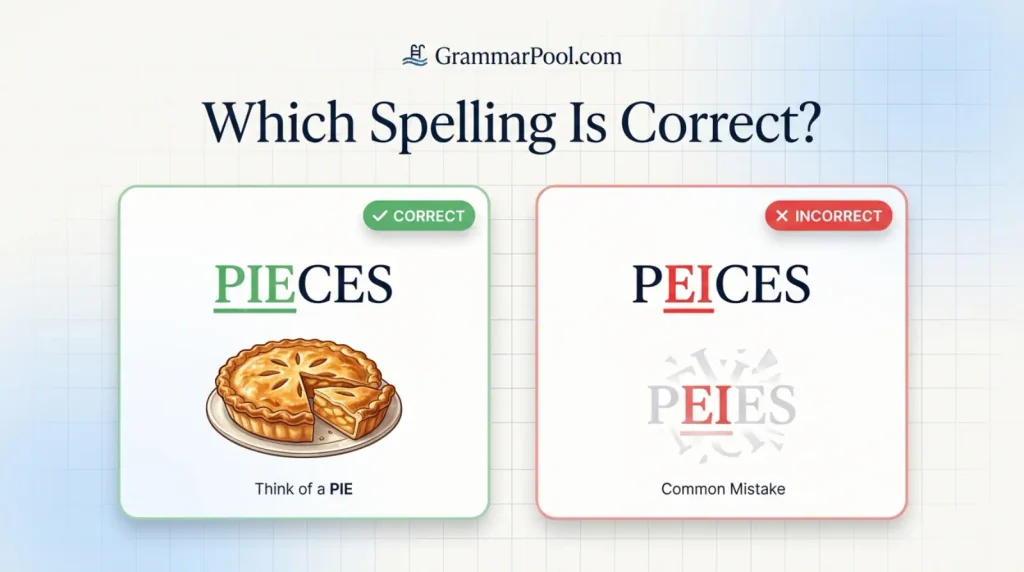
Pieces is the correct spelling, while peices is a misspelling. If you are writing about parts of an object, portions of food, fragments of something broken, or individual works of art, always use pieces. The word peices is not a standard English spelling.
The confusion usually occurs because people remember the sound of the word but reverse the positions of the letters i and e. Fortunately, a simple spelling trick can help you remember the correct form.
Whether you are writing a school assignment, a business email, a blog post, or a casual message, learning the difference between pieces vs. peices will help you avoid this common spelling mistake.
Pieces vs. Peices: The Quick Answer
- Pieces: Correct. It is the plural form of piece, meaning individual parts, portions, or items.
- Peices: Incorrect. It is a common misspelling of pieces and should not be used in standard English writing.
For example:
- Correct: She divided the cake into six pieces.
- Incorrect: She divided the cake into six peices.
The correct spelling is pieces, with the letter i before the letter e.
What Does Pieces Mean?
Pieces is the plural form of the noun piece. It refers to two or more separate parts, portions, objects, or individual items.
People use the word in everyday conversations, academic writing, professional communication, cooking instructions, art discussions, and many other contexts.
The singular word piece refers to one part or item. Adding -s creates the plural form pieces.
For example:
- One piece of chocolate.
- Two pieces of chocolate.
- One piece of furniture.
- Several pieces of furniture.
Notice that pieces can describe physical objects as well as portions of something larger. It can also refer to individual creative works, such as musical compositions, articles, paintings, or literary works.
Examples of Pieces in Sentences
- The children collected the broken pieces of the glass vase.
- Please cut the pizza into eight equal pieces.
- She wrote several interesting pieces for the school newspaper.
- The carpenter carefully fitted the wooden pieces together.
- I packed a few pieces of fruit for lunch.
- The museum displayed beautiful pieces of ancient pottery.
- He found the missing pieces of the puzzle under the sofa.
- The chef arranged the chocolate pieces on top of the dessert.
In each example, pieces refers to multiple parts, portions, or individual items.
What Does Peices Mean?
Peices is a spelling error, not a standard English word. Writers sometimes use it when they accidentally reverse the i and e in pieces.
Although a reader will usually understand what someone means when they see peices, the spelling is incorrect in standard American English and standard written English generally.
You should avoid using peices in essays, articles, emails, product descriptions, social media posts, and professional documents.
Incorrect Examples and Their Corrections
– Incorrect: I bought three peices of bread.
Correct: I bought three pieces of bread.
– Incorrect: The puzzle has fifty peices.
Correct: The puzzle has fifty pieces.
– Incorrect: She arranged the peices of paper on the table.
Correct: She arranged the pieces of paper on the table.
– Incorrect: The artist created several beautiful peices of pottery.
Correct: The artist created several beautiful pieces of pottery.
The solution is the same in every example: write pieces, not peices.
Why Do People Confuse Pieces and Peices?
The confusion between pieces and peices is primarily a spelling problem. Both forms look similar, and the letters appear in an order that some writers find difficult to remember.
Several factors can contribute to the mistake.
1. Confusion About I Before E
Many English learners learn the familiar spelling guideline “i before e,” but that guideline has exceptions and cannot reliably determine every English spelling.
The word pieces follows the i before e sequence in its first four letters: p-i-e-c.
Remembering the exact spelling of this common word is more reliable than trying to apply the general guideline to every word.
2. Writing Too Quickly
When people type quickly, they may reverse adjacent or nearby letters without noticing. Since pieces and peices contain the same letters in a different order, the mistake can slip into a sentence.
For example, someone writing “The package contains several pieces” might accidentally type “The package contains several peices.”
A quick spelling check can catch the error before publication.
3. Relying on Pronunciation
The two spellings may look different, but the intended word is pronounced the same way in ordinary speech. Because pronunciation does not clearly reveal the correct letter order, writers need to remember the conventional spelling.
Reading a sentence aloud can help with meaning and clarity, but it will not necessarily identify this particular spelling error.
4. Typing Without Proofreading
Autocorrect and spell-checking tools can catch many spelling mistakes, but writers should not assume every error will be detected. Settings, software, and context can affect which corrections appear.
For important writing, review the spelling yourself and use a trusted dictionary or proofreading tool when necessary.
How to Remember the Correct Spelling of Pieces
The easiest way to avoid this error is to remember the word’s letter sequence rather than trying to memorize both forms.
Memory Trick 1: Remember P-I-E
The correct word begins with the letters P-I-E:
P-I-E-C-E-S = PIECES
Think of a pie cut into several pieces. The word pie appears at the beginning of pieces, which makes this a useful visual memory aid.
For example:
“The baker cut the pie into six pieces.”
Whenever you hesitate between pieces and peices, remember the pie.
Memory Trick 2: Connect Piece With Pieces
Learn the singular and plural forms together:
- One piece
- Two pieces
- Several pieces
The plural form simply adds s to piece. The original letter order stays the same.
This method is useful because it connects the correct spelling to a word you may already know.
Memory Trick 3: Look for the Correct Letter Order
Before submitting an article or assignment, check that the word is spelled:
P-I-E-C-E-S
If you see P-E-I-C-E-S, the letters have been reversed.
This quick visual check is especially helpful when proofreading long documents.
Pieces vs. Peices: Comparison Table
| Feature | Pieces | Peices |
|---|---|---|
| Correct spelling | Yes | No |
| Standard English word | Yes | No |
| Part of speech | Noun, plural | Misspelling |
| Meaning | Parts, portions, or individual items | No standard meaning |
| Singular form | Piece | Not applicable |
| Example | Three pieces of cake | Incorrect spelling |
| Suitable for professional writing | Yes | No |
The distinction is straightforward: pieces is the correct word, and peices is a spelling mistake.
Common Uses of Pieces in Everyday English
Understanding how pieces appears in different contexts makes it easier to use the word correctly.
Pieces of Food
The word often refers to portions of food that have been divided into smaller amounts.
Examples:
- We shared two pieces of cake after dinner.
- Cut the chicken into small pieces before cooking.
- She added a few pieces of fruit to the bowl.
Pieces of Objects
When an object breaks or consists of separate components, pieces can describe its parts.
Examples:
- The child picked up the pieces of the broken toy.
- The mechanic replaced several damaged pieces of equipment.
- We assembled the furniture using the included pieces.
Pieces of Writing or Music
The word can also describe individual creative works.
Examples:
- She published three short pieces in a literary magazine.
- The pianist performed two classical pieces at the concert.
- The editor selected several opinion pieces for the weekend edition.
Pieces of Information
In some contexts, pieces refers to separate facts, details, or parts of a larger explanation.
Examples:
- The detective gathered several pieces of evidence.
- I received two important pieces of information.
- Each chapter provides new pieces of the story.
These examples demonstrate that pieces is a flexible noun used across many subjects and situations.
Is Pieces Singular or Plural?
Pieces is plural. Its singular form is piece.
Use piece when referring to one item and pieces when referring to more than one.
Examples:
- Singular: I found one piece of paper.
- Plural: I found five pieces of paper.
- Singular: She played a musical piece.
- Plural: She played three musical pieces.
The noun that follows pieces of may be uncountable. For example, English speakers commonly say “two pieces of advice” and “three pieces of furniture.”
In these expressions, pieces is plural, but advice and furniture remain uncountable nouns. You would not normally write “two advices” or “three furnitures” in standard English.
Pieces vs. Piece’s vs. Pieces’
These forms can look similar, but they serve different purposes.
Pieces
Pieces is the ordinary plural form of piece.
Example: The pieces are on the table.
Piece’s
Piece’s is the possessive form of the singular noun piece. It indicates that something belongs to or is associated with one piece.
Example: The piece’s rough edges made it difficult to handle.
Here, the rough edges belong to one particular piece.
Pieces’
Pieces’ is the possessive form of the plural noun pieces. It indicates that something belongs to multiple pieces.
Example: The pieces’ different shapes made the puzzle challenging.
Here, the shapes are associated with several pieces.
Remember that an apostrophe is not needed simply to make piece plural. Use pieces, not piece’s, when you mean more than one piece.
Frequently Asked Questions
Is Pieces or Peices Correct?
Pieces is correct. Peices is a misspelling and should be corrected whenever you encounter it in standard English writing.
How Do You Spell Pieces Correctly?
Spell the word P-I-E-C-E-S. A useful trick is to remember the letters P-I-E at the beginning, as in a pie cut into pieces.
Why Is Peices Incorrect?
Peices reverses the positions of the letters i and e in the correct spelling. The standard English word is pieces.
What Is the Singular of Pieces?
The singular form is piece. For example, one piece of chocolate becomes two pieces of chocolate.
Does Pieces Have More Than One Meaning?
Yes. Depending on the context, pieces can refer to parts of an object, portions of food, works of art or music, written articles, or individual elements of a larger whole.
Can I Use Pieces in Formal Writing?
Yes. Pieces is appropriate for formal and informal writing, including academic assignments, business documents, reports, articles, and everyday communication.
Conclusion
When comparing pieces vs. peices, the answer is simple: pieces is the correct spelling, while peices is a misspelling.
The word pieces is the plural of piece and refers to parts, portions, or individual items. You can use it when discussing food, broken objects, artwork, music, written content, and many other subjects.
To remember the correct spelling, think of P-I-E at the beginning of P-I-E-C-E-S. Then check the word carefully when proofreading.
Whenever you need this word in a sentence, choose pieces. It is the standard spelling for clear, accurate, and professional English.

Olivia Smith is a US English writer and language enthusiast who specializes in spelling, word choice, and commonly confused words. She creates clear, practical guides that help readers understand the correct spelling, meaning, and usage of English words.
At GrammarPool.com, Olivia focuses on spelling-choice topics, common spelling mistakes, and easy-to-understand explanations for everyday English users. Her writing is designed to make confusing word choices simple, accurate, and easy to remember.
Expertise: US English, spelling, word choice, commonly confused words, grammar, and language usage.