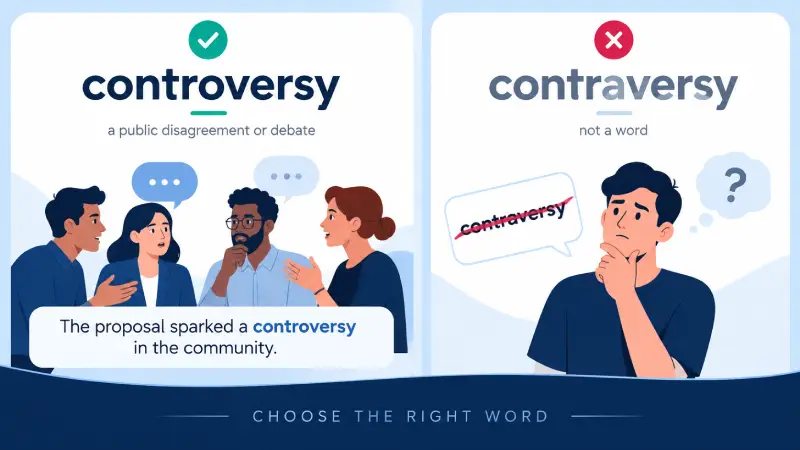
Is it controversy or contraversy? The correct spelling is controversy. Contraversy is a common misspelling.
is a noun that describes a situation involving strong disagreement, debate, or opposing opinions. You might see it in news reports, academic writing, politics, entertainment, business, or everyday conversations.
Although contraversy looks and sounds similar, it is not the standard spelling of the word. Therefore, when you mean a public disagreement or debate, always write controversy.
Is It Controversy or Contraversy?
Controversy is the correct spelling.
Contraversy is incorrect when you intend to use the standard English noun for a dispute or disagreement.
| Spelling | Correct? | Meaning |
|---|---|---|
| Controversy | ✅ Yes | A public disagreement, dispute, or debate |
| Contraversy | ❌ No | Common misspelling of “controversy” |
For example:
- The decision caused a controversy among local residents.
- The new policy has sparked controversy.
- The issue remains a subject of public controversy.
- His comments created a major controversy online.
By contrast, these sentences contain the common spelling error:
- The decision caused a contraversy. ❌
- The policy sparked contraversy. ❌
The correct form in both cases is controversy.
What Does Controversy Mean?
Controversy means a situation in which people strongly disagree about an issue, decision, action, person, or idea.
The disagreement can happen between individuals, groups, organizations, experts, politicians, or members of the public.
For example:
The proposed law created controversy across the country.
This means that the proposed law caused significant disagreement or debate.
Similarly:
The athlete became involved in a controversy after making the statement.
Here, controversy refers to a disputed or debated situation surrounding the athlete.
The word often appears when an issue receives considerable public attention. However, a controversy does not necessarily mean that one side is right and the other is wrong. It simply indicates that significant disagreement exists.
Why Is Controversy Spelled With “O”?
The correct spelling is:
C-O-N-T-R-O-V-E-R-S-Y
The middle of the word can cause confusion because some speakers may pronounce it in a way that makes the spelling less obvious.
A useful way to break it down is:
con + tro + ver + sy
That gives you:
controversy
The incorrect form contraversy changes the vowel pattern in the middle of the word. This mistake probably happens because the pronunciation can make the correct spelling difficult to remember.
Instead of relying entirely on pronunciation, remember the visual pattern:
controversy
The middle contains -vers-, not -vers- with an extra “a” replacing the “o” pattern.
Why Do People Spell It Contraversy?
The misspelling contraversy is understandable because English spelling does not always match pronunciation perfectly.
When people hear the word, they may interpret its middle sound incorrectly. As a result, they sometimes write contraversy instead of controversy.
Another reason is that English contains many words in which an unstressed vowel is difficult to identify from speech alone. If you have heard the word frequently but rarely seen it written, the incorrect spelling can seem natural.
For example, someone might write:
The political decision created a lot of contraversy.
The sentence sounds understandable, but the spelling is incorrect.
The correct version is:
The political decision created a lot of controversy.
Therefore, if you are unsure, check the written form rather than relying only on how the word sounds.
Controversy: Meaning and Usage
Controversy usually refers to a matter that attracts disagreement or debate.
It can describe a small dispute or a major public issue, depending on context.
Public Controversy
A public controversy involves disagreement that receives attention from a wider audience.
Examples:
- The mayor faced public controversy after announcing the plan.
- The decision became a major public controversy.
- The company tried to respond to the growing controversy.
Political Controversy
Political issues often generate controversy because different groups have competing views.
Examples:
- The proposed bill sparked political controversy.
- The senator became involved in a political controversy.
- The issue remains at the center of a national controversy.
Social Controversy
Social issues can also become controversial when people hold strongly different opinions.
Examples:
- The campaign generated widespread controversy.
- The topic has remained a source of social controversy.
- Public debate grew as the controversy continued.
Media Controversy
News organizations frequently use the word when reporting on disputed events.
Examples:
- The interview caused controversy across social media.
- The celebrity responded to the recent controversy.
- News outlets continued covering the controversy.
How to Use Controversy in a Sentence
Because controversy is a noun, it normally functions as the subject or object of a sentence.
Here are several natural examples.
- The decision sparked controversy.The decision caused people to disagree or debate the issue.
- The controversy attracted national attention.The disagreement became widely known.
- She avoided commenting on the controversy.She chose not to discuss the disputed issue.
- The company faced controversy after the announcement.The announcement caused public disagreement or criticism.
- Experts continue to debate the controversy.Specialists continue discussing the disputed issue.
- The controversy has affected the organization’s reputation.The disagreement has had an impact on how people view the organization.
Notice that controversy works naturally with verbs such as spark, cause, create, fuel, avoid, address, face, and resolve.
Common Phrases With Controversy
Learning common word combinations can make the spelling easier to remember.
Here are some frequently used phrases:
- spark controversy
- cause controversy
- create controversy
- fuel controversy
- stir controversy
- face controversy
- avoid controversy
- address the controversy
- resolve the controversy
- a major controversy
- a public controversy
- a political controversy
- a growing controversy
- a heated controversy
- a controversial issue
For example:
The announcement sparked controversy among residents.
Likewise:
The organization faced controversy after changing its policy.
These common combinations are useful in both formal and everyday writing.
Controversy vs. Controversial
Another useful distinction is between controversy and controversial.
Controversy is a noun.
Controversial is an adjective.
Compare these sentences:
- The decision caused controversy.
- The decision was controversial.
In the first sentence, controversy names the disagreement.
In the second sentence, controversial describes the decision.
More examples include:
- The speech created controversy.
- The speech contained several controversial statements.
- The issue remains a source of controversy.
- The issue is highly controversial.
Understanding this difference can help you avoid another common usage mistake.
Controversy vs. Debate
Although controversy and debate can overlap, they are not always interchangeable.
A debate usually refers to a discussion in which people present different arguments or viewpoints.
A controversy emphasizes disagreement or dispute surrounding an issue.
For example:
The candidates held a debate about the proposed policy.
This describes a structured discussion.
On the other hand:
The proposed policy caused controversy.
This emphasizes the disagreement surrounding the policy.
Therefore, use debate when you want to focus on the discussion itself. Use controversy when you want to emphasize the disputed nature of the issue.
Controversy vs. Dispute
Dispute is another related word.
A dispute usually involves disagreement between people or groups. Meanwhile, controversy often describes a broader issue that attracts public discussion.
For example:
The two companies are involved in a legal dispute.
This sentence describes a disagreement between two companies.
By comparison:
The company’s new policy caused controversy.
Here, the issue has attracted wider disagreement or public attention.
Of course, the words can overlap in some situations. Still, their emphasis differs depending on context.
Common Mistakes With Controversy
The most common spelling mistake is adding an a in the middle:
❌ contraversy
✅ controversy
Here are more examples:
❌ The decision created a lot of contraversy.
✅ The decision created a lot of controversy.
❌ The actor responded to the contraversy.
✅ The actor responded to the controversy.
❌ The issue remains highly debated because of the contraversy.
✅ The issue remains highly debated because of the controversy.
Another mistake involves confusing the noun with the adjective:
❌ The issue is a very controversy topic.
✅ The issue is a very controversial topic.
The correct choice depends on the grammatical role of the word.
How to Remember the Spelling of Controversy
A simple memory trick can help you avoid contraversy.
Remember:
CON + TRO + VERSY = CONTROVERSY
The word contains “tro”, not “tra.”
Think:
CONTROVERSY has TRO.
You can also connect it with the related adjective:
controversy → controversial
Both words begin with:
contro-
For example:
- controversy
- controversial
That shared beginning provides another useful spelling clue.
Quick Spelling Test
If you see these two forms:
controversy
contraversy
Choose the first one.
A quick mental check is:
“Is the middle spelled tro?”
If yes, write:
controversy
Controversy in News Writing
News articles frequently use controversy because journalists often report on disputed decisions, statements, policies, and events.
For example:
The new policy has sparked controversy among residents.
Another example is:
Officials addressed the controversy during a press conference.
In news-style writing, the word can describe an issue without automatically declaring one side correct.
That distinction matters because controversy describes disagreement rather than proving that a particular claim is true or false.
Controversy in Academic Writing
Academic writers may use controversy when discussing disagreements among researchers, scholars, or competing theories.
Examples include:
- The theory remains the subject of academic controversy.
- Researchers continue to examine the controversy surrounding the findings.
- The historical claim has generated considerable controversy.
- Scholars disagree about the source of the controversy.
In academic writing, the word works especially well when you want to describe an established area of disagreement.
However, writers should still explain the specific issue instead of relying on the word alone.
Controversy in Business Writing
Businesses can also face controversy over products, advertisements, policies, executive decisions, or public statements.
For example:
The advertising campaign generated controversy among customers.
Similarly:
The company issued a statement addressing the controversy.
Clear wording matters in professional communication. Therefore, if a business is discussing a disputed issue, controversy is the correct spelling for the noun.
Controversy in Everyday English
You do not need a formal context to use controversy.
People use it in everyday conversations about movies, sports, celebrities, schools, technology, social media, and current events.
For example:
- That decision caused a lot of controversy.
- The movie became controversial after its release.
- I don’t want to get involved in the controversy.
- The controversy spread quickly online.
- Everyone seems to have an opinion about the controversy.
Thus, controversy is a versatile word that fits many situations.
Is Contraversy Ever Correct?
For standard English writing, contraversy is not the correct spelling of the noun meaning a disagreement or disputed issue.
If you are writing an essay, article, email, report, social media post, or professional document, use controversy.
The spelling contraversy may appear online because people frequently make spelling errors. However, frequent appearance does not make it the standard spelling.
There can also be unusual names or specialized uses in language, but those do not change the standard spelling of the English noun.
Controversy vs. Contraversy: Quick Comparison
| Feature | Controversy | Contraversy |
|---|---|---|
| Standard English spelling | ✅ Yes | ❌ No |
| Part of speech | Noun | Misspelling |
| Meaning | Disagreement or disputed issue | No standard meaning |
| Common in formal writing | Yes | No |
| Common in news writing | Yes | No |
| Example | The decision caused controversy. | The decision caused contraversy. ❌ |
The key point is simple: controversy is the standard spelling.
FAQs
Is controversy the correct spelling?
Yes. Controversy is the correct spelling for a situation involving strong disagreement, debate, or public dispute. Contraversy is a misspelling.
Is contraversy a word?
Contraversy is not the standard spelling of the English noun meaning disagreement or public dispute. Use controversy instead.
What does controversy mean?
Controversy means a situation involving significant disagreement, debate, or opposing opinions about an issue, decision, person, or idea.
How do you spell controversy?
Spell it:
C-O-N-T-R-O-V-E-R-S-Y
The correct form is controversy, not contraversy.
What is the adjective form of controversy?
The adjective is controversial.
For example:
The decision was controversial.
The noun form is:
The decision caused controversy.
What is the difference between controversy and debate?
A debate focuses on discussion and the presentation of opposing arguments. A controversy focuses more broadly on disagreement or dispute surrounding an issue.
Can controversy mean a public disagreement?
Yes. In many contexts, controversy refers to a public disagreement that attracts attention or discussion.
How can I remember the spelling of controversy?
Remember the middle pattern:
CON + TRO + VERSY
Think: controversy has “TRO,” not “TRA.”
Quick-Reference Takeaway
- ✅ Controversy = correct spelling
- ❌ Contraversy = misspelling
- Controversy is a noun.
- It means a situation involving disagreement, debate, or dispute.
- Common phrases include spark controversy, cause controversy, and face controversy.
- The adjective form is controversial.
- Remember: CON + TRO + VERSY = CONTROVERSY.
Conclusion
The correct spelling is controversy, not contraversy. Use controversy when you are referring to a disagreement, disputed issue, or public debate.
Although contraversy may seem natural because of pronunciation, it is not the standard spelling. Therefore, remember the middle pattern “tro” and write controversy.
Whether you are writing a news article, school assignment, business report, academic paper, or everyday message, controversy is the form you should use.