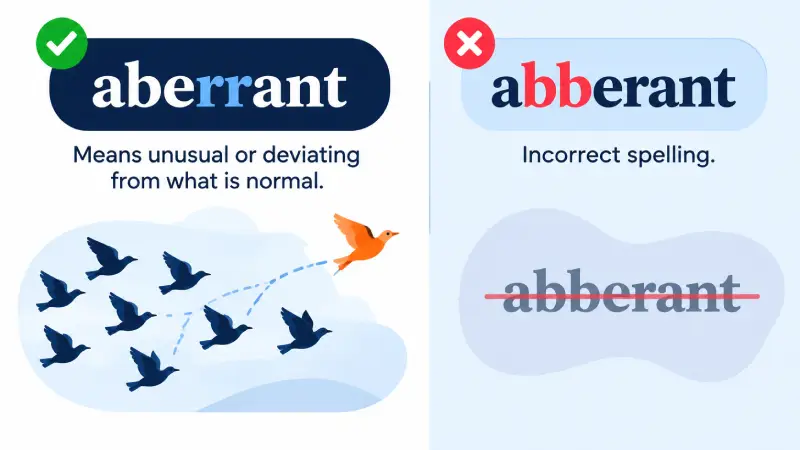
Aberrant is the correct spelling. Abberant is a common misspelling and is not the standard English form.
If you are wondering whether to write aberrant or abberant, choose aberrant. The word is an adjective that describes something unusual, abnormal, or different from what is expected or typical.
Quick Answer: Aberrant or Abberant?
The correct spelling is aberrant.
- Aberrant ✅ Correct
- Abberant ❌ Incorrect
The key spelling difference is the placement of the letters after ab. Aberrant contains one b and two r’s:
A-B-E-R-R-A-N-T
By contrast, abberant incorrectly uses two b’s and only one r.
Correct: The scientist noticed an aberrant result in the experiment.
Incorrect: The scientist noticed an abberant result in the experiment.
What Does Aberrant Mean?
Aberrant is an adjective meaning unusual, abnormal, or different from what is considered normal or expected.
It can describe behavior, results, patterns, actions, or other things that deviate from an established standard.
For example:
The test produced an aberrant result.
The researcher investigated an aberrant pattern in the data.
His aberrant behavior surprised everyone.
The word often appears in formal, academic, scientific, medical, or technical writing, although it can also be used in everyday English.
Why Is Abberant Incorrect?
Abberant is incorrect because it does not follow the standard spelling of the English word aberrant.
The correct spelling has:
- One b
- Two r’s
So the correct pattern is:
ab + e + rrant = aberrant
A common mistake is to double the b because English contains many words with doubled consonants. However, aberrant does not follow that pattern.
Remember:
Aberrant has one B and two R’s.
How Do You Spell Aberrant?
The correct spelling is:
A-B-E-R-R-A-N-T
That gives you:
aberrant
A useful way to remember it is to focus on the middle of the word:
abe + rrant
The word has rr, not bb.
Aberrant ✅
Abberant ❌
What Is the Meaning of Aberrant?
The meaning of aberrant is something that departs from what is normal, usual, or expected.
For example:
The doctor noticed an aberrant reading on the monitor.
The unusual result appeared to be an aberrant data point.
The team investigated the aberrant behavior.
In each example, aberrant describes something that does not fit the expected pattern.
Aberrant in Everyday English
Although aberrant is somewhat formal, it can be used in a variety of situations.
For example:
The company investigated an aberrant pattern in customer complaints.
One aberrant result affected the overall average.
The researcher removed an aberrant data point after further analysis.
His aberrant behavior was unusual for someone normally so calm.
The word is especially useful when you want to describe a deviation from a normal pattern without simply saying strange or unusual.
Aberrant in Scientific and Academic Writing
Aberrant is common in scientific and academic contexts because researchers often need to describe observations that differ from expected patterns.
For example:
The researchers identified an aberrant response during the experiment.
The software detected an aberrant value in the dataset.
An aberrant result required additional testing.
In these contexts, aberrant does not necessarily mean that something is wrong. It simply indicates that the observation differs from what is expected or typical.
Aberrant vs. Abnormal
Aberrant and abnormal can have similar meanings, but they are not always interchangeable in every context.
Abnormal generally means not normal or outside the usual range.
Aberrant emphasizes a deviation from an expected pattern, standard, path, or behavior.
For example:
The test showed an abnormal result.
The system detected an aberrant pattern.
Both words can describe something unusual, but aberrant often highlights the idea of deviation.
Aberrant vs. Unusual
Unusual is a broad and common word meaning not typical or ordinary.
Aberrant is more formal and often suggests that something has departed from an expected pattern.
Compare:
We noticed an unusual pattern.
We noticed an aberrant pattern in the data.
The first sentence is natural in everyday conversation. The second sounds more formal and technical.
Aberrant Examples
Here are several examples using the correct spelling.
The analyst discovered an aberrant value in the report.
Researchers studied the aberrant pattern carefully.
The machine detected an aberrant signal.
One aberrant observation required further investigation.
The unusual behavior appeared to be aberrant rather than typical.
These examples show how aberrant can describe different types of deviations.
Common Phrases With Aberrant
Aberrant behavior
This phrase describes behavior that differs from what is expected or considered normal.
The manager noticed aberrant behavior during the investigation.
Aberrant result
This refers to a result that differs from an expected result or pattern.
The laboratory repeated the test because of an aberrant result.
Aberrant pattern
This describes a pattern that deviates from the usual pattern.
The software detected an aberrant pattern in the data.
Aberrant value
This phrase is common in data analysis and scientific contexts.
The analyst checked the aberrant value before completing the report.
Aberrant response
This describes a response that differs from an expected response.
The researchers examined the aberrant response in greater detail.
Aberrant vs. Abberant Examples
The spelling difference becomes easier to see in complete sentences.
Correct
The scientist found an aberrant result.
The system detected an aberrant pattern.
His aberrant behavior attracted attention.
The researcher investigated an aberrant value.
The report describes an aberrant response.
Incorrect
The scientist found an abberant result.
The system detected an abberant pattern.
His abberant behavior attracted attention.
The researcher investigated an abberant value.
The report describes an abberant response.
In each incorrect example, abberant should be replaced with aberrant.
Is Aberrant a Correct Word?
Yes. Aberrant is a standard English adjective.
It describes something that differs from what is normal, expected, or typical.
For example:
The researcher identified an aberrant pattern.
The spelling abberant is not the standard form of the word.
How Do You Pronounce Aberrant?
In American English, aberrant is commonly pronounced approximately:
uh-BERR-uhnt
The pronunciation can vary slightly depending on the speaker and context. However, the spelling remains the same:
aberrant
Pronunciation can sometimes contribute to spelling mistakes, so remembering the written pattern is helpful.
How to Remember the Spelling Aberrant
The easiest spelling trick is:
One B, two R’s = aberrant.
Write it like this:
A-B-E-R-R-A-N-T
The important part is the middle:
ERR
Not:
BB
You can remember:
Aberrant breaks the usual pattern, but its spelling keeps one B and two R’s.
That distinction can help prevent the common mistake abberant.
Aberrant or Abberant in American English
For standard American English, use aberrant.
The spelling abberant is considered a misspelling rather than an alternative spelling. Therefore, use aberrant in professional documents, academic writing, articles, reports, emails, and other formal or informal English writing.
The standard spelling is also used in other major varieties of English.
Why Do People Spell Aberrant as Abberant?
The mistake usually happens because writers remember that the word contains a doubled consonant but place the double letters in the wrong position.
The correct word has:
one B + two R’s
That gives:
aberrant
A writer may instead double the b and write:
abberant
Because both versions look visually plausible at first glance, this can be an easy spelling error to make.
The best solution is to memorize the middle of the word:
-err-
Aberrant vs. Abberant: Quick Comparison
| Word | Correct? | Meaning |
|---|---|---|
| Aberrant | ✅ Yes | Unusual or different from what is expected or typical |
| Abberant | ❌ No | Common misspelling of aberrant |
The key difference is simple: aberrant has one B and two R’s.
FAQs
Is aberrant or abberant correct?
Aberrant is correct. Abberant is a common misspelling and should not be used in standard English.
How do you spell aberrant correctly?
The correct spelling is A-B-E-R-R-A-N-T: aberrant. It has one B and two R’s.
What does aberrant mean?
Aberrant means unusual, abnormal, or different from what is expected, normal, or typical.
Is abberant a word?
Abberant is not the standard spelling of the English adjective. The correct spelling is aberrant.
What is another word for aberrant?
Depending on the context, alternatives include unusual, abnormal, atypical, irregular, and deviant. The best choice depends on the meaning and tone of the sentence.
How do you use aberrant in a sentence?
You can use aberrant to describe something that differs from an expected pattern. For example: “The researcher noticed an aberrant result in the data.”
Conclusion
Aberrant is the correct spelling, while abberant is incorrect. The word aberrant is an adjective that describes something unusual, abnormal, or different from what is expected.
The easiest way to remember the spelling is:
Aberrant = one B + two R’s
So, whenever you are choosing between aberrant and abberant, use aberrant.

Olivia Smith is a US English writer and language enthusiast who specializes in spelling, word choice, and commonly confused words. She creates clear, practical guides that help readers understand the correct spelling, meaning, and usage of English words.
At GrammarPool.com, Olivia focuses on spelling-choice topics, common spelling mistakes, and easy-to-understand explanations for everyday English users. Her writing is designed to make confusing word choices simple, accurate, and easy to remember.
Expertise: US English, spelling, word choice, commonly confused words, grammar, and language usage.