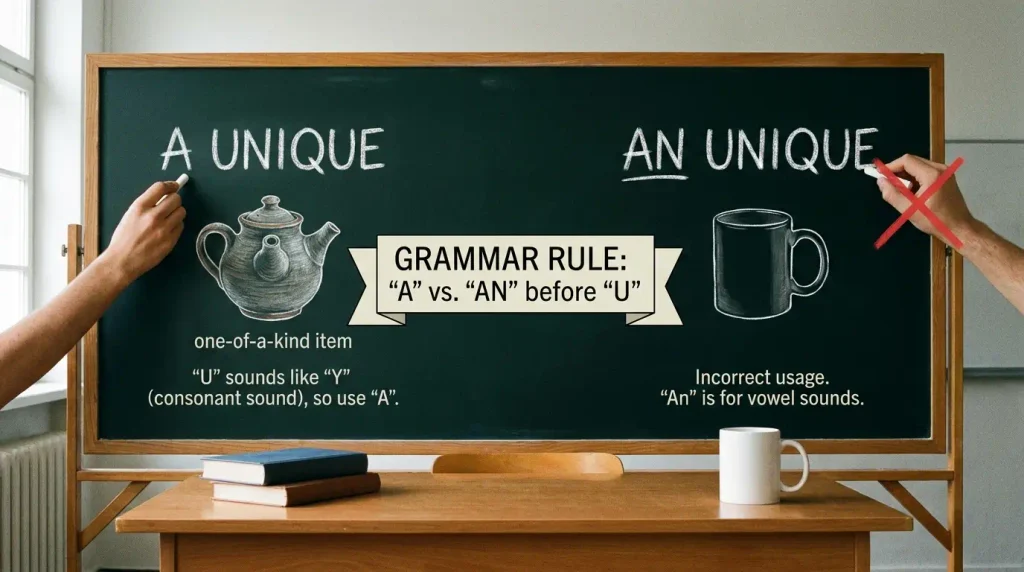
“A unique” is correct in standard English, while “an unique” is generally incorrect. The reason is that the article a or an depends on the initial sound of the following word, not simply its first letter.
The word unique begins with the consonant sound /y/, as in “you.” Therefore, you should write a unique idea, a unique opportunity, and a unique experience, not an unique idea or an unique opportunity.
The rule is simple: use a before unique because its first sound is a consonant sound, even though the word begins with the vowel letter u.
Quick Answer: A Unique or An Unique?
- Correct: A unique
- Generally incorrect: An unique
- Reason: Unique begins with a consonant sound, /y/.
- Part of speech: Unique is an adjective.
- Example: She has a unique talent for storytelling.
Remember that English articles depend on pronunciation rather than spelling alone. That is why we say a university and a uniform, but an umbrella and an unusual event.
What Does Unique Mean?
Unique is an adjective that means one of a kind, unlike anything else, or distinctive. It describes something that stands out because of its particular qualities, characteristics, design, or nature.
For example:
- She has a unique way of explaining difficult ideas.
- This museum displays a unique collection of historical objects.
- Every person has a unique personality.
- The artist created a unique design for the building.
- We had a unique opportunity to meet the author.
In each sentence, unique describes a person, object, quality, or experience. The article a comes before unique because the word begins with the consonant /y/ sound.
Why Is A Unique Correct?
The phrase a unique follows the standard English rule for indefinite articles.
English uses two indefinite articles: a and an. Although both can refer to something nonspecific, their use depends on the initial sound of the next word.
Use A Before a Consonant Sound
Use a when the next word begins with a consonant sound.
Examples include:
- A unique idea
- A useful tool
- A university student
- A European country
- A uniform design
- A one-time opportunity
Although unique, useful, university, and uniform begin with the letter u, they start with the /y/ consonant sound. Therefore, a is the correct article.
Use An Before a Vowel Sound
Use an when the next word begins with a vowel sound.
Examples include:
- An umbrella
- An unusual situation
- An urgent message
- An understanding person
- An interesting story
- An excellent opportunity
The difference is the sound at the beginning of the word, not the written vowel or consonant.
Why Is An Unique Generally Incorrect?
The phrase an unique is generally considered incorrect in standard modern English because unique normally begins with a consonant sound.
The word is commonly pronounced approximately as yoo-NEEK. Since the first sound resembles the beginning of you, it requires a, not an.
Compare these examples:
| Incorrect | Correct |
|---|---|
| An unique idea | A unique idea |
| An unique opportunity | A unique opportunity |
| An unique experience | A unique experience |
| An unique person | A unique person |
| An unique solution | A unique solution |
| An unique design | A unique design |
In formal writing, academic assignments, business communication, and professional articles, use a unique.
A Unique vs. An Unique: Key Differences
The difference between a unique and an unique concerns the correct use of English articles.
| Feature | A Unique | An Unique |
|---|---|---|
| Standard usage | Correct | Generally incorrect |
| Article rule | Used before a consonant sound | Used before a vowel sound |
| First sound of unique | /y/, a consonant sound | /y/, a consonant sound |
| Suitable for formal writing | Yes | No |
| Example | She found a unique solution. | She found an unique solution. |
The first sentence is grammatically correct. The second sentence should be revised to use a unique solution.
Examples of A Unique in Sentences
The following examples show how to use a unique naturally in everyday and professional English.
Everyday Examples
- My sister has a unique sense of style.
- We discovered a unique café during our trip.
- He has a unique ability to remember names.
- They live in a unique house near the lake.
- She gave me a unique gift for my birthday.
Academic and Professional Examples
- The researcher proposed a unique approach to the problem.
- Our company developed a unique marketing strategy.
- The student presented a unique perspective on the topic.
- The team found a unique way to improve productivity.
- The project offers a unique opportunity for collaboration.
Creative Writing Examples
- The novel follows a unique character who travels between worlds.
- The painter developed a unique visual style.
- The garden features a unique combination of colors and textures.
- The story presents a unique interpretation of an old legend.
- The musician created a unique sound by combining different instruments.
All these sentences use a correctly because unique begins with a consonant sound.
Other Words That Follow the Same Rule
Unique is not the only word that begins with a vowel letter but takes a instead of an. Several other English words follow the same pronunciation-based rule.
| Word or phrase | Correct example | Reason |
|---|---|---|
| University | A university | Begins with /y/ |
| Uniform | A uniform | Begins with /y/ |
| Useful | A useful tool | Begins with /y/ |
| European | A European visitor | Begins with /y/ |
| Unusual | An unusual event | Begins with a vowel sound |
| Umbrella | An umbrella | Begins with a vowel sound |
| Hour | An hour | The initial h is silent |
| Honest | An honest answer | The initial h is silent |
These examples demonstrate why you should listen to the first sound rather than rely only on the first letter.
Common Mistakes to Avoid
When choosing between a and an, avoid these common errors.
- Choosing an based only on the letter u: Not every word beginning with u requires an. For example, write a unique idea.
- Assuming an always sounds more natural before a vowel letter: The article must match the actual initial sound.
- Ignoring pronunciation: Words such as university and unique begin with a /y/ sound.
- Using an unique in formal writing: Replace it with a unique for standard grammatical usage.
- Applying the rule inconsistently: Use the same sound-based principle throughout your writing.
A helpful way to check your sentence is to say the word aloud. If the first sound is a consonant, use a. If it is a vowel sound, use an.
Frequently Asked Questions (FAQs)
Is A Unique or An Unique Correct?
A unique is correct in standard English. The word unique begins with the consonant /y/ sound, so it takes a rather than an.
Why Do We Say A Unique Instead of An Unique?
We say a unique because the word begins with a /y/ consonant sound, similar to the beginning of you. English articles depend on sounds rather than the first written letter.
Is Unique a Vowel or a Consonant Sound?
Unique begins with a consonant sound, /y/, even though its first written letter is the vowel u. That is why the correct phrase is a unique.
Can I Write An Unique in Formal English?
In standard modern English, avoid an unique. Use a unique in essays, professional documents, articles, emails, and other formal writing.
Is It A Unique Opportunity or An Unique Opportunity?
The correct phrase is a unique opportunity. The word unique begins with a consonant sound, so a is the appropriate article.
What Is the Rule for A and An?
Use a before a consonant sound and an before a vowel sound. For example, write a unique idea, but an unusual idea.
Final Thoughts
A unique is the correct phrase, while an unique is generally incorrect in standard English. The key is to remember that a and an depend on pronunciation, not spelling alone. Since unique begins with the consonant /y/ sound, always use a unique idea, a unique experience, or a unique opportunity in standard writing.

Olivia Smith is a US English writer and language enthusiast who specializes in spelling, word choice, and commonly confused words. She creates clear, practical guides that help readers understand the correct spelling, meaning, and usage of English words.
At GrammarPool.com, Olivia focuses on spelling-choice topics, common spelling mistakes, and easy-to-understand explanations for everyday English users. Her writing is designed to make confusing word choices simple, accurate, and easy to remember.
Expertise: US English, spelling, word choice, commonly confused words, grammar, and language usage.