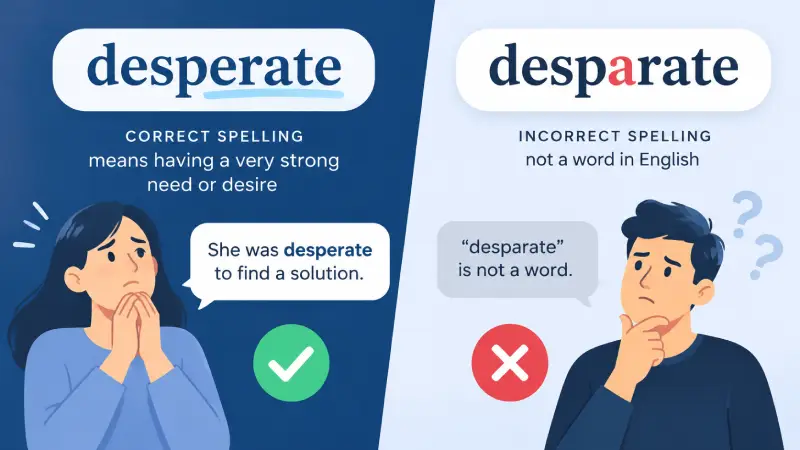
Desperate is the correct spelling. Desparate is a common misspelling and is not the standard spelling of the adjective meaning “having a great need,” “feeling hopeless,” or “extremely serious.”
Quick answer:
✅ desperate
❌ desparate
Why Is Desperate the Correct Spelling?
The standard spelling is desperate, with -perate in the middle:
d-e-s-p-e-r-a-t-e
The incorrect form desparate drops the e after the p:
d-e-s-p-a-r-a-t-e
That small spelling difference is easy to miss, especially because the pronunciation of desperate does not clearly emphasize every written vowel.
Desperate is an adjective. It can describe a person who has little or no hope, someone who needs or wants something very strongly, a dangerous or serious situation, or an extreme attempt made when other options have failed. Major American-English dictionaries recognize these uses.
For example:
She was desperate for a job.
Here, desperate describes her urgent need for employment.
The team made a desperate attempt to finish the project.
Here, desperate describes an extreme or last-resort effort.
What Does Desperate Mean?
Desperate has several related meanings, so it appears in many different kinds of American English writing.
1. Having a Very Strong Need or Desire
Someone can be desperate for something when they need or want it very badly.
I’m desperate for some sleep.
She was desperate for good news.
The company is desperate for new customers.
He became desperate for a second chance.
The structure desperate for + noun is especially common.
You can also use:
desperate + to + verb
She was desperate to find her missing phone.
He was desperate to prove himself.
They were desperate to leave before the storm arrived.
Oxford’s American English dictionary specifically records the patterns desperate for something and desperate to do something.
2. Feeling That There Is Little or No Hope
Desperate can describe a person who feels that a situation has become extremely difficult or hopeless.
The stranded hikers were becoming desperate.
She felt desperate after receiving the rejection.
The family grew desperate when they could not contact him.
In this sense, the word describes an emotional or psychological response to a difficult situation without requiring the person to take reckless action.
3. Extremely Serious or Dangerous
A situation can also be desperate when it is extremely serious.
The hospital faced a desperate shortage of supplies.
The neighborhood was in desperate need of clean water.
The company was in a desperate financial situation.
American Heritage includes senses of desperate involving critical or nearly hopeless conditions.
4. A Last-Resort or Extreme Attempt
The adjective often describes an action taken when ordinary solutions have failed.
The rescue team made a desperate attempt to reach the hikers.
She made a desperate effort to meet the deadline.
The players made a desperate attempt to score before the clock ran out.
He took desperate measures to protect his business.
Oxford identifies this use for actions that offer little hope of success or are attempted after other options have failed.
Desperate Is an Adjective
One reason desperate can appear in so many sentences is that it is an adjective.
An adjective describes a noun or, in some structures, gives information about the subject.
Compare:
It was a desperate situation.
Here, desperate describes the noun situation.
The situation became desperate.
- Here, desperate follows the linking verb became and describes the subject situation.
She felt desperate.
- Here, desperate describes how she felt.
The related adverb is desperately.
She desperately needed help.
The related noun is desperation.
His desperation was obvious.
These forms should not be confused:
- desperate = adjective
- desperately = adverb
- desperation = noun
Desperate vs. Desparate
There is no meaning distinction between desperate and desparate in standard modern American English because desparate is not the standard spelling of this word.
The correct form is:
desperate
The commonly seen incorrect form is:
desparate
For example:
❌ She was desparate for an answer.
✅ She was desperate for an answer.
And:
❌ They made a desparate attempt to escape.
✅ They made a desperate attempt to escape.
If you are using the word to mean “extremely needy,” “hopeless,” “serious,” or “last-resort,” spell it desperate.
Desperate in Everyday American English
The word is very common in ordinary conversation.
I’m desperate for a cup of coffee.
She’s desperate to hear from her family.
We were desperate for a break.
He was desperate to find his keys.
They were desperate for good news.
In casual speech, desperate can sometimes be used less literally to emphasize a strong desire.
For example:
I’m desperate for a vacation.
This does not necessarily mean the speaker has literally lost all hope. It can simply emphasize how strongly the person wants a vacation.
Desperate in Professional Writing
Desperate is also appropriate in professional and business contexts when the situation genuinely involves serious need, urgency, or an extreme response.
The company was desperate for additional funding.
The organization is in desperate need of volunteers.
The team made a desperate effort to meet the deadline.
The manufacturer faced a desperate shortage of materials.
However, professional writers should choose the word carefully. Calling a business strategy desperate, for example, can communicate a strongly negative judgment.
Compare:
The company made a last-minute attempt to increase sales.
with:
The company made a desperate attempt to increase sales.
The second sentence suggests a much greater sense of urgency and limited options.
Desperate in School Writing
The word can be useful in essays, narratives, literary analysis, and other school writing.
The character becomes increasingly desperate as the story progresses.
The soldiers make a desperate attempt to defend the town.
The novel portrays a family living in desperate conditions.
Her desperate search for answers drives the story forward.
When writing academically, use desperate when the context supports its meaning rather than using it simply as a stronger synonym for bad.
Desperate in Text Messages
The same spelling applies in informal messages.
I’m desperate for sleep 😂
I’m desperate to know what happened.
We were desperate for food after the hike.
He’s desperate to get that job.
Informal writing may shorten words or ignore some punctuation, but desperate remains the standard spelling.
Common Mistakes With Desperate
Mistake 1: Writing Desparate
This is the most direct spelling error.
❌ I am desparate for help.
✅ I am desperate for help.
The key is to remember the e after p:
des-p-e-rate
Mistake 2: Writing Despirate
Another spelling sometimes produced by pronunciation is despirate.
❌ She was despirate to find a solution.
✅ She was desperate to find a solution.
The standard spelling contains pera, not pira.
Mistake 3: Confusing Desperate With Disparate
This is a different word entirely.
Desperate relates to extreme need, urgency, hopelessness, or risky action.
Disparate means noticeably different or unrelated.
The family was desperate for help.
The two groups had disparate goals.
These words look somewhat similar, but their meanings are completely different.
Mistake 4: Forgetting the Second E
Writers sometimes remember the beginning and ending of the word but lose the internal vowel:
❌ desparate
❌ despirate
✅ desperate
When proofreading, look specifically at the middle:
des-p-e-rate
Why Is Desperate So Often Misspelled?
The pronunciation helps explain some of the confusion.
In American English, desperate is commonly pronounced approximately DES-per-it, so the written a in the second syllable may not sound like a clearly pronounced “a.” American Heritage gives pronunciations reflecting this reduced vowel pattern.
As a result, someone spelling the word from sound may be tempted to write a form such as desparate.
English spelling cannot always be reconstructed perfectly from pronunciation. For frequently used words such as desperate, learning the established spelling is more reliable than trying to spell every syllable exactly as it sounds.
How to Remember the Spelling of Desperate
A useful memory trick is to connect desperate with despair.
The two words are historically related. American Heritage traces desperate through Middle English to Latin dēspērātus, related to dēspērāre, “to despair.”
You do not need to remember the Latin history to spell the word, but the connection can help:
despair → desperate
Another simple spelling pattern is:
DES + PER + ATE
Think:
des-PER-ate
not:
des-PAR-ate
The middle e is the letter people most often leave out.
A Fast Spelling Test
If you are unsure whether to write desperate or desparate, pause after desp:
desp + e + rate
That gives:
desperate
You can also connect it with the related forms:
- desperate
- desperately
- desperation
Seeing the family together makes the spelling easier to recognize.
She was desperate for help and desperately searched for a solution, but her desperation continued to grow.
Notice that all three forms retain the desper- spelling.
Desperate vs. Despairing
These words can overlap, but they are not always interchangeable.
Despairing emphasizes a loss of hope.
She gave a despairing look.
Desperate can include hopelessness, but it can also emphasize urgent need or willingness to take extreme action.
She made a desperate attempt to save the project.
American Heritage lists desperate as involving despair as well as extreme urgency, need, and other related meanings.
Desperate vs. Urgent
Urgent means something requires immediate attention.
Desperate can communicate urgency, but it usually adds a stronger sense of serious need, limited options, distress, or hopelessness.
Compare:
We have an urgent need for volunteers.
This says the need requires quick attention.
We have a desperate need for volunteers.
This suggests the need is extremely serious and pressing.
The two words can overlap, but desperate generally carries more emotional or extreme force.
Desperate vs. Disparate
This is one of the most important related spelling confusions.
Desperate means extremely needy, serious, hopeless, or urgent.
Disparate means fundamentally different or belonging to different categories.
The patient was in desperate need of treatment.
The study compared two disparate groups.
A good memory aid is:
desperate = distress
disparate = different
Do not substitute one for the other.
Real-World Examples
In a Text Conversation
Nina: Did you find another apartment?
Marcus: Not yet. I’m getting desperate because my lease ends next week.
Nina: I saw a listing this morning. I’ll send it to you.
Here, desperate describes Marcus’s increasing urgency and concern.
In a Workplace Update
The team had only two days left before launch. After discovering a serious technical problem, the developers made a desperate effort to identify the cause and restore the system.
The adjective describes an extreme effort made under serious pressure.
In an Article
After several days without reliable information, the missing hiker’s family became increasingly desperate for news. Search teams continued working through the night.
Here, desperate expresses intense need and distress.
FAQ
Is desperate or desparate correct?
Desperate is correct. Desparate is a common misspelling and should not be used as the standard spelling of the word.
Why do people spell desperate as desparate?
The pronunciation can make the middle vowel difficult to hear clearly, so writers may spell the word according to how it sounds. The standard written form is desperate.
What does desperate mean?
Desperate can mean having little hope, needing or wanting something very strongly, facing an extremely serious situation, or making an extreme or last-resort attempt.
Is desperate an adjective?
Yes. Desperate is primarily an adjective. Its related forms include desperately, an adverb, and desperation, a noun.
Is desperate related to despair?
Yes. The words are historically related. Desperate comes through Middle English from Latin dēspērātus, related to the verb meaning “to despair.”
Quick-Reference Takeaway
| Word | Correct? | Meaning |
|---|---|---|
| desperate | ✅ Yes | Extremely needy, urgent, serious, hopeless, or last-resort |
| desparate | ❌ No | Common misspelling of desperate |
| desperately | ✅ Yes | In a desperate manner; to an extreme degree |
| desperation | ✅ Yes | A state of being desperate |
| disparate | ✅ Yes | Fundamentally different or distinct |
Remember:
DES-PER-ATE = desperate
If you mean “in urgent need,” “without much hope,” “extremely serious,” or “an extreme attempt,” the correct spelling is desperate, not desparate.

Olivia Smith is a US English writer and language enthusiast who specializes in spelling, word choice, and commonly confused words. She creates clear, practical guides that help readers understand the correct spelling, meaning, and usage of English words.
At GrammarPool.com, Olivia focuses on spelling-choice topics, common spelling mistakes, and easy-to-understand explanations for everyday English users. Her writing is designed to make confusing word choices simple, accurate, and easy to remember.
Expertise: US English, spelling, word choice, commonly confused words, grammar, and language usage.