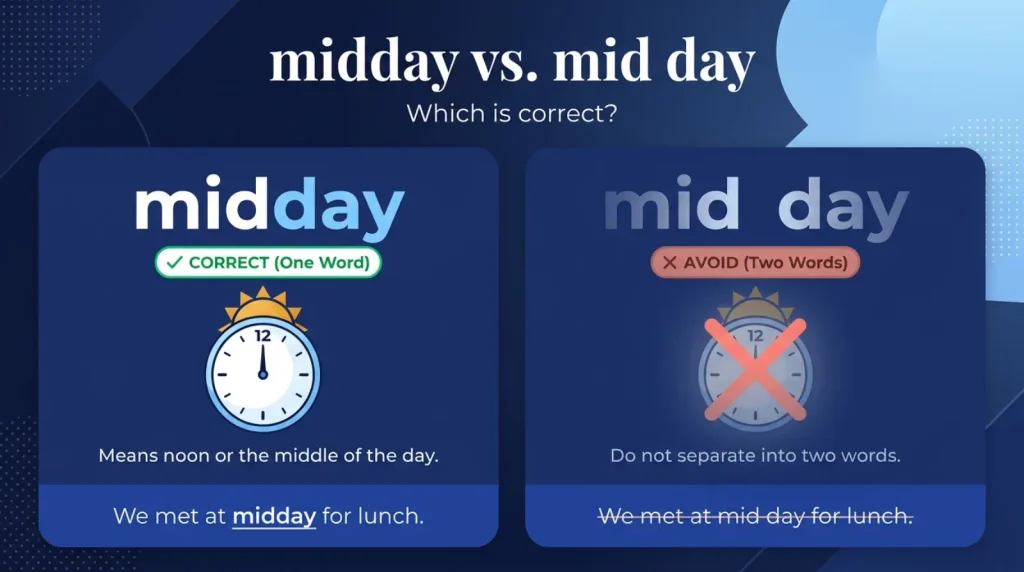
Midday is the standard spelling in American English when referring to noon or the period around the middle of the day. Mid day is generally not the preferred spelling for this meaning, although the hyphenated form mid-day appears in some publications and older texts.
For everyday writing, choose midday. For example, write “The meeting starts at midday,” not “The meeting starts at mid day.” The distinction is primarily about compound-word spelling, not a difference between two separate meanings.
What Does Midday Mean?
Midday is a noun that refers to noon or the period around noon. It can also function as an adjective when it describes something that happens or exists around that time.
The word combines mid, meaning the middle, and day. Although these elements have separate meanings, standard modern English generally treats their combination as one word.
Consider these examples:
- Noun: We usually eat lunch at midday.
- Adjective: The midday sun made the sidewalk unbearably hot.
- General time reference: The delivery should arrive by midday.
- Descriptive use: The midday heat forced the hikers to rest.
The meaning can be exact or approximate, depending on context. Some speakers use midday to mean precisely noon, while others use it for the surrounding period.
For example, a weather forecast might say, “Rain will reach the city around midday.” This does not necessarily mean that the rain will begin at exactly 12:00 p.m. In contrast, a meeting invitation that specifies “12:00 p.m. Eastern Time” gives a more precise time.
Midday vs. Mid Day: The Main Difference
The primary difference is the spelling convention.
Midday is the established closed compound for the time around noon. It is suitable for casual messages, academic assignments, professional emails, news reports, and formal writing.
Mid day, written as two separate words, is not the usual standard form when expressing this meaning. Writers sometimes separate the elements because they appear to be two independent words, but that does not make the open spelling the preferred choice.
The hyphenated spelling mid-day also occurs, particularly in older material or publications that follow a specific house style. However, most general contemporary writing can use midday without a hyphen.
| Feature | Midday | Mid day |
|---|---|---|
| Standard modern spelling | Yes | Generally not preferred |
| Meaning | Noon or the period around noon | Usually intended to express the same meaning |
| Part of speech | Noun and adjective | No established separate-word function for the ordinary meaning |
| Example | We arrived at midday. | Prefer: We arrived at midday. |
| Professional writing | Recommended | Usually revise to midday |
| Exact timing | Can be approximate or exact, depending on context | Does not provide greater precision |
The important point is that this is not a case like affect versus effect, where the words have different functions and meanings. Instead, it concerns the conventional spelling of a compound word.
When Should You Use Midday?
Use midday whenever you mean noon or the period surrounding it. The following examples demonstrate how the word works in different situations.
1. Everyday Conversation
In ordinary conversation, midday helps people discuss plans without specifying an exact clock time.
- I’ll meet you outside the library around midday.
- We left early to avoid driving in the midday heat.
- She usually takes her lunch break just before midday.
- The children returned home shortly after midday.
- Can you pick up the groceries before midday?
In each sentence, midday identifies a general time or period. If the plans require a precise appointment, a clock time may be more helpful.
2. Business and Professional Writing
Professional communication often uses midday for deadlines, meetings, deliveries, and scheduled announcements.
- Please submit the revised proposal by midday tomorrow.
- The team will review the new marketing plan during the midday meeting.
- Our supplier expects the shipment to reach the warehouse around midday.
- Management plans to release the announcement shortly after midday.
- The office will close at midday on Friday.
The expression by midday is particularly useful for deadlines. It means the task should be completed no later than the intended midday point.
However, if a deadline has legal or financial consequences, specify the exact time and relevant time zone. A deadline of “12:00 p.m. on October 30, Eastern Time” leaves less room for interpretation than “by midday.”
3. School and Academic Writing
Students can use midday naturally in essays, reports, descriptions, and research writing.
- The researchers recorded the temperature at midday and again in the evening.
- Students gathered in the courtyard during their midday break.
- The experiment produced different results under the midday sun.
- Several bird species became less active during the hottest part of the day.
- The school cafeteria begins serving lunch shortly before midday.
In scientific writing, distinguish between a general description and a measured observation. Midday may be sufficient when describing a broad daily pattern, but an experiment may require a timestamp such as 12:15 p.m.
4. News and Weather Reports
Weather forecasts and news reports frequently use midday to communicate approximate timing.
- Heavy showers are expected to reach the region by midday.
- Officials scheduled a midday press conference to discuss the emergency.
- Temperatures could approach 95 degrees by midday.
- The road reopened shortly before midday, according to the announcement.
- A midday update will provide more information about the storm.
These examples show why midday is useful: it communicates a recognizable part of the day without requiring an exact minute.
Midday as a Noun and an Adjective
Understanding the word’s grammatical function helps you use it confidently in different sentence structures.
Midday as a Noun
A noun names a person, place, thing, idea, or period. As a noun, midday identifies the middle of the day.
Examples:
- Midday arrived before the hikers reached the summit.
- We expect the technician to arrive around midday.
- The temperature often peaks near midday during the summer.
- By midday, the waiting room was nearly full.
- The store receives its largest lunch-hour crowd around midday.
The word commonly appears after prepositions such as at, by, around, before, and after.
These expressions serve different purposes:
- At midday: Identifies when something happens.
- By midday: Sets a deadline or endpoint.
- Around midday: Indicates an approximate time.
- Before midday: Places an event earlier than the intended midday point.
- After midday: Places an event later than that point.
For example, “The report must be ready by midday” establishes a deadline, while “The report arrived after midday” describes when it arrived.
Midday as an Adjective
An adjective describes a noun. When midday appears before another noun, it identifies something associated with that part of the day.
Examples:
- The midday sun made the outdoor ceremony uncomfortable.
- We scheduled a shorter midday break for the staff.
- She listened to the midday news while preparing lunch.
- The midday temperature exceeded the morning reading.
- Visitors should bring water during the midday hours.
The spelling remains midday whether the word functions as a noun or an adjective. Its grammatical role does not require a space or a hyphen.
Common Midday Spelling Mistakes
Several habits can lead writers to use mid day instead of midday. Recognizing these patterns makes proofreading easier.
Mistake 1: Separating the Two Elements
Because mid and day can each appear as independent words, writers may assume they should remain separate when combined.
Incorrect for standard general writing: “We expect the package to arrive by mid day.”
Preferred: “We expect the package to arrive by midday.”
How to avoid it: Remember that midday is an established compound, just like sunlight and weekend. Its spelling is conventional rather than determined by whether its elements can stand alone.
Mistake 2: Adding a Space Before a Noun
Some writers correctly use midday as a noun but separate the word when using it as a modifier.
Less suitable: “The mid day sun was unusually strong.”
Preferred: “The midday sun was unusually strong.”
How to avoid it: Keep the spelling consistent in both grammatical roles. The word remains closed when it modifies sun, break, meeting, or news.
Mistake 3: Assuming a Hyphen Is Necessary
A writer may encounter mid-day in an older book and assume that the hyphen is mandatory.
Less suitable for most current general writing: “We scheduled a mid-day appointment.”
Preferred: “We scheduled a midday appointment.”
How to avoid it: Follow the publication’s style guide. If no specific rule applies, use the standard modern spelling midday.
Mistake 4: Confusing Midday With an Exact Clock Time
A writer may use midday for an appointment that requires minute-level accuracy.
Less precise: “Your interview begins at midday.”
More precise: “Your interview begins at 12:15 p.m.”
How to avoid it: Decide whether the reader needs a general period or an exact time. The spelling of midday does not determine how precisely the time is defined.
How to Remember the Correct Spelling
Two simple methods can help you remember the difference.
Memory trick 1: Think of midday as one established unit.
Just as sunrise and sunset are written as single words, midday is normally written as one word. Remember the complete form rather than assembling it from two separate elements every time you write it.
Memory trick 2: Replace midday with noon.
If the sentence still makes sense when you substitute noon, you probably need the standard word midday, not the two-word form.
For example:
- “The meeting starts at midday.”
- “The meeting starts at noon.”
Both sentences work, although midday may refer to a broader period in some contexts.
This substitution test helps confirm the intended meaning. It does not mean the words always have exactly the same range of meaning.
Midday vs. Noon, Noontime, and Midnight
These related expressions describe different aspects of time. Understanding them helps you choose the most precise word for your sentence.
Midday vs. Noon
Noon usually refers directly to 12 o’clock in the daytime. Midday can refer to noon or the surrounding period.
For example, “The appointment is at noon” sounds precise, while “We should arrive around midday” allows more flexibility.
Both are standard American English. Choose noon when you mean the clock time and midday when a broader description is suitable.
Midday vs. Noontime
Noontime refers to the time around noon. It is a valid word, although noon and midday may sound more concise in many sentences.
For example:
- We usually eat lunch at noontime.
- We usually eat lunch at midday.
Both sentences are understandable. The choice depends on the tone and rhythm of the writing.
Midday vs. Midnight
Midday refers to noon or the middle of the daytime period. Midnight refers to 12 o’clock at night.
Compare these sentences:
- The outdoor festival begins at midday.
- The online submission deadline expires at midnight.
- We reached the campsite around midday.
- Our flight arrived shortly after midnight.
Confusing these words can cause serious scheduling mistakes. When communicating travel plans, deadlines, or appointments, consider including an exact time and date.
Midday vs. Midmorning and Midafternoon
Midmorning refers to the middle portion of the morning, while midafternoon refers to the middle portion of the afternoon.
For example, a schedule might say, “The first inspection is planned for midmorning, lunch will take place at midday, and the final inspection is scheduled for midafternoon.”
These compounds communicate approximate periods rather than precise clock times. They are useful in schedules and descriptions when exact minutes are unnecessary.
Midday in Real-World Contexts
Example 1: A Text Conversation
Maya: Are we still meeting at the park today?
Jordan: Yes. Let’s meet around midday instead of 10 a.m.
Maya: Sounds good. I’ll bring lunch.
Here, midday gives both people a general time for their plans without requiring a specific appointment minute.
Example 2: A Professional Email
Subject: Updated Project Schedule
Hi Taylor,
I’ve revised the project timeline to include the latest client feedback. Please review the document by midday tomorrow so we can discuss any changes during our afternoon call.
Thanks,
Morgan
The word is appropriate for a professional deadline when the intended time is sufficiently clear. For a strict contractual deadline, a precise time and time zone would be better.
Example 3: A Weather Report
Clear skies are expected through the morning, but cloud cover will increase by midday. Temperatures may reach their daily high during the early afternoon, with scattered showers possible later in the day.
This example uses midday as an approximate time marker. It does not promise that cloud cover will increase at exactly 12:00 p.m.
Frequently Asked Questions
Is midday one word or two?
Midday is one word in standard modern American English. Use it to refer to noon or the period around noon.
Is mid day grammatically incorrect?
The issue is mainly spelling, not grammar. In ordinary contemporary writing, midday is the established form, while mid day is generally not preferred for the same meaning.
Is mid-day correct?
The hyphenated form mid-day appears in some older texts and particular editorial styles. However, midday is the preferred form for most modern general writing.
Does midday mean exactly 12 p.m.?
Not necessarily. Midday can refer to noon precisely or to the broader period around noon. Use an exact clock time when precision matters.
Should I write midday sun or mid day sun?
Write midday sun. The compound remains one word when it modifies another noun.
Quick Reference: Midday vs. Mid Day
- Correct standard spelling: Midday
- Meaning: Noon or the period around noon
- Part of speech: Noun and adjective
- Correct example: We expect to arrive by midday.
- Correct compound: The midday sun was intense.
- Generally avoid: Mid day
- Related distinction: Noon usually identifies 12 o’clock directly, while midday can refer to a broader period.
Final verdict: Use midday, not mid day, in standard American English. Whether you are writing an email, a school assignment, a business report, or an everyday message, the one-word spelling is the clearest and most conventional choice.