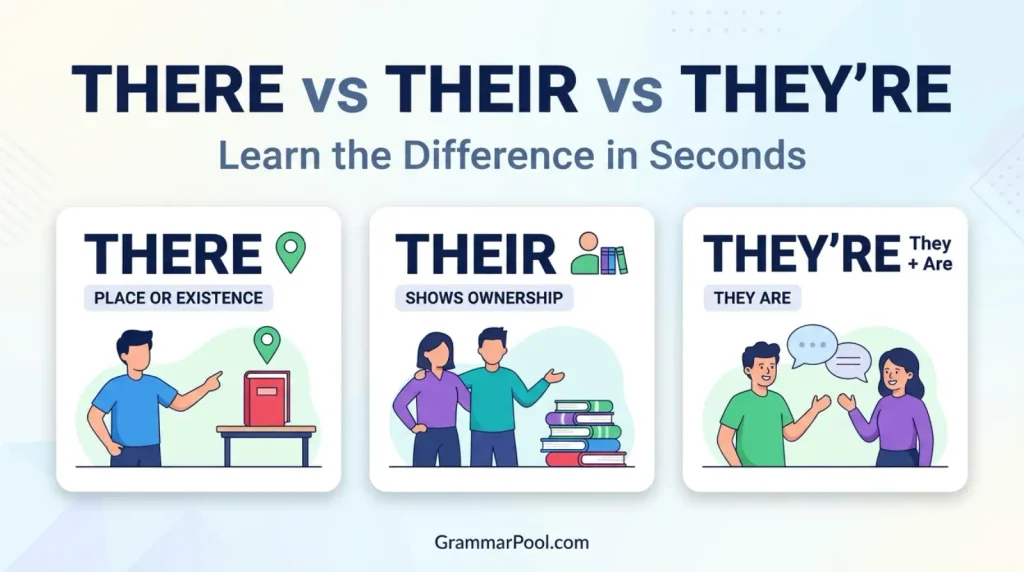
There vs their vs they’re is a common English grammar confusion because all three words sound exactly alike in most varieties of spoken English. However, they have different meanings and grammatical functions. There refers to a place or introduces something, their shows possession, and they’re is a contraction of they are.
For example, “Put the books there,” “Those are their books,” and “They’re reading their books” are all correct. The easiest way to choose the right word is to understand what your sentence means rather than relying on pronunciation.
Quick Answer: There vs Their vs They’re
- There: Refers to a place or introduces a sentence or statement. Example: The keys are over there.
- Their: Shows that something belongs to two or more people, animals, or things. Example: The students forgot their notebooks.
- They’re: A contraction meaning they are. Example: They’re waiting outside.
Remember this simple rule: there = place or existence, their = possession, they’re = they are.
What Does There Mean?
There is commonly used as an adverb referring to a place. It can also function as an introductory word that indicates the existence or presence of something.
The correct meaning depends on how you use it in a sentence. When there refers to a location, it often answers the question “Where?” When it introduces an idea about existence, it helps communicate that something exists, happens, or becomes available.
1. There as a Word for a Place
Use there when referring to a particular location, especially one away from the speaker or already identified in the conversation.
Examples:
- Please leave your shoes there by the door.
- I saw your brother standing there after school.
- The nearest gas station is over there.
- We visited the museum yesterday, and the guide met us there.
- If you put the groceries there, I can organize them later.
- The restaurant looks beautiful from there.
In each example, there identifies a location. You could often replace it with a specific place name or phrase without changing the basic meaning.
For example, “Leave your shoes there” could become “Leave your shoes by the door.”
2. There to Show That Something Exists
There also appears in sentences that introduce the existence or presence of something. This construction is especially common with the verb be, including is, are, was, and were.
Examples:
- There is a message waiting for you.
- There are several ways to solve this problem.
- There was a power outage last night.
- There were three packages outside the house.
- There will be a meeting on Friday.
- There has been a change in the schedule.
In these sentences, there does not identify a physical location. Instead, it introduces something that exists or happens.
Notice the difference between these two examples:
- There is a dog outside.
- The dog is there.
The first sentence introduces the dog’s presence. The second tells you where the dog is.
3. Common Mistakes With There
A frequent error occurs when writers use their or they’re in a sentence that refers to a place or introduces existence.
Incorrect: Their are several books on the table.
Correct: There are several books on the table.
Incorrect: Put the bags over their.
Correct: Put the bags over there.
To avoid these mistakes, check whether the sentence refers to a location or states that something exists. If it does, there may be the correct choice.
What Does Their Mean?
Their is a possessive determiner. It shows that something belongs to, is associated with, or is connected to multiple people, animals, or things.
It usually appears before a noun, such as house, car, ideas, children, or responsibilities. Unlike there, which can refer to a place, their establishes a relationship between the noun and its owner or owners.
1. Their to Show Ownership
Use their when talking about something belonging to other people or something associated with them.
Examples:
- The children packed their lunches before leaving.
- My neighbors painted their house last weekend.
- The employees submitted their reports on time.
- The players celebrated their victory after the game.
- The students brought their laptops to class.
- The dogs wagged their tails when the family returned.
In every example, their connects the noun to the people or animals associated with it.
For instance, “their lunches” means the lunches belonging to the children. Similarly, “their victory” means the victory achieved by the players.
2. Their With Singular They
Although their often refers to multiple owners, it can also refer to one person when that person uses they/them pronouns or when the person’s gender is unknown or irrelevant.
Examples:
- Someone left their phone on the counter.
- Every applicant should bring their identification.
- Jordan said their appointment starts at noon.
- If a customer has a question, direct them to their account page.
Singular their is widely accepted in contemporary English. It is useful when you do not know someone’s gender, when gender is not relevant, or when referring to a person who uses they/them pronouns.
Therefore, it is incorrect to assume that their always requires multiple owners.
3. Their in Professional and Academic Writing
Their is equally useful in casual conversation, business communication, and formal writing.
Consider these examples:
- Employees must review their benefits before enrollment.
- Each department is responsible for their assigned tasks.
- Researchers should explain their methods clearly.
- Customers can update their contact information online.
The third example refers to researchers collectively. The other examples illustrate common workplace and administrative contexts.
For singular antecedents such as each employee, the choice between singular their and a construction using his or her can depend on the sentence, house style, and intended meaning. Singular their is generally a natural, inclusive option in modern American English.
4. Common Mistakes With Their
Writers sometimes use there or they’re before a noun when they mean ownership.
Incorrect: The students forgot there homework.
Correct: The students forgot their homework.
Incorrect: They’re house needs a new roof.
Correct: Their house needs a new roof.
A helpful clue is the word immediately following their. If it is a noun that belongs to or is associated with someone, their may be the correct choice.
What Does They’re Mean?
They’re is a contraction of they are. A contraction combines words and replaces omitted letters with an apostrophe.
In this case, the apostrophe marks the missing letters in are. The meaning remains the same whether you write they are or they’re.
Examples:
- They’re coming to dinner tonight.
- They’re excited about the new project.
- They’re working on a school assignment.
- They’re planning a trip for next summer.
- They’re ready to begin the presentation.
- They’re going to arrive a little late.
Each sentence works with the expanded form they are.
For example, “They’re coming to dinner tonight” means “They are coming to dinner tonight.”
1. They’re With Actions
Use they’re when they are is followed by a present participle ending in -ing.
Examples:
- They’re preparing dinner for their guests.
- They’re studying for the final exam.
- They’re building a new website.
- They’re waiting for the bus.
- They’re discussing the results of the experiment.
In these examples, they’re introduces an ongoing action.
2. They’re With Descriptions
They’re can also introduce a description using an adjective or a noun phrase.
Examples:
- They’re happy with the results.
- They’re very talented musicians.
- They’re ready for the interview.
- They’re excellent teammates.
- They’re the people we met yesterday.
The word are acts as a linking verb, connecting the subject they to a description or identification.
3. The They’re Replacement Test
One of the easiest ways to check they’re is to replace it with they are.
If the sentence remains grammatically correct and keeps its intended meaning, they’re is probably correct.
Correct: They’re waiting outside.
Replacement: They are waiting outside.
The sentence works, so they’re is correct.
Incorrect: They’re car is parked outside.
Replacement: They are car is parked outside.
The replacement does not work. The sentence expresses ownership, so the correct word is their: “Their car is parked outside.”
This test is especially useful when writing quickly, texting, or proofreading an article.
There vs Their vs They’re: Side-by-Side Comparison
| Feature | There | Their | They’re |
|---|---|---|---|
| Meaning | A place or existence | Ownership or association | They are |
| Grammatical function | Adverb or introductory word | Possessive determiner | Contraction |
| Usually followed by | A place reference or verb phrase | A noun | An adjective, noun phrase, or -ing verb |
| Example | The keys are there. | It is their car. | They’re driving home. |
| Quick test | Does it refer to a place or existence? | Does it show possession? | Can you replace it with “they are”? |
Although these words sound alike, their grammatical roles differ. Choosing the correct spelling requires understanding what the sentence communicates.
Common Mistakes: There vs Their vs They’re
Mistake 1: Using There Instead of Their
Incorrect: The children put there backpacks away.
Correct: The children put their backpacks away.
The sentence refers to backpacks belonging to the children. Therefore, their is required.
Mistake 2: Using Their Instead of They’re
Incorrect: Their going to the movies tonight.
Correct: They’re going to the movies tonight.
The sentence means “They are going to the movies tonight.” Since the words they are fit naturally, use they’re.
Mistake 3: Using They’re Instead of There
Incorrect: They’re is a problem with the computer.
Correct: There is a problem with the computer.
The sentence introduces the existence of a problem. It does not describe what a group of people is doing.
Mistake 4: Using There Instead of They’re Before an Adjective
Incorrect: There excited about the announcement.
Correct: They’re excited about the announcement.
The intended meaning is “They are excited.” The replacement test immediately reveals the correct form.
Mistake 5: Forgetting the Apostrophe
Incorrect: Theyre ready for the presentation.
Correct: They’re ready for the presentation.
In standard writing, the apostrophe is required in this contraction. Informal digital messages sometimes omit punctuation, but edited writing should preserve the standard spelling.
Mistake 6: Assuming Their Always Refers to Multiple People
Incorrect assumption: Their can never refer to one person.
Correct understanding: Their can refer to multiple people or to one person through singular they.
For example, “Taylor said their package arrived” may refer to one person named Taylor. The pronouns used and the context determine the meaning.
How to Remember There, Their, and They’re
Two practical techniques can help you choose the right word quickly.
Memory Trick 1: Match Each Word to a Clue
- There: Think of here and there, which can refer to places.
- Their: Think of ownership. The word answers the question “Whose?”
- They’re: Think of the apostrophe as a signal that two words have been shortened: they are.
These clues connect each spelling to its main function.
Memory Trick 2: Ask a Question
When you are unsure which word to use, ask yourself what the sentence means.
Question 1: Am I talking about a place or saying something exists?
Use there.
Example: There is a package outside.
Question 2: Am I showing who owns something?
Use their.
Example: Their package arrived today.
Question 3: Do I mean “they are”?
Use they’re.
Example: They’re opening their package now.
The three sentences demonstrate how all three words can appear in closely related contexts without sharing the same meaning.
There vs Their vs They’re in Real-World Examples
Scenario 1: A Text Message
Emma: Are the kids home yet?
Noah: Yes, they’re in the kitchen.
Emma: Did they bring their school bags?
Noah: Yes, I put them over there by the door.
Each word performs a different function. They’re means “they are,” their shows ownership, and there identifies a location.
Scenario 2: A Workplace Email
Subject: Meeting Documents
Hi everyone,
There are several documents attached to this email. Please review their contents before the meeting. If they’re difficult to open, let me know so I can send another copy.
Thank you.
In this email, there introduces the existence of documents, their indicates that the contents belong to or are associated with the documents, and they’re means “they are.”
Scenario 3: A School Assignment
A student writes:
“There are three students in the science club. They’re preparing their presentation for Friday.”
This paragraph uses all three words correctly. The first sentence introduces the students’ existence, the second describes what they are doing, and the final word shows whose presentation they are preparing.
Related Confusions: Other Homophones in English
There, their, and they’re belong to a broader group of English words called homophones. Homophones sound alike but have different meanings or spellings.
Your vs You’re
Your shows possession, while you’re means you are.
- Is this your notebook?
- You’re going to enjoy the concert.
The same replacement test works: if you are fits, use you’re.
To vs Too vs Two
To commonly introduces direction or an infinitive, too means also or excessively, and two is the number 2.
- We went to the store.
- I want to come too.
- She bought two tickets.
The correct choice depends on the intended meaning, not pronunciation.
Its vs It’s
Its shows possession, while it’s means it is or it has in certain grammatical constructions.
- The dog wagged its tail.
- It’s raining outside.
Remember that possessive its does not use an apostrophe, unlike most possessive nouns.
Here vs Hear
Here refers to a place, while hear relates to the sense of hearing.
- Please sit here.
- I can hear the music.
These words illustrate why spelling matters even when pronunciation does not help distinguish them.
Frequently Asked Questions
1. What is the difference between there, their, and they’re?
There refers to a place or introduces existence, their shows possession, and they’re means they are. Their meanings and grammatical functions determine which spelling is correct.
2. How can I tell whether to use their or they’re?
Replace they’re with they are. If the sentence remains grammatically correct, use they’re. If you are showing ownership, as in “their house,” use their.
3. Is there always a place?
No. There can refer to a location, as in “Put it there,” but it can also introduce existence, as in “There are two options.”
4. Can their refer to one person?
Yes. Their can be used with singular they, including when someone’s gender is unknown or when a person uses they/them pronouns.
5. Why do there, their, and they’re sound the same?
They are homophones in most varieties of spoken English. Their pronunciation is alike, but their spellings, meanings, and grammatical functions are different.
Quick Reference: There vs Their vs They’re
| Word | Remember It As | Example |
|---|---|---|
| There | Place or existence | There is a book on the desk. |
| Their | Belonging to someone | Their book is on the desk. |
| They’re | They are | They’re reading the book. |
Conclusion
The difference between there vs their vs they’re becomes simple once you connect each spelling to its purpose. Use there for a place or to introduce something that exists, their to show possession, and they’re whenever you mean they are.
When proofreading, check the meaning of the sentence instead of relying on sound. If you can replace the word with they are, choose they’re. If it shows ownership, choose their. Otherwise, when the sentence refers to a place or introduces existence, there is likely the correct choice.
Learning these three words will make your emails, school assignments, articles, and everyday messages clearer and more professional.